


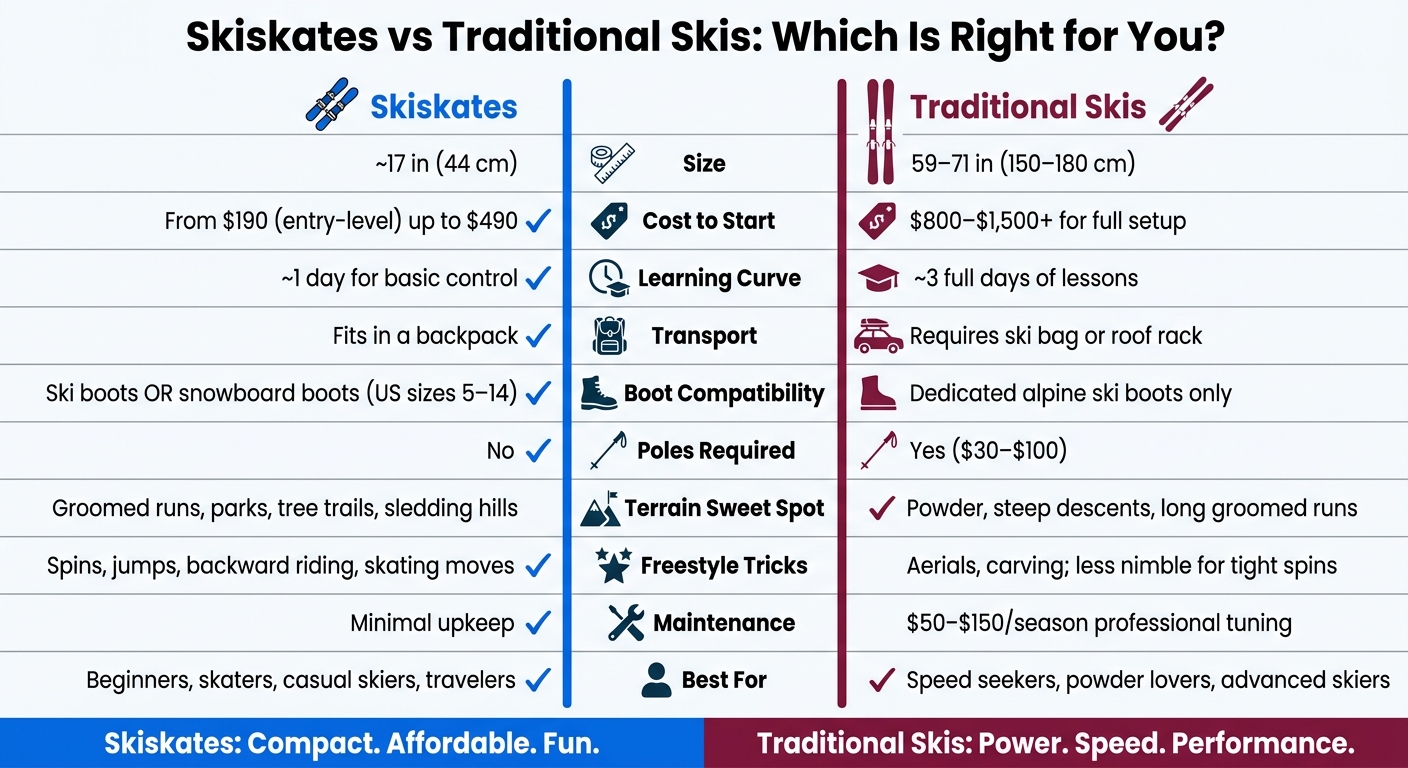
Skiskates are compact, 17-inch skis designed for a skating motion on snow, offering a more agile and fun alternative to long skis. They’re ideal for groomed runs, freestyle tricks, and crowded slopes, making them perfect for casual skiers or those with skating experience. Unlike long skis, which excel at high-speed stability and deep powder, Skiskates focus on portability, ease of learning, and affordability.
Key Highlights:
- Size & Portability: Fits in a backpack, unlike long skis that need a roof rack or ski bag.
- Ease of Use: Beginners can master basic turns in a day; skaters adapt quickly.
- Cost: Starting at $190, significantly cheaper than a full ski setup ($800+).
- Flexibility: Compatible with ski or snowboard boots (U.S. sizes 5–14).
- Performance: Great for tight turns, icy terrain, and freestyle tricks, but less suited for deep powder or steep descents.
Quick Comparison:
| Feature | Skiskates | Long Skis |
|---|---|---|
| Length | ~17 in (44 cm) | ~59–71 in (150–180 cm) |
| Terrain Focus | Groomed runs, parks | Powder, steep descents |
| Learning Curve | ~1 day | ~3 days |
| Cost | From $190 | $800–$1,500+ |
| Transport | Backpack-friendly | Requires ski bag/rack |
| Freestyle Tricks | Spins, jumps, skating | Aerials, carving |
Skiskates simplify skiing with their compact design and lower cost, making them a great option for fun, casual runs. If speed and powder performance aren’t your priority, they’re worth a try.
Skiskates vs Traditional Skis: Full Comparison Guide
All you need to know - Snowfeet* | Skiskates | Skiboards | Snowblades | Skiblades FAQ
sbb-itb-32287b2
Performance on the Snow
Short skis shine when it comes to quick turns in tight spots. With lengths as short as 17 inches and a parabolic design, they make edge-to-edge transitions feel effortless, allowing for sharp, snappy turns on groomed trails. But skiing isn’t just about turning - controlling speed across various conditions is just as important.
Here’s where the comparison gets interesting. Traditional skis dominate when it comes to stability at high speeds and in deep powder, making them the go-to choice for aggressive descents. On the other hand, short skis, equipped with steel edges, excel in precise speed control on icy or packed terrain. They’re more about agility than barreling down slopes, offering a controlled, responsive experience - perfect for the groomed runs that many U.S. skiers frequent.
For freestyle enthusiasts, short skis are a game-changer:
"I love how easy they are to ski and skate and how many different kinds of tricks I can perform without much effort and almost no restrictions."
This flexibility makes them a favorite in snow parks, on cat tracks, and even on sledding hills. Spins, jumps, and backward riding are all within reach. While traditional skis can handle aerial tricks, they struggle with the tight spins and ground moves that short skis make effortless.
Here’s a quick comparison of their performance:
| Performance Metric | Short Skis (Skiskates) | Traditional Skis |
|---|---|---|
| Turning Agility | Exceptional; quick edge-to-edge transitions | Moderate; needs more radius and effort |
| Speed Control | Precise on icy terrain, thanks to steel edges | Better for extreme speeds; highly stable |
| Stability | High for their size with wide profiles | Superior at high speeds and in deep powder |
| Freestyle Tricks | Perfect for spins, jumps, and backward riding | Good for aerials; less nimble for tight spins |
| Maneuverability | Highly responsive and direct | Feels bulky in tighter spaces |
Short skis thrive on groomed trails, beginner-friendly blue and green runs, and in freestyle environments. Their playful, dynamic nature makes them a joy for both casual skiing and trick-heavy sessions.
Versatility and Use Cases
Skiskates bring a level of flexibility that suits a variety of terrains and situations. Whether you're navigating groomed runs, weaving through tree trails, or hitting the terrain park, they adapt seamlessly. While they may not shine in deep powder or on steep descents, they excel in the kinds of conditions most U.S. skiers encounter during a typical weekend trip - think resort runs, sledding hills, and narrow glades. This versatility isn’t just about performance; it extends to everyday convenience as well, particularly when it comes to transport and boot options.
Portability is where Skiskates truly stand out. Measuring just 17 inches (44 cm), they can easily fit into a standard backpack. Compare that to traditional skis, which are usually 59–71 inches (150–180 cm) long and require a roof rack or ski bag for transport. For travelers, this compact size is a game-changer, eliminating the hassle of oversized baggage fees and bulky gear.
Another major advantage is their binding compatibility. Skiskates feature adjustable, tool-free bindings that work with both ski boots and snowboard boots (U.S. sizes 5–14). This makes them perfect for snowboarders curious about skiing or families looking to share equipment without investing in multiple setups. However, it’s worth noting that these strap-style bindings don’t function like certified alpine bindings, meaning you’ll notice differences in edge control and safety release mechanisms.
| Feature | Skiskates | Traditional Skis |
|---|---|---|
| Terrain sweet spot | Groomed runs, parks, trees, sledding hills | Groomers, powder, long descents |
| Length | ~17 in (44 cm) | ~59–71 in (150–180 cm) |
| Transport | Fits in a backpack | Needs roof rack/ski bag |
| Boot compatibility | Ski boots or snowboard boots | Dedicated alpine ski boots only |
| Home storage | Closet shelf or under a bed | Requires dedicated wall rack or garage space |
For casual skiers, families, or those who only hit the slopes a few times each winter, Skiskates offer a practical and convenient alternative to traditional skis. Their compact size and versatile design make them an appealing choice for anyone looking to simplify their winter adventures.
Learning Curve and Adaptability
One of the standout differences with Skiskates is how quickly beginners can get the hang of them. For most first-time skiers, it typically takes around 3 full days of lessons to confidently link turns and manage speed on beginner slopes. Skiskates, however, shrink that learning curve significantly. Many new users feel at ease on green and blue runs within just one day. Why? The reduced rotational inertia makes turning and stopping far more intuitive.
Here’s the key: Skiskates measure only 17 inches (44 cm) in length, which means they have much less rotational inertia compared to traditional skis. This shorter length allows for quicker, more natural movements, so your body and the equipment work together seamlessly to initiate turns with minimal effort.
If you have experience in skating sports, the transition becomes even smoother. Whether you’ve played ice hockey, enjoyed inline skating, or practiced figure skating, you’ll already be familiar with the stance, edge pressure, and lateral weight shifts that Skiskates require. As user Giovanni shared:
"I used to play ice hockey so Skiskates are perfect for me. It's exactly like ice skating on snow."
For seasoned skiers, switching to Skiskates isn’t about relearning everything - it’s about fine-tuning your technique. Expect to adjust to quicker turns and a more upright posture. After just 3–5 runs on easy terrain, most skiers recalibrate their muscle memory, making it easier to navigate tight spaces like tree lines or moguls.
Here’s a quick comparison of Skiskates and traditional skis:
| Criteria | Skiskates | Traditional Skis |
|---|---|---|
| Time to basic control | ~1 day for most beginners | ~3 full days of lessons |
| Best for skaters/hockey players | Quick adaptation | Slower; unfamiliar platform |
| Turn initiation | Immediate, low effort | Requires more technique |
| Tight spaces & crowded runs | Easy to maneuver | More cumbersome |
| High-speed stability | Requires early speed management | More inherently stable |
| Instruction format | Self-taught or short session | Structured ski school recommended |
This ease of learning and adaptability makes Skiskates a great option for anyone looking for a dynamic and agile skiing experience, especially on varied terrain.
Gear and Cost
Snow sports come with a hefty upfront price tag - so let’s break down what you’re spending and what you’re getting. A full set of traditional ski gear - skis, boots, bindings, poles, helmet, and goggles - can easily cost $800 to $1,500+ if you’re buying new. And that’s not even counting extras like lift tickets, lessons, or a ski bag for travel. Ski boots alone typically run between $200 and $500, and getting bindings professionally mounted (plus annual safety checks) adds another $50 to $100 per season.
Now, compare that with Skiskates, which are both simpler and lighter on your wallet. Both the Ski Boots and Snowboard Boots models are priced at $490 and can be used with boots you already own. Starting fresh? The Snowfeet Basic model begins at just $190, making it one of the most affordable ways to hit the slopes. Plus, with Skiskates, you skip the need for poles, binding mounting fees, or a bulky ski bag - they’re compact enough to fit in a regular backpack.
Traditional skis also require regular professional maintenance - things like base cleaning, edge sharpening, scratch repairs, hot waxing, and binding adjustments. These aren’t optional either; dirt, salt, and ice can quickly dull ski edges or dry out the base, while unprotected bases can rust and shorten the lifespan of your gear. Skiskates, on the other hand, demand much less upkeep due to their smaller size, saving both time and money.
Here’s a quick comparison of costs:
| Category | Skiskates | Traditional Skis |
|---|---|---|
| Equipment cost (entry-level) | From $190 (Snowfeet Basic) | $400–$800+ for skis + bindings |
| Boots | Use existing ski/snowboard boots | $200–$500 (separate purchase) |
| Poles | Not needed | $30–$100 |
| Seasonal maintenance | Minimal | $50–$150/season (professional tuning) |
| Travel/storage | Fits in a backpack | Requires ski bag or rental |
| Total first-year estimate | ~$190–$490 | ~$800–$1,500+ |
For those who already own ski or snowboard boots, Skiskates offer an affordable way to enjoy the slopes without the hassle - or the ongoing maintenance costs - that come with traditional ski gear.
Pros and Cons
Let’s break down the key differences between Skiskates and traditional long skis, summarizing their strengths and limitations based on performance, ease of use, and practicality.
| Skiskates | Traditional Long Skis | |
|---|---|---|
| Speed on flat terrain | Faster; push-off happens while the ski is already gliding | Slower; ski must briefly stop to grip before each push-off |
| Maneuverability | High – short length excels in tight, steep terrain | Lower; long skis can cross tips in narrow areas |
| Learning curve | Steeper; skating technique requires more practice | Gentler; diagonal stride feels more natural for beginners |
| Physical demand | Greater; especially challenging on climbs | Less; suited for a more relaxed, steady pace |
| Lateral stability | Strong; stiff boots and bindings support skating motion | Depends on groomed tracks for guidance |
| Portability | Compact enough to fit in a backpack | Needs a ski bag or rental storage |
| Maintenance | Minimal upkeep | Requires regular professional tuning each season |
| Cost to start | Starts at $190 | $800–$1,500+ for a complete setup |
| Terrain flexibility | Ideal for wide, groomed, or rolled trails | Works on tracked trails and even ungroomed backcountry |
| Poles required | No | Yes |
Skiskating is undeniably more physically demanding, particularly on steep inclines. For those seeking a leisurely, low-effort experience, traditional skis are the better choice.
However, if speed, agility, and convenience are what you’re after, Skiskates shine. Their compact design, lower upfront cost, and no-poles setup make them a streamlined, no-fuss option. These differences highlight the unique appeal and trade-offs of each style, helping you weigh what matters most for your skiing adventures.
Conclusion
When weighing performance, ease of use, and overall experience, both Skiskates and traditional long skis clearly cater to different skiing preferences. Here's a quick breakdown to help you decide which might suit you better:
- For complete beginners, Skiskates are a fantastic choice. Their compact size (some as short as 44 cm) makes turning and stopping intuitive. Most first-timers can master basic gliding and controlled turns within just a session or two on beginner-friendly slopes like green or easy blue runs.
- For athletes with skating or boarding experience, Skiskates feel like second nature. If you've spent time inline skating, playing ice hockey, or snowboarding, you'll find the weight shifts, edging, and rhythm familiar. Your first day will likely be more about fine-tuning your technique than starting from scratch.
- For seasoned skiers, traditional skis still shine when it comes to high-speed carving, long downhill runs, or deep powder days. That said, Skiskates can be a great secondary option. They're perfect for crowded resort days, weaving through tree runs, or enjoying a nimble, playful ride without the bulk of a full ski setup.
Beyond these comparisons, Skiskates stand out for their affordability and convenience. Their lightweight and compact design means they can easily fit into a backpack, making them a practical and fun alternative for various winter adventures.
If you enjoy playful, fitness-focused laps on accessible terrain, Skiskates might just win you over - and you may find yourself leaving your long skis behind.
FAQs
Can I use Skiskates on most U.S. resort runs?
Skiskates are built to handle the majority of runs at U.S. ski resorts. They shine on groomed trails, weave effortlessly through tight trees, and handle moguls with ease. In snowparks, they’re great for jumps, tricks, and rail slides. Thanks to their lightweight design and easy maneuverability, they adapt well to different mountain terrains, delivering a fun and energetic ride.
Do I need ski boots, or can I wear snowboard boots?
When using Skiskates, you have the flexibility to choose between ski boots or snowboard boots, thanks to their tool-free, adjustable bindings.
- Ski boots: These offer greater precision, stability, and edge control, making them perfect for carving or downhill runs.
- Snowboard boots: Known for their softer design, they prioritize comfort and mobility, making them ideal for freestyle tricks or walking around.
Whatever you choose, make sure your boots fit snugly to maintain control while avoiding restricted circulation.
Are Skiskates safe without release bindings?
Skiskates come equipped with non-release bindings, offering a blend of convenience, comfort, and performance. For your safety, it's crucial to adjust the bindings properly to match your boot shell length. Each pair also includes safety leashes to provide extra security. Remember to wear a certified snow helmet and ensure your boots fit snugly to maintain optimal control and stability on the slopes.

Leave a comment
This site is protected by hCaptcha and the hCaptcha Privacy Policy and Terms of Service apply.