

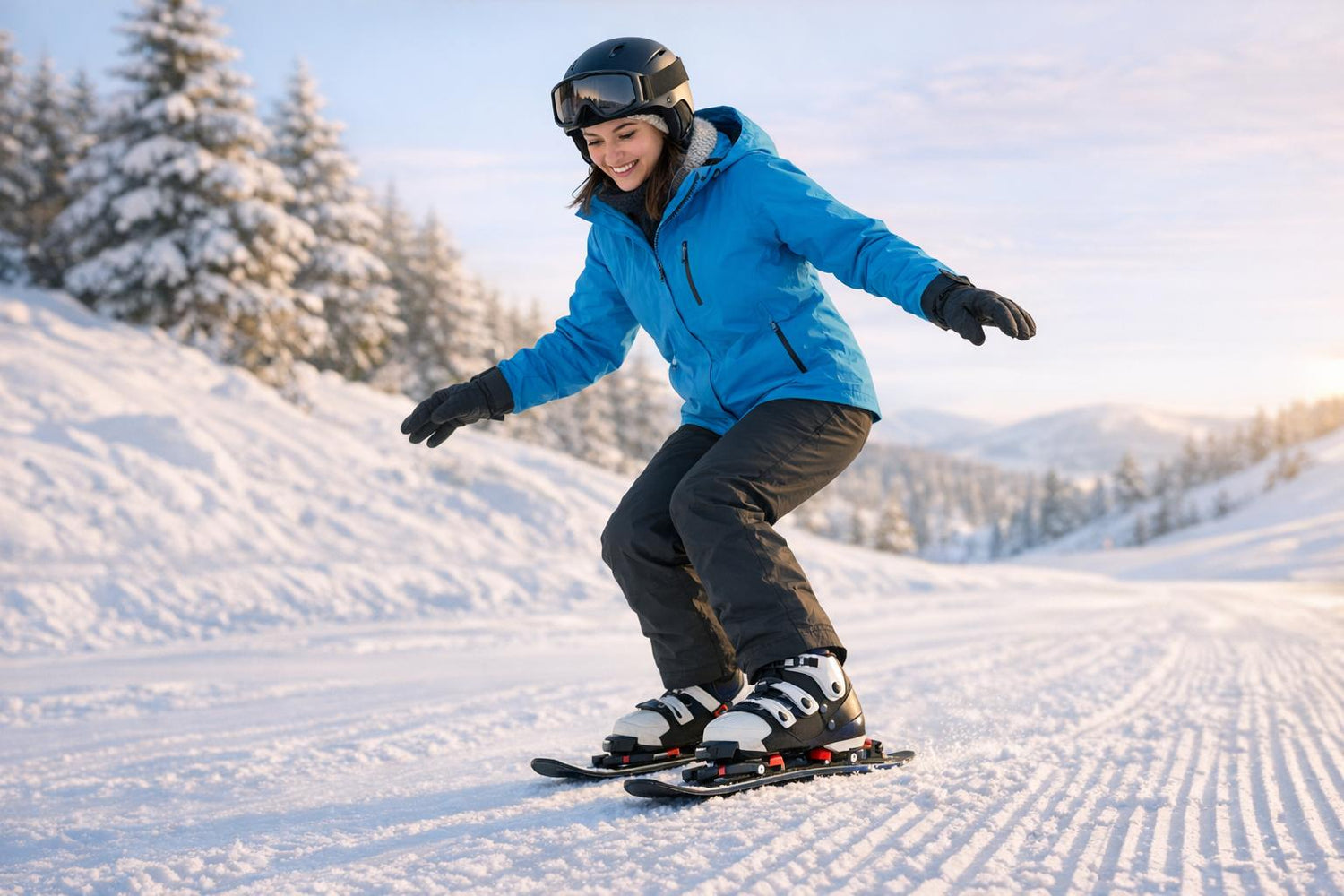
Skiskates are compact, 17.3-inch-long mini skis that blend skiing and ice skating movements, offering a fun and portable way to enjoy snow sports. They’re lightweight, beginner-friendly, and fit in a standard backpack, making them perfect for quick trips to groomed slopes, sledding hills, or trails. Designed with durable materials like steel edges and wood cores, they’re compatible with both ski and snowboard boots. Skiskates are easy to learn - most users feel confident within minutes - and are great for carving, spinning, and even tricks. However, they work best on packed snow or slopes with less than 4 inches of powder.
Key Features:
- Size: 17.3 inches long, fits in a backpack.
- Boot Compatibility: Works with ski boots (US 4.5–14.5) or snowboard boots (US 6–14.5).
- Terrain: Best for groomed slopes, sledding hills, and light powder.
- Cost: $190–$490, much cheaper than full ski setups.
- Learning Curve: Most beginners get the hang of it in about 5 minutes.
Skiskates offer a simple, fun, and affordable way to experience snow sports without bulky gear or steep learning curves.
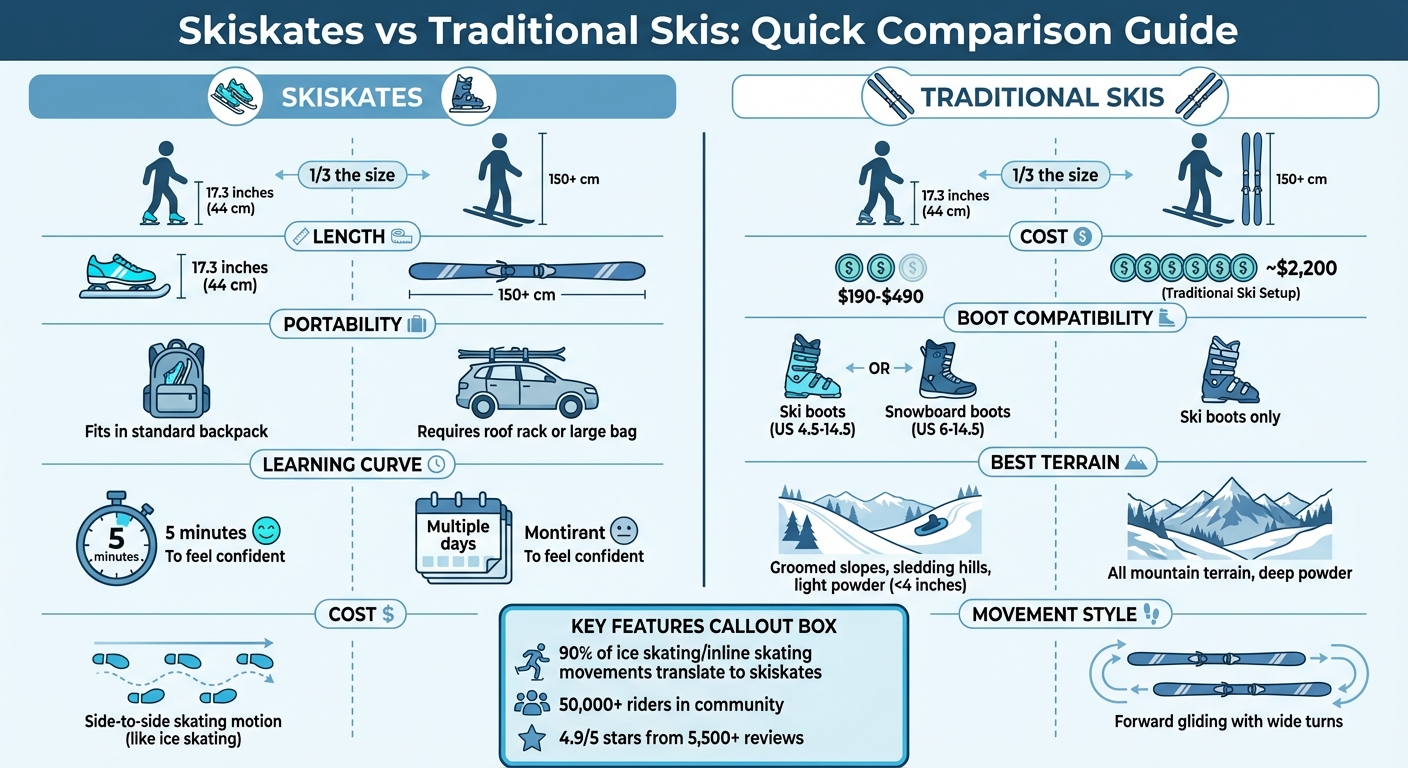
Skiskates vs Traditional Skis: Key Differences and Specifications
Snowfeet* & Skiskates Tutorial - How to Become a PRO Skiskater
sbb-itb-32287b2
What Are Skiskates?
Skiskates are a compact piece of snow sport gear, blending the features of ice skates and skis into a 44 cm (17.3 inches) design. They allow you to glide on snow with movements similar to ice skating and even perform tricks with familiar skating techniques.
Despite their small size, skiskates are built for performance. They feature a wood core, cap construction, steel edges, and a sintered base designed for speed. These materials, typically found in full-length skis, ensure they’re tough enough for mountain use. They also come with an innovative binding system that adds to their functionality.
One of the standout features is their adjustable, tool-free binding system. These non-release bindings come in two options: one for standard ski boots and another for snowboard boots. They also include safety leashes, a requirement at many ski resorts. The bindings are designed to fit a wide range of sizes - covering 36–49 EU (4.5–14.5 US) for ski boots and 38–49 EU (6–14.5 US) for snowboard boots.
Thanks to their lightweight and compact design, skiskates are easy to carry. They fit neatly in a car trunk without needing a roof rack and are perfect for public transportation or as backup gear for spontaneous mountain trips.
How Skiskates Differ from Regular Skis
The key difference between skiskates and traditional skis is their length. Regular skis are usually 150 cm or longer, but skiskates measure just 44 cm - about one-third the size. This shorter length allows for a completely different style of movement. While traditional skis are designed for gliding forward and making wide turns, skiskates excel at quick, dynamic maneuvers.
Their compact size makes them incredibly agile. You can spin, jump, ride backward, and navigate narrow trails or forest paths with ease. However, their smaller platform requires more active balance. To stay stable, you’ll need to keep your weight centered over the middle of your feet - or slightly toward your heels - while maintaining a shoulder-width stance with bent knees.
How Skating on Snow Works
Skiskates are designed for an intuitive, side-to-side skating motion, much like ice hockey or rollerblading. Instead of gliding straight, you generate momentum by pushing off from side to side. If you’ve ever ice skated or inline skated, this movement will feel natural, and the secure bindings ensure your energy transfers efficiently with each push.
To stay in control, keep your legs flexible and your weight evenly distributed to prevent the tips of the skiskates from catching in the snow. Stopping is straightforward: perform a hockey stop by turning your feet perpendicular to your direction and digging the steel edges into the snow. This technique provides the grip needed for quick, confident stops. Many users with a background in hockey say it feels just like ice skating - only on snow.
Benefits of Skiskates for Beginners
Main Advantages
For beginners, skiskates are incredibly easy to pick up - most people can get the hang of them in just 5 minutes. If you have experience with ice skating, hockey, or inline skating, you’re already ahead of the game. Up to 90% of the movements translate directly to skiskating.
Another big plus? Portability and boot compatibility. Skiskates are just 17.3 inches long, which means they can easily fit into a standard backpack. Plus, there’s no need to invest in special boots - they work seamlessly with your regular winter or snowboard boots.
When it comes to cost, skiskates are budget-friendly compared to traditional ski touring. Entry-level models start at $190, and premium options top out around $490. That’s a far cry from the $2,200 you’d spend on a full ski touring setup.
Of course, while there are plenty of benefits, beginners should also be aware of a few challenges.
Common Challenges
Even with their advantages, skiskates come with some hurdles for new users. Here’s a breakdown of common challenges and how to tackle them:
| Challenge | Description | Solution |
|---|---|---|
| Balance Stability | With a shorter 17.3-inch platform, skiskates don’t offer as much front-to-back support as traditional skis, making balance trickier. | Use a centered stance, keep your knees bent, and position your feet shoulder-width apart. A slight lean toward your heels can also help. |
| Deep Powder Limitations | Skiskates struggle in snow deeper than 4 inches (~10 cm), where they tend to sink. | Stick to groomed slopes, packed snow, or hiking trails for the best performance. |
| Stopping Technique | Their small surface area makes stopping more difficult than with regular skis. | Learn the hockey stop: turn your feet perpendicular to your direction, dig the edges into the snow, and evenly distribute your weight. |
| Physical Strain Risk | An improper stance could strain your knees or hips, especially if your legs lack flexibility. | Keep your knees slightly bent, stay flexible, and lean your upper body forward to maintain your center of gravity. |
Skiskates are best suited for groomed slopes, sledding hills, and well-maintained trails. Avoid extremely steep or uneven terrain, as the shorter platform can become a disadvantage. For beginners, intermediate (red) slopes may also feel challenging at first.
How to Choose Your First Skiskates
Selecting the Right Size
Picking the right size skiskates is key to enjoying both comfort and control on the slopes.
Forget the traditional ski-length-to-height rule. Skiskates are ultra-short skis (less than 20 inches long), so the old height-to-length ratio doesn’t apply here.
For beginners, opt for skiskates between 17.3 and 25.6 inches (44–65 cm). Shorter lengths are easier to maneuver, help you avoid crossing tips, and make it simpler to build your skills. Plus, the 17.3-inch (44 cm) model is small enough to fit in a standard backpack.
If you find balancing front-to-back tricky, consider a slightly longer model, like the 25.6-inch (65 cm). It offers a more stable base and extra support. Models over 25.6 inches strike a balance between skiskates and traditional skis but are less portable.
Boot size is more important than height or weight. Most skiskates come with bindings that fit ski boots ranging from US sizes 4.5–14.5 (22.5–32.5 Mondo Point) and snowboard boots from US sizes 6–14.5. To ensure a perfect fit, adjust your bindings at home with the exact boots you’ll be using - this saves time and hassle later.
Binding Types Explained
After choosing the right size, selecting the best bindings will elevate your experience.
There are two main binding types: ski boot bindings and snowboard boot bindings. Both are non-release bindings, commonly used for skiskates under 39 inches because they are lightweight and easy to adjust.
Ski boot bindings provide excellent stability and sharp edge control, making them great for a fast, traditional skiing experience. On the other hand, snowboard boot bindings are all about comfort and flexibility, ideal for tricks and walking around the resort without changing footwear.
"In my opinion, the snowboard bindings is the best type for skiskates. I love how easy it is to put snowboard boots on and walk with them, they don't hurt like ski boots, and I feel more flexible during the ride." - Zbyněk, Founder, Snowfeet
Some ultra-short models, like 15-inch mini skis, feature universal bindings that work with regular waterproof winter boots. While these are convenient, they offer less ankle support. Whatever you choose, make sure your boots are waterproof and provide proper ankle stability.
Materials and Construction
When it comes to quality, the materials and construction of your skiskates make all the difference.
Top-tier skiskates often feature certified sustainable wood cores, cap construction, steel edges, and sintered bases. These models start at around $490 for the 17.3-inch version. If you’re looking for a more budget-friendly option, fiberglass-reinforced models deliver solid performance and range between $190–$250.
Look for key features like steel edges for better carving, a protective topsheet, and reinforcing layers for durability. Premium options often come pre-waxed, but regular maintenance - like waxing and drying the metal edges - helps prevent rust. Every model is handcrafted in the mountains of Europe, ensuring lasting quality and attention to detail.
Getting Started: Basic Techniques and Safety
Learning Basic Movements
Start on flat, groomed snow to get a feel for your skiskates. Begin by practicing how to click into your bindings and try gliding with just one skiskate. This initial step helps you get comfortable with the equipment.
Adopt a centered, athletic stance: keep your feet shoulder-width apart, bend your knees and ankles, and shift your weight slightly forward over the balls of your feet. Unlike traditional skis, skiskates demand active front-to-back balance. The motion feels more like ice skating or inline skating than the parallel glide of longer skis.
"You have to keep the front-back balance, so it feels very natural to those who play ice hockey, ice skate, or even use inline skates." - Snowfeet Team
Practice shifting your weight from one foot to the other on flat terrain. This helps you build the balance needed for the skating motion. Once you’re comfortable, progress to a gentle hill with a flat runout area where you can glide to a natural stop. Most beginners pick up the basics within a single day.
When it comes to stopping, you’ve got two main options. First, try a hockey stop - turn both skiskates perpendicular to the slope and dig in the steel edges to slow down. Alternatively, form a V-shaped wedge by pushing your heels outward. And if you happen to fall, use the "dead bug" method: roll onto your back with your feet in the air to untangle yourself, then roll to the side and push yourself up from your hands and knees.
Once you've got the basic movements down, make sure to follow safety measures to keep your time on the slopes enjoyable and injury-free.
Safety Guidelines
Always wear a helmet and check the rules at your local ski resort. Some places have specific guidelines about using mini skis on groomed runs, so confirm they’re allowed before heading out.
Stick to groomed trails and avoid deep powder - skiskates are designed to perform best on snow no thicker than 4 inches (10 cm). Steer clear of steep slopes, bumpy or uneven terrain, and areas prone to avalanches. Beginners should stick to "green" trails (the easiest ones) until they’ve gained confidence and control.
Using poles can provide extra stability when you’re starting out, though they’re not a requirement. If you decide to use them, choose skate skiing poles that reach between your chin and lips, which is about 90% of your height. If you fall, roll sideways to reduce the risk of injury.
"Falling is generally much safer than falling with skis or snowboard." - Snowfeet Team
Where to Use Skiskates
Best Terrains for Skiskates
Skiskates shine on groomed ski slopes, where the packed and smooth snow provides the ideal surface for carving and stopping. Their metal edges ensure excellent grip, making them perfect for precision maneuvers. They're also a hit in snow and terrain parks, thanks to their compact 44 cm (17-inch) design, which is great for executing jumps, spins, and freestyle tricks.
If you're looking for a more casual experience, skiskates work wonderfully on sledding hills and smaller neighborhood slopes. Their compact build allows you to navigate narrow hiking trails and forest paths - places where traditional skis would struggle. Even urban snowy paths become your playground, letting you glide right up to your doorstep with ease.
For the best performance, stick to hard-packed snow and moderate slopes. These conditions maximize grip and control. While skiskates can handle light powder up to about 4 inches (10 cm) deep, deeper snow or extremely uneven surfaces can make stability more challenging. Similarly, steep terrain, icy patches, or areas with large bumps may cause the short tips to catch, so it's best to avoid those.
With these terrains in mind, skiskates open up a world of possibilities for winter fun and exploration.
Activities You Can Do
The right terrain unlocks a range of exciting skiskating activities.
Recreational snow skating is one of the most popular ways to enjoy skiskates. If you're familiar with ice skating or inline skating, the motion will feel natural, allowing you to cruise down groomed runs with ease. In terrain parks, you can try tricks like riding backward, spinning, or even jumping.
"Skiskates are super fun for downhill skiing, riding backwards, spinning, jumping and all kinds of tricks in snow parks and on the slopes." – Skiskates.com
Skiskates also double as a great tool for cross-country training. Hockey players, for example, can use them to stay in shape and maintain their skating skills during the winter months. Another popular activity is "hike and slide" - hike up a trail with skiskates in your pack, then skate your way back down. Families love them too, as their short learning curve makes it easy for everyone to join in on the fun, making them a fantastic choice for quick local adventures.
Conclusion
Skiskates offer a hassle-free way to dive into winter sports. Thanks to their compact design, there's no need for roof racks or oversized gear bags. You can easily stash them in your car, making spontaneous trips to nearby hills or hiking trails a breeze.
What makes skiskates even more appealing is their simplicity. Their movement mimics familiar skating techniques, and most riders find themselves gliding confidently within minutes instead of days. Plus, with options that work with ski or snowboard boots, they cater to a range of preferences. With over 50,000 riders in the community and an impressive 4.9/5-star rating from more than 5,500 verified reviews, it's clear these are winning people over quickly.
Their versatility is another major draw. You’re not tied to pricey ski resorts - local sledding hills, forest trails, or even groomed slopes can all become your playground. Whether you're looking for a laid-back way to enjoy snowy afternoons with family or want to experiment with tricks in a terrain park, skiskates fit right in with your plans and skill level.
If traditional skiing feels overwhelming or too complicated, skiskates offer a refreshing alternative. They’re easy to pick up, packed with fun, and give you the freedom to explore winter landscapes however you like. It’s a great way to make the most of snowy days on your own terms.
FAQs
How do I choose the right skiskates for my needs?
When picking out skiskates, start by thinking about your skill level and the terrain you plan to tackle. These compact skates, roughly 17 inches in length, are best suited for groomed slopes rather than deep powder. Their short design makes them incredibly nimble, but they do demand a bit more balance. For beginners, models that pair with your existing ski or snowboard boots can make the transition smoother and more comfortable.
Next, pay attention to boot compatibility and binding type. Skiskates come with bindings tailored for either ski boots or snowboard boots. Choosing a pair that matches the boots you already own ensures a snug, secure fit and saves you from needing to invest in new footwear.
Finally, consider weight, durability, and budget. Skiskates are lightweight, typically weighing about 3.5 pounds per pair, and are built with durable wood-core construction for stability and longevity. Prices generally start around $330, so think about how frequently you’ll use them and whether the quality aligns with your needs.
By keeping these factors in mind, you can find skiskates that suit your skill level, work seamlessly with your gear, and make your time on the slopes enjoyable and hassle-free.
Can skiskates be used in deep snow or on steep terrain?
Skiskates are made for groomed ski slopes and packed snow, offering their best performance on well-maintained trails. They aren't built for deep powder or steep, rugged terrain, so it's important to stick to easier, prepared paths to get the most out of them.
How are Skiskates different from traditional skis in terms of learning and cost?
Skiskates are often easier for beginners to pick up compared to traditional skis. Thanks to their short and lightweight design, they feel more like skating on snow, which can be a natural transition for anyone familiar with ice skating or rollerblading. However, their compact size - just 17 inches long - can make balancing a bit trickier for those completely new to snow sports. Even so, the learning process is generally straightforward and tends to progress faster for many users.
In terms of cost, Skiskates start at about $330. While this is pricier than some entry-level mini skis, it's far cheaper than a full traditional ski setup, which can easily range from several hundred to over a thousand dollars. For those curious about snow sports but hesitant to invest heavily in gear, Skiskates offer a more budget-friendly way to hit the slopes.

Leave a comment
This site is protected by hCaptcha and the hCaptcha Privacy Policy and Terms of Service apply.