

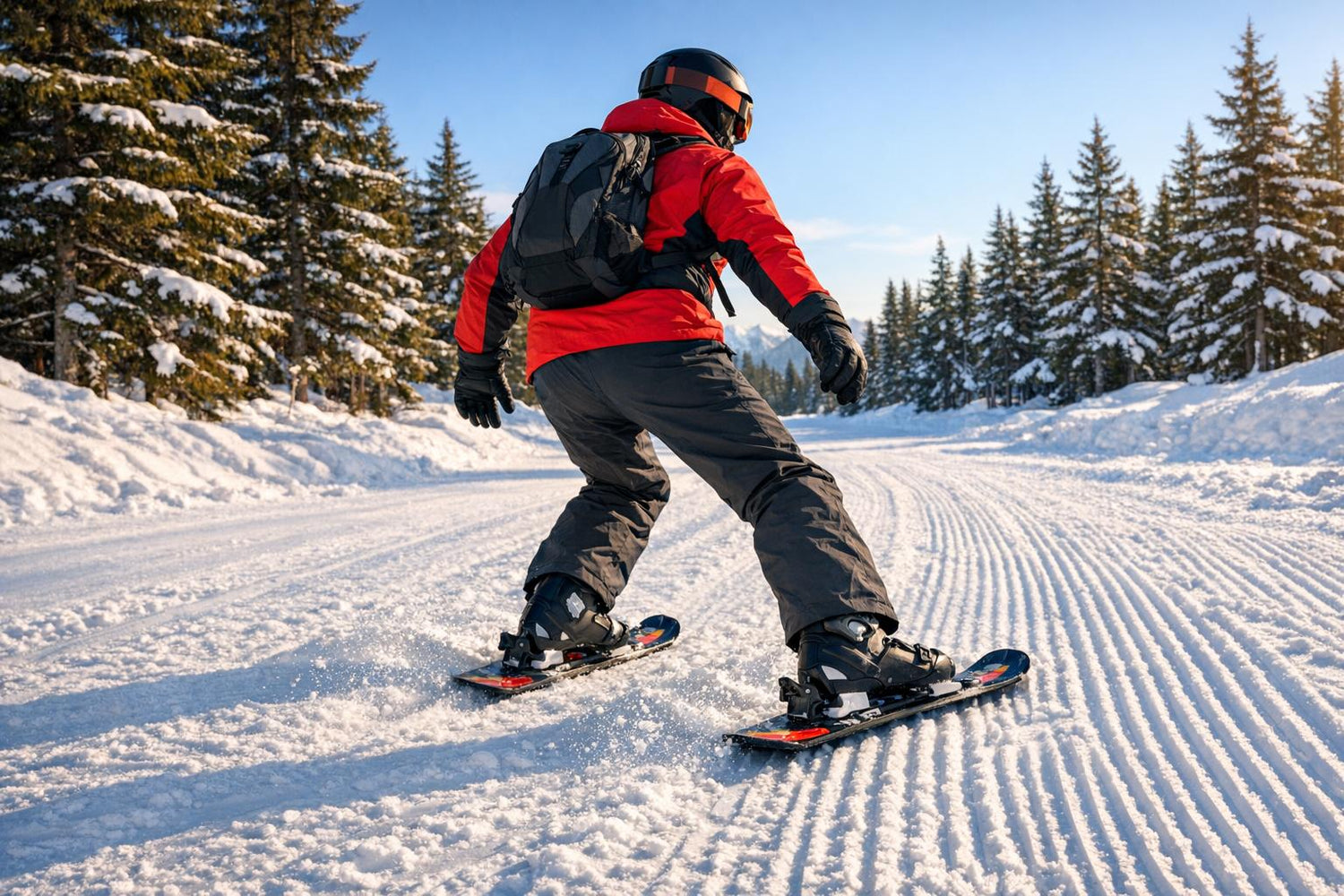
Skiskating combines the motion of ice skating with skiing, using short skis (about 17 inches long) to glide on snow. Instead of traditional skiing's forward motion, skiskating involves side-to-side pushes, similar to skating. It’s easy to pick up, especially for those with skating experience, and great for groomed slopes, snow parks, or narrow trails.
Key Points:
- What You Need: Short skis (Skiskates), ski/snowboard boots, and basic snow gear.
- How It Works: Push laterally with angled skis, shifting weight side-to-side for propulsion.
- Who It’s For: Ice skaters, hockey players, or anyone wanting a compact, fun winter sport.
- Where to Use: Groomed slopes, light powder (up to 4 inches), and snow parks.
Quick Tips:
- Start on smooth, groomed slopes.
- Use a slight forward lean and keep knees bent for balance.
- Beginners can try affordable models like Snowfeet Original ($190).
Skiskating is growing fast, with over 50,000 riders worldwide. Its compact gear, easy learning curve, and skating-like feel make it a hit for all skill levels.
What Is Skiskating?
Skiskating is a winter sport that blends the side-to-side motion of ice skating with the mechanics of skiing, using ultra-short skis to glide across snow. Instead of the traditional forward gliding seen in skiing, skiskating lets you push laterally, much like skating on ice. This approach doesn’t just change how you move - it also reshapes how skis are designed.
"Skiskating is essentially a combination of skiing and skating... it genuinely feels like ice skating, just on the snow." - Skiskates.com
The equipment is built like traditional skis, featuring wood cores, steel edges, and cap construction. However, the design is compact, resembling the feel of ice skates. These short skis, typically under 20 inches (50 cm) long, attach to standard ski boots or snowboard boots using adjustable bindings, making them versatile and easy to use.
What makes skiskating stand out is its portability and agility. The shorter skis allow for quick turns, jumps, and tricks, especially in snow parks, where longer skis might feel cumbersome. They’re also perfect for navigating narrow trails or tight spaces, opening up areas that full-length skis can’t easily handle.
The sport is particularly appealing to those with a background in ice hockey, ice skating, or inline skating, as it requires similar balance and movement. Unlike cross-country skate skiing, which involves long skis and poles, skiskating focuses on downhill terrain and snow parks, offering an experience that closely mirrors the dynamics of ice skating.
sbb-itb-32287b2
How Skiskating Works
Skiskating relies on lateral push-offs rather than the forward gliding motion seen in classic skiing. The technique involves pushing off with a moving, angled ski while shifting your weight to the opposite ski. This creates a pendulum-like motion, shifting your center of gravity side to side, perpendicular to your path. Unlike traditional skiing, where a ski needs to pause briefly to grip the snow, skiskating allows continuous movement, making it a fluid and agile sport. Let’s dive into the mechanics of propulsion, gliding, and balance that set skiskating apart.
Propulsion and Gliding
Skiskating generates momentum through precise edging and efficient weight shifts. As you push off, you tilt the ski onto its edge, which grips the snow and provides a stable base for propulsion. The skis are positioned in a "V" shape, and the angle of this "V" changes depending on the terrain. On steeper climbs, the angle widens for better grip, while flatter surfaces allow for a narrower, more forward-facing stance.
Balance is critical during the glide phase. Keeping your weight centered or slightly shifted toward your heels ensures smooth movement. If you lean too far forward, the short tips of the skiskates can dig into the snow, disrupting your glide. While the design of skiskates aids in smooth transitions, proper weight distribution is essential for maintaining efficiency across different types of terrain.
Control and Balance
Once you’ve mastered propulsion and gliding, maintaining control becomes the next challenge. This demands sharp edge control and dynamic body positioning. Rolling your ankles and knees inward enhances edge grip, which is key for turning, braking, and climbing. On uneven terrain or slopes, keeping your knees bent and your legs flexible helps absorb shocks and maintain stability.
"Keep the front-back balance by placing your weight over the middle of your feet or over your heels." - Snowfeet Team
A staggered stance - where one foot is slightly ahead of the other - can greatly improve front-to-back stability, especially when dealing with rough snow or adjusting your speed. Your legs should remain about shoulder-width apart, with a slight forward lean in your upper body. This athletic posture allows for quick adjustments and ensures lateral forces from your legs transfer effectively to the ski edges. The torsional stiffness of ski or snowboard boots further enhances this control. Mastering these fundamentals is essential before delving into equipment options or advanced techniques.
Equipment You Need for Skiskating
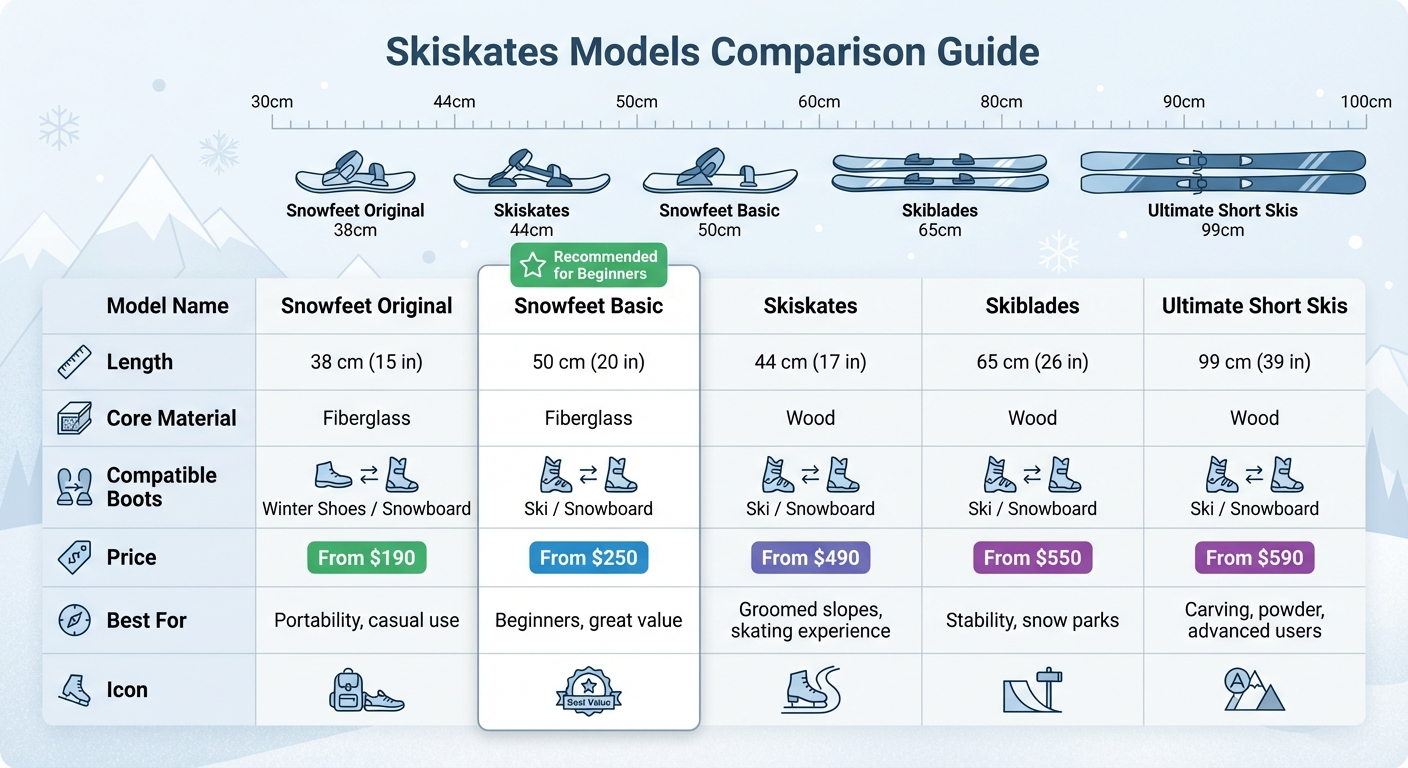
Skiskates Models Comparison: Length, Materials, and Price Guide
Starting with skiskating doesn’t require a mountain of gear, which is part of its charm. The essentials? Skiskates short skis and matching boots. These compact 44 cm (17 in) skis are small enough to fit in a standard backpack, yet they pack a punch when it comes to performance. Built with a durable wood core and cap construction, they include steel edges for precision turns and hockey stops, plus a sintered base for smooth, fast gliding.
Skiskates come with two adjustable, tool-free binding options: one designed for alpine ski boots and another for snowboard boots. They accommodate a wide range of sizes - EU 36–49 (US 4.5–14.5) for alpine boots and EU 38–49 (US 6–14.5) for snowboard boots - and include safety leashes for added security.
"In my opinion, Skiskates is the best product for slopes we developed so far. I love how easy they are to ski and skate and how many different kinds of tricks I can perform without much effort." - Zbyněk, Founder, Snowfeet
When choosing boots, aim for a fit that feels snug but not tight - like a firm handshake. For beginners, boots with a flex rating of 50–80 offer a good starting point, while more experienced users might prefer a stiffer flex of 85–130. A quick test? Bend your knees; your toes should just slightly pull away from the front of the boot.
Safety and comfort are just as important as performance. Equip yourself with a certified snow helmet (preferably with MIPS technology), UV-protected anti-fog goggles, and waterproof gloves. Dress in layers for warmth and flexibility: a moisture-wicking base layer, an insulating mid-layer, and a waterproof outer shell with a minimum 5,000 mm rating. Skip the cotton - it retains moisture - and keep your Skiskates in top shape by waxing the base regularly.
Skiskates Models Comparison
Here’s a quick comparison of Skiskates models to help you find the right fit for your needs:
| Model | Length | Core Material | Compatible Boots | Price | Best For |
|---|---|---|---|---|---|
| Snowfeet Original | 38 cm (15 in) | Fiberglass | Winter Shoes / Snowboard | From $190 | Portability, casual use |
| Snowfeet Basic | 50 cm (20 in) | Fiberglass | Ski / Snowboard | From $250 | Beginners, great value |
| Skiskates | 44 cm (17 in) | Wood | Ski / Snowboard | From $490 | Groomed slopes, skating experience |
| Skiblades | 65 cm (26 in) | Wood | Ski / Snowboard | From $550 | Stability, snow parks |
| Ultimate Short Skis | 99 cm (39 in) | Wood | Ski / Snowboard | From $590 | Carving, powder, advanced users |
Gear Recommendations for Beginners
For those just starting out, the Snowfeet Basic (50 cm) is a great entry point at $250. Its fiberglass-reinforced build keeps costs manageable while still offering steel edges for solid control and reliable stopping power. The 50 cm length strikes a nice balance, providing enough stability to build confidence while preserving the natural skating motion. Plus, it’s compatible with both ski and snowboard boots, so you might not even need to buy new footwear.
If you’re completely new and want to try skiskating without a big upfront investment, the Snowfeet Original (38 cm) is an excellent choice at $190. This model works with regular waterproof winter shoes (sizes 6–13 US or 38–47 EU), making it ideal for beginners who want to test the waters. Its lightweight, portable design is perfect for hiking trails or sledding hills. While the fiberglass core requires regular waxing to maintain speed, its simplicity and affordability make it a solid option for learning the basics before upgrading to more advanced gear.
Skiskating Techniques and Tips
Basic Techniques for Beginners
Start with an athletic stance: keep your ankles, knees, and hips slightly bent to lower your center of mass and improve balance. Instead of pushing off the ball of your foot, focus on rolling pressure through the inside edge of your ski and pushing sideways to prevent the ski tip from digging into the snow.
"Being proficient and remaining balanced atop one foot is a trait shared by advanced skiers, so the more you practice this skill... the better you'll be."
- Ken Knapp, REI Editor Emeritus
Work on one-foot balance by aligning your nose, hip, knee, and toe vertically over the ski you're gliding on. A helpful drill is the "waddle skate", where you lift one ski while gliding on the other - this helps you practice shifting your weight using your lower body without relying on poles. To manage speed, use the wedge technique by bringing the ski tips together and pushing the heels apart, applying pressure to the inside edges by rolling your knees inward. For turning, try step turns - lift one ski, angle it in the direction you want to go, and shift your weight onto it.
The V1 rhythm (also called Offset) is the go-to technique for most terrains. This involves planting both poles at the same time during one ski's push-off, followed by a solo push with the other ski in a 3-1 rhythm. It’s estimated that skiskaters use V1 for over 90% of their movements, with about 60% of the power coming from the legs. Make sure your poles are the right size - they should reach between your chin and lips, or about 90% of your height. Once you’re comfortable with these basics, you’ll be ready to tackle intermediate techniques.
Intermediate and Advanced Maneuvers
After mastering V1, progress to V2 (One Skate) for flat terrain and moderate inclines. This symmetrical technique involves planting your poles with every push of your legs in a 1-1 rhythm. To refine your balance, try the "one skate dance" drill, which helps you rely less on strength and more on technique. For steeper slopes, switch to the herringbone technique by forming a wide V-shape with your skis and digging the inside edges into the snow for grip.
"Lower your centre of mass by maintaining some soft flexion at the ankle, knee and hip joints at all times. Never stand fully upright."
For advanced carving, engage your ski edges by lifting your pinky toe inside your boot and pressing your shins toward "10 o'clock" or "2 o'clock" against the boot cuff. Keep your upper body steady and facing downhill while your feet carve beneath you. To stop on a slope, use a carved traverse by gliding across the hill and tipping your skis onto their uphill edges, turning sharply until you come to a stop. If you’re feeling adventurous, practice whirlybirds - a 360-degree spin on the snow achieved by rotating your shoulders, hips, and feet in sync.
Best Terrains and Conditions for Skiskating
Groomed ski slopes are ideal for skiskating, offering smooth, compact surfaces that make carving, speed control, and hockey stops easier. Firm, packed snow provides excellent edge grip while allowing for a fluid glide. Snow parks are another great option, especially for practicing jumps, spins, and freestyle tricks.
Skiskates can also handle sledding hills and hiking trails, as long as the snow is firm enough. They perform well in light powder up to about 4 inches deep, but anything deeper can make flotation and control much harder.
"Hard pack groomer at the resort? Ideal skating conditions. Skiing and skating are the ying and yang of winter sports."
- Maggie, Staff Member, Sugar Bowl/Royal Gorge
Steep, deep, or uneven terrain is best avoided, as it can make control difficult. Icy slopes demand advanced skills and sharp edges to maintain grip. When selecting a run, stick to the middle of the slope to stay clear of trees and embankments - fixed objects are a major cause of serious injuries during falls. Be extra careful in sticky snow or slush, especially when temperatures hover around freezing. These conditions can cause your skiskates to catch unexpectedly, increasing the risk of knee or shoulder injuries.
If you're just starting out, choose wide, well-groomed green runs with gradients below 25% to work on your balance. Keep in mind that injuries often happen between 2 p.m. and 4 p.m., when fatigue sets in and snow conditions change. To minimize risk, plan your session earlier in the day. For better stability on the shorter platform, keep your weight centered over the middle of your feet or heels and maintain slightly bent knees.
Conclusion
Skiskating blends the thrill of skiing with the agility of skating, creating a compact and approachable winter sport. Using ultra-short skis, riders propel themselves forward with a skating motion, relying on precise weight shifts for control. Stopping is a breeze too, whether through a hockey stop or a heel brake, making it an easy transition for seasoned skaters.
The gear is simple and effective. All you need are skiskates equipped with bindings for ski boots or snowboard boots. And if it's been covered earlier, keeping the edges in good shape ensures smooth rides and peak performance.
For many, the learning curve is incredibly short - just about five minutes, especially for those with skating experience. Beginners are encouraged to start on groomed green slopes while steering clear of deep powder or steep runs until they've mastered control.
"These felt so familiar to skating but on snow! I instantly picked it up when I first hit the slopes without any difficulty." - Jonjon, Verified User
It’s no surprise that skiskating has gained such a strong following. With over 50,000 riders worldwide and an impressive 4.9/5-star average from more than 5,500 verified reviews, it’s clear this sport offers a fun and practical way to enjoy the slopes. The quick learning process and unmatched freedom of movement make it a perfect choice for a wide range of ages and skill levels.
FAQs
What are the best conditions for skiskating?
For the best skiskating experience, aim for a firm, well-groomed snow surface, like machine-prepared cross-country trails. These trails provide the smooth, compacted base you need for effortless gliding and strong lateral push-offs. Ideally, the snow should be cold and dry, with temperatures below freezing (32°F) to maintain the necessary firmness. Steer clear of soft or slushy snow, as it can hinder performance.
Flat or gently rolling terrain works best, as it complements the straight-line, speed-skate motion of skiskating. Look for trails that are freshly groomed, wide enough to accommodate parallel skis (about 3–4 feet), and free of deep ruts or uneven spots. Early mornings are often the prime time to hit the trails since the snow tends to be firmer before the sun warms it up. In essence, cold, dry days on smooth, level trails set the stage for an enjoyable skiskating session.
What makes skiskating different from traditional skiing?
Skiskating offers a fresh twist on traditional skiing by swapping out long skis for ultra-short 44 cm skiskates. These compact skates let you keep your feet shoulder-width apart, allowing for a smooth, gliding motion that feels more like skating or rollerblading than skiing.
Unlike traditional skiing, which uses longer skis and techniques like forward striding or carving to tackle slopes, skiskating introduces a different way to move. This approach not only simplifies things for beginners but also makes it easier to enjoy a variety of terrains, bringing a new level of excitement to winter sports.
What equipment do I need to try skiskating?
To begin your skiskating journey, you'll need a few key pieces of gear: short skate-ski skis, skate-ski boots with compatible bindings, and longer ski poles to help with balance and propulsion. These items are specifically designed to give you the right mix of control and agility on the snow.
It's important to ensure your equipment fits well and matches your experience level. If you're just starting out, visiting a local outdoor sports shop can be a great way to get expert advice on picking the right gear.


Leave a comment
This site is protected by hCaptcha and the hCaptcha Privacy Policy and Terms of Service apply.