


Skiskating thrives under specific snow and weather conditions. The ideal setup includes firm, compacted snow and temperatures between 20°F and 32°F. These factors ensure optimal glide, edge control, and reduced physical strain. Avoid icy, overly soft, or wet snow, as they can hinder performance and increase risks. Groomed trails are best for beginners, while advanced skaters may enjoy challenging terrains like snow parks or frozen lakes. Key tips for preparation include checking weather reports, using specialized gear like stiffer skis and longer poles, and dressing appropriately for the region's climate. Proper planning can make your skiskating experience smoother and safer.
Snow and Weather Conditions
Best Snow Texture and Density
For skiskating, firm and compacted snow provides the most reliable surface. This type of snow offers a stable platform for clean edge control while remaining forgiving enough for smooth gliding. Groomed and packed trails are particularly helpful for beginners and skiers with longer skis, as they ensure consistent conditions.
Man-made snow, on the other hand, has rounder and denser crystals. This creates a compact, abrasive surface that offers excellent stability but comes with a trade-off: it tends to wear down ski bases faster than natural snow. Mornings on man-made snow often bring icy, fast tracks, but as temperatures rise during the day, the snow can become wet and slushy, altering the glide.
In high-altitude areas like the Rockies or Wasatch Range, midwinter snow is often soft and powdery. This kind of snow allows skis to sink slightly rather than glide on top, which can impact your technique. For these conditions, skis with softer tips and tails are better suited, as they help the skis float above the surface instead of diving into it. Paying attention to these differences can help you choose the right equipment and refine your approach for various skiskating environments. These variations, influenced by altitude and location, are discussed more in later sections.
Temperature Ranges
The sweet spot for skiskating lies between 20°F and 32°F . As noted by the editors at the 100 Collection™:
The ideal temperature range for skiing is between 20°F and 32°F (-7°C and 0°C). In this range, the snow is in perfect condition - firm enough to carve cleanly but soft enough to be forgiving.
When temperatures approach 32°F, snow starts to melt, becoming heavy and waterlogged. This creates more resistance, making every stride more taxing. If the temperature drops again, the melted snow refreezes into compacted ice. On the other end, when temperatures dip below 20°F, snow hardens into icy or hardpack surfaces, which offer minimal grip and make it harder to maintain clean edges. You might also notice the snow crunching loudly underfoot - the colder it gets, the louder the crunch.
While temperature plays a key role, other weather conditions also shape the quality of your skiskating experience.
Weather Patterns to Watch
The best skiskating days are typically clear or lightly overcast. Freshly fallen snow can create excellent texture, but skiing during active snowfall can cause visibility issues, with snow accumulating on your goggles. To avoid interruptions, aim to hit the trails shortly after the snow has stopped falling.
Wind can be a major obstacle, creating snowdrifts that block your path and increasing the risk of frostbite due to wind chill. A strong wind can make the temperature feel 20–30°F colder than it actually is. Rain or sleet should be avoided entirely, as they make trails dangerously slick and icy, posing serious safety risks. For the most accurate conditions, check local weather stations or skiing apps for real-time updates before heading out.
sbb-itb-32287b2
Terrain Types for Skiskating
Flat and Gentle Slopes
Terrain plays a key role in shaping your skiskating experience. Flat, wide trails are perfect for learning the basics, offering plenty of space to practice the lateral V-shaped motion without worrying about veering off course. These trails allow beginners to focus on mastering technique while gradually building speed and confidence.
Gentle slopes are another excellent choice for beginners. They provide a controlled environment to work on balance and coordination without the risk of excessive speed. These slopes are typically well-groomed, ensuring a consistent surface ideal for learning. As Carrie McCusker, a Level 2 TrainingPeaks Coach, explains:
Trails for skate skiing require wider grooming and are more commonly found at specialized Nordic centers.
Starting on flat terrain or green runs is highly recommended. These areas offer the stability and safety needed to perfect the side-to-side V-pattern before moving on to steeper, more challenging terrain. Lower-angle slopes also tend to be safer, as gravity keeps the snowpack stable, reducing the risk of slipping or losing control. Conversely, narrower trails demand more precise control and can be a greater challenge for those still refining their skills.
Trails and Hiking Paths
While wide, flat trails provide stability, narrow trails and hiking paths introduce a rugged, technical challenge. These paths are better suited for experienced skaters who have developed the precision and control needed to navigate uneven terrain. Unlike the groomed surfaces found at Nordic centers, these trails often feature unpredictable conditions, requiring quick adjustments and parallel control.
For those seeking adventure, some trails, like those leading to Giant Washbowl in the Adirondacks, offer a unique experience. While you may need to hike in with your gear, the reward is often a private, uncrowded skating area. However, venturing into such unmaintained paths comes with risks. Always carry self-rescue equipment, such as picks and ropes, to ensure safety in remote or unpredictable conditions.
Snow Parks and Open Slopes
For skaters looking to push their limits, snow parks and open slopes provide a thrilling challenge. These areas cater to advanced skaters who can handle the physical demands of high-speed gliding, steep inclines, and aggressive uphill climbs. Wide-open slopes and snow parks are ideal for Type III skaters, offering the perfect setting for fast downhill runs and dynamic movements.
Frozen lakes also present a unique opportunity for long-distance gliding. For example, Lake Morey in Vermont boasts a 4.3-mile skating trail, the longest maintained ice trail in the United States. In more remote regions, wind can naturally smooth the ice, creating excellent conditions for gliding. However, it's crucial to monitor ice thickness and surface conditions before venturing onto these areas to ensure safety.
How to Ski - Variable Snow Conditions
Seasonal and Regional Factors
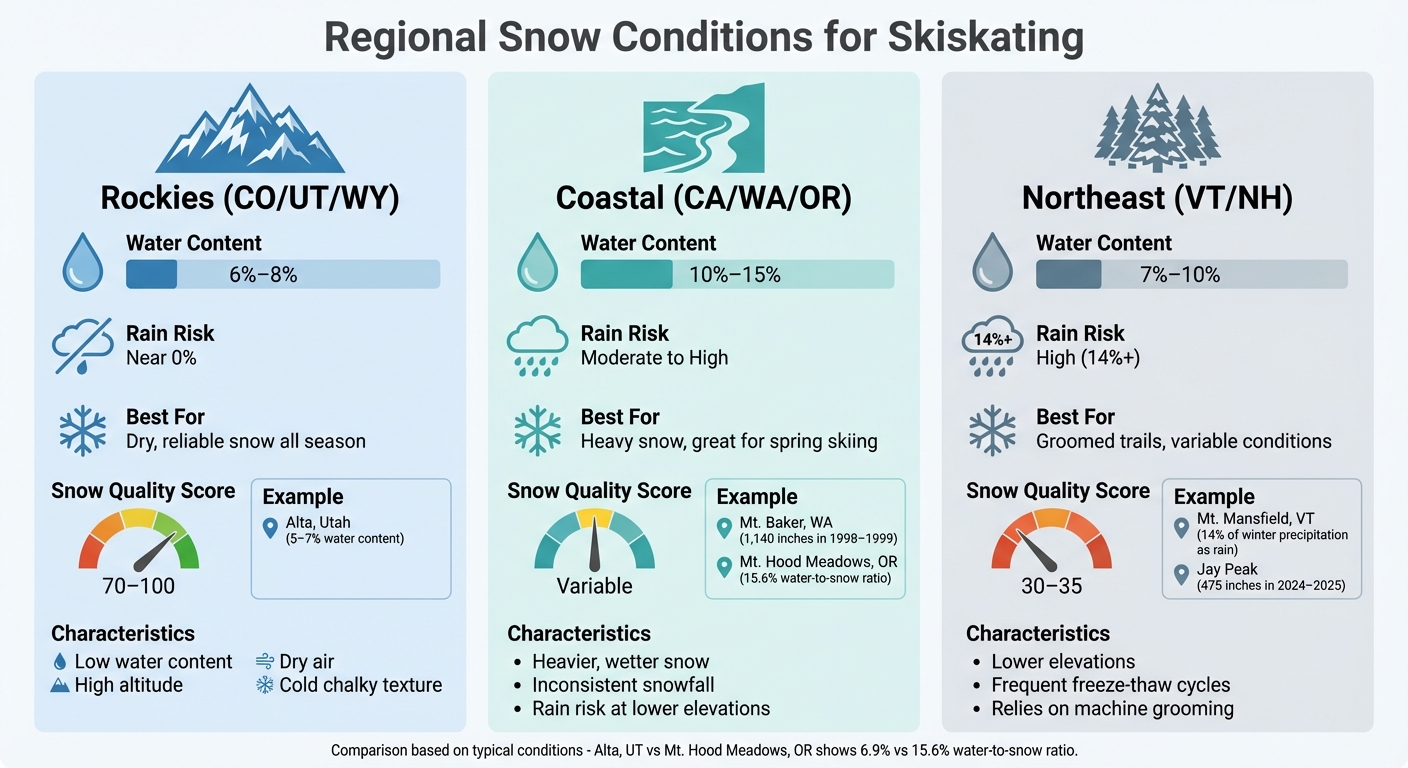
Regional Snow Conditions Comparison for Skiskating: Rockies vs Coastal vs Northeast
Best Seasons
When it comes to skiskating, the time of year plays a big role in determining the quality of conditions. Late winter through early spring often provides the ideal setup, thanks to a solid, compact snowpack that creates the firm surface skiskating thrives on.
For most of the United States, January and February mark the peak of the season. Resorts like Solitude and Snowbird in Utah’s Cottonwood Canyon, as well as Mt. Baker in Washington, are known for their deep snow during this time. In higher-altitude areas like Colorado’s Arapahoe Basin and Loveland, the season often starts as early as late October or early November. The Northeast, led by Killington in Vermont, also offers early-season access.
As the season progresses into March and April, the snow softens, and longer daylight hours make for enjoyable spring skiing. Resorts like Palisades Tahoe in California and Mt. Bachelor in Oregon are standout destinations during this time, often extending their seasons well into April. However, spring conditions require a bit of planning - early morning sessions are best since the snow is firmer and provides excellent glide. By the afternoon, rising temperatures can turn the snow slushy, which increases friction and makes skating more challenging. For those chasing the longest season, Mammoth Mountain in California and Timberline Lodge in Oregon sometimes stay open through July or even August.
These seasonal patterns vary by location, directly influencing snow quality and texture.
Regional Snow Differences
Snow quality isn’t just about timing - it’s also about geography. Different regions of the U.S. offer distinct conditions based on snow water content and climate.
The Rocky Mountain region, which includes Utah, Colorado, and Wyoming, is a standout for skiskating. Snow here typically has a low water content, ranging from 6% to 8%. Alta, Utah, for example, often sees snow in the 5–7% range. This low water content, combined with high altitudes and dry air, helps preserve the snow’s cold, chalky texture - perfect for creating firm skating lanes. It’s no wonder resorts in this region often score high for snow quality, with ratings between 70 and 100.
On the other hand, coastal areas like the Pacific Northwest and the Sierra Nevada have a different story. Snow here is heavier and wetter, with water content ranging from 10% to 15%. Mt. Baker in Washington, for instance, saw a staggering 1,140 inches of snowfall during the 1998–1999 season. However, these regions face challenges like inconsistent snowfall and a higher risk of rain at lower elevations. For example, the water-to-snow ratio at Mt. Hood Meadows in Oregon is about 15.6%, compared to just 6.9% at Vail, Colorado.
The Northeast presents its own unique challenges. Lower elevations and frequent freeze-thaw cycles make conditions more unpredictable. At Mt. Mansfield in Vermont, around 14% of winter precipitation falls as rain, compared to almost none at Alta, Utah. While snowfall totals can be impressive - like Jay Peak’s 475 inches during the 2024–2025 season - skiskating here often relies on machine grooming to counter these natural inconsistencies. Even the best resorts in the East rarely achieve snow quality scores above 30–35, a far cry from the Rockies’ 70–100 range.
Here’s a quick look at how regional differences stack up:
| Region | Water Content | Rain Risk | Best For |
|---|---|---|---|
| Rockies (CO/UT/WY) | 6%–8% | Near 0% | Dry, reliable snow all season |
| Coastal (CA/WA/OR) | 10%–15% | Moderate to High | Heavy snow, great for spring skiing |
| Northeast (VT/NH) | 7%–10% | High (14%+) | Groomed trails, variable conditions |
Preparing for the Best Conditions
A great skiskating session isn't just about finding the right conditions - it also comes down to careful planning and preparation.
Checking Weather and Snow Reports
Mountain weather can be unpredictable, and standard weather apps often miss key details like elevation, slope orientation, and how snow reacts to varying conditions. That's where specialized tools like OpenSnow come in. OpenSnow provides forecasts that are up to 50% more accurate in mountain environments. It also offers real-time webcams and satellite maps so you can double-check snow conditions before heading out. For those looking to save, free apps like SnowSignals provide basic forecasts, with the option to upgrade for more advanced features. The Pro tier even includes AI-powered "snow evolution" modeling, which tracks how snow changes throughout the day as it compacts, melts, or refreezes. You can set custom alerts for snow depth or fresh powder and compare multiple forecast models for better accuracy.
Once you've got a reliable forecast, the next step is making sure your gear is up to the task.
Choosing the Right Gear
Your gear can make or break your time on the slopes, so it's worth getting it right. Skiskates are a versatile choice, featuring adjustable, tool-free bindings that work with both ski and snowboard boots. They come with steel edges for better grip, a lightweight design, and a sustainable wood core, priced at $490.00.
Clothing is just as important. In wetter regions like the Pacific Northwest, fully waterproof outer shells (like those made with GORE‑TEX) paired with minimal insulation work best. In colder, drier areas like the Rockies, heavier insulation early in the season and lighter layers for sunny days are a smart choice. As Nicholas Allen, Senior Sales Specialist at REI, advises:
When you're wet, you're cold.
Avoid cotton - it traps moisture and leaves you freezing. Instead, go for synthetic fabrics or merino wool base layers that wick away sweat. For goggles, choose lenses based on light conditions: darker or mirrored lenses for sunny days and yellow or rose tints for flat light. Quality goggles under $100 can do the job, as long as they fit snugly with your helmet to reduce fogging.
With the right gear in hand, staying safe and maintaining your equipment is the next step.
Safety and Maintenance
Helmet usage has surged from 25% in the 2002–03 season to 90% in 2023–24. As Ed Zebrowski, Product Information Specialist at REI, puts it:
We're human, we crash. You've got to protect the most important part of your body.
But helmets aren't a cure-all for safety. According to the National Ski Areas Association:
A participant's behavior has more to do with their safety and that of others than any piece of equipment.
Stick to your skill level and stay aware of your surroundings, even with protective gear. Regular maintenance is also key - sharpen your steel edges and check your bindings often. If you're looking for extra warmth, place footwarmers above your toes to keep them cozy without losing control.
And don't forget sunscreen! Snow reflects UV rays, amplifying their effect. Apply sunscreen to overlooked spots like the underside of your chin, nose, and ears to avoid burns.
Conclusion
Mastering skiskating starts with understanding your conditions. Recognizing the right temperature ranges, distinguishing between firm powder and wet snow, and staying updated on grooming reports can transform your sessions into safer, more enjoyable experiences. Knowing these details lays the groundwork for consistently better days on the slopes.
Preparation is the other key piece. Good conditions not only improve your technique but also protect your gear and boost your confidence. As the editors at the 100 Collection™ explain:
Understanding what you're skiing on helps you adjust your technique and set realistic expectations for the day.
But it’s not just the snow that matters. Factors like how elevation increases UV exposure, how wind chill can drop temperatures by 20 to 30 degrees, and why yellow-tinted goggles are better in flat light all play a role in creating a more controlled and enjoyable experience. By adapting your approach to the environment and planning ahead, you can make the most of every session.
Take a few minutes before heading out to check the weather, layer up appropriately, and ensure your gear is in top shape. When you combine thoughtful planning with a deep understanding of the conditions, you’re not just skiing - you’re working in harmony with the mountain for a safer and more rewarding ride.
FAQs
How can I tell if snow is too icy or too wet for skiskating?
Snow that's overly icy tends to feel hard and glassy, creating unsafe conditions for skiskating. On the flip side, wet snow feels dense and slushy, which can negatively impact both performance and safety. Always assess the snow's texture and consistency to ensure the conditions are appropriate.
What gear tweaks should I make for man-made snow vs natural snow?
When it comes to man-made snow, it’s crucial to use waxes specifically designed for this type of surface. Artificial snow has a unique composition that requires specialized waxing techniques to maintain performance and glide.
For natural snow, standard waxes usually work well, as they are crafted to match its texture and moisture levels. By tailoring your waxing method to the type of snow you’re dealing with, you can greatly improve your skiskating experience.
Is it safe to skiskate on frozen lakes, and what should I check first?
Skating on frozen lakes can be risky if you don’t take the right precautions. Before stepping onto the ice, take a close look for any visible dangers like cracks, holes, slushy spots, or areas where water might still be moving. It’s also important to measure the ice thickness to confirm it’s strong enough to support skating. Taking these steps helps minimize risks and makes the experience much safer.


Leave a comment
This site is protected by hCaptcha and the hCaptcha Privacy Policy and Terms of Service apply.