


If you’re an ice skater, transitioning to skiskating is simpler than you think. The skills you’ve built - balance, edge control, and weight shifting - translate well to snow. Skiskates, with their compact design and metal edges, feel familiar and make it easier to control turns, stops, and glides.
Here’s a quick breakdown:
- Why it’s easier: Your muscle memory from ice skating gives you a head start.
- What you’ll need: Skiskates like the Snowfeet Basic ($190) or advanced models ($490) are great options.
- How to start: Practice balance drills, gliding, and snow-specific stopping techniques.
- Key adjustments: Shift your weight fully onto your gliding ski and adapt to snow’s uneven surface.
How Ice Skating Skills Transfer to Skiskating
Skills That Work on Both Ice and Snow
If you've spent time ice skating, you're already ahead when it comes to skiskating. The edge control you've honed on the ice translates smoothly to the snow, as skiskates feature metal edges similar to ice skate blades. The way you apply pressure during turns on ice works almost identically on skiskates.
Your ability to shift weight effectively on ice also comes into play. This muscle memory helps you manage pressure distribution during turns and stops on skiskates. Plus, the compact design of skiskates - usually under 20 inches and without extended tips or tails - makes it easier to maintain balance on uneven snow, a skill that feels natural for seasoned ice skaters.
Why Skiskates Work Well for Ice Skaters
Skiskates are designed to fit seamlessly into the movements you're already familiar with from ice skating. They complement your natural skating techniques, offering a smooth turning radius that feels intuitive.
As Alasdair from snowHeads Forum points out, skiskates enhance dynamic balance and edge control, making it easier for figure skaters to adapt their jumps and rotations to freestyle moves on snow. This blend of familiar motion and specialized design makes skiskating a logical next step for ice skaters.
sbb-itb-32287b2
Recommended Skiskates for Beginners
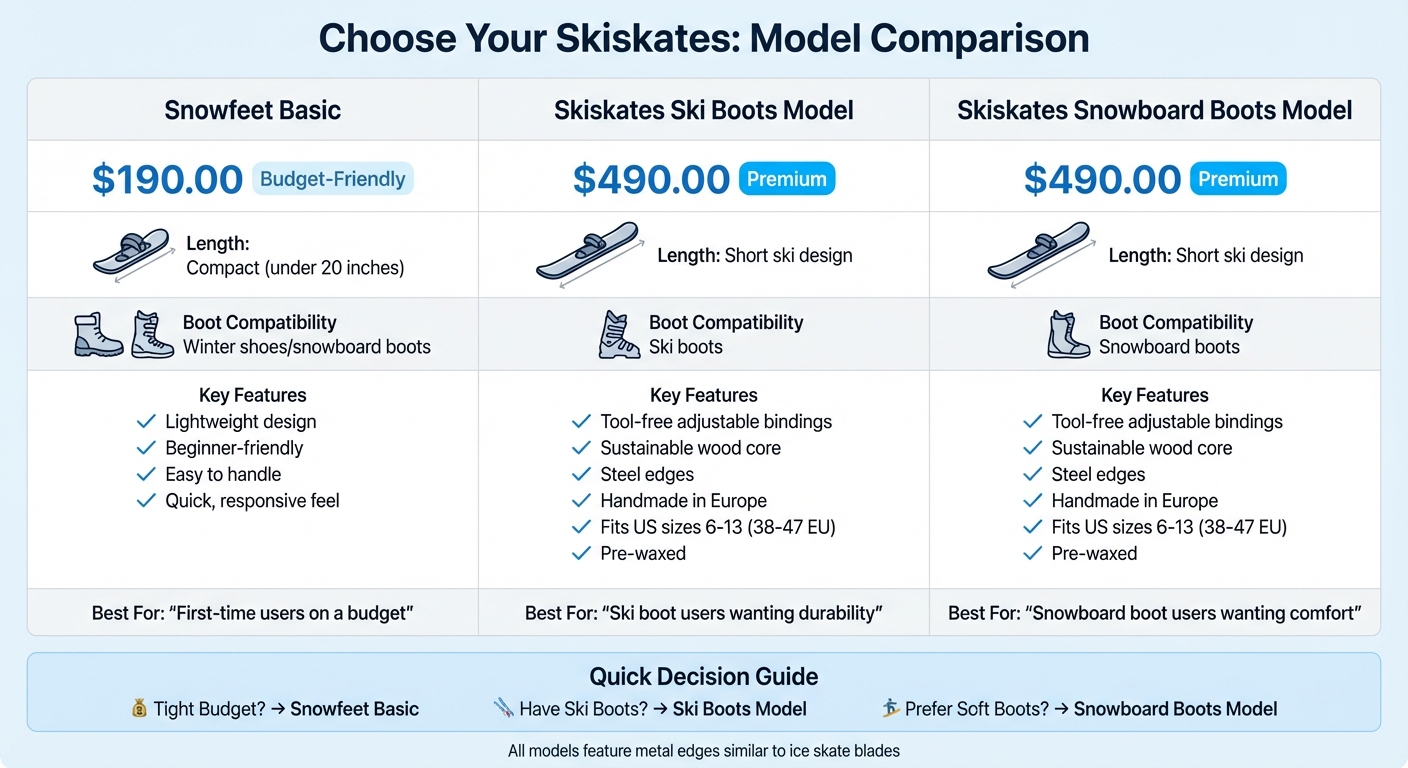
Skiskates Model Comparison Guide for Ice Skaters
Best Skiskates Models for First-Time Users
If you're transitioning from ice skating to snow, the Snowfeet Basic is a great starting point at just $190.00. These mini ski skates are compact and lightweight, designed to mimic the quick, responsive feel of ice skates. Perfect for beginners, they’re easy to handle and budget-friendly.
For those looking for something more durable, the Skiskates Ski Boots Model priced at $490.00 offers high-quality construction with tool-free adjustable bindings that fit your existing ski boots. Handmade in Europe, it features a sustainable wood core, steel edges, and a sturdy cap construction - perfect for tackling a variety of terrains.
Prefer softer snowboard boots? The Snowboard Boots Model, also priced at $490.00, offers the same premium build as the ski boots version but is compatible with snowboard boots instead. Both $490.00 models share the same craftsmanship and materials, differing only in their boot compatibility.
| Model | Price | Length | Boot Compatibility | Key Features |
|---|---|---|---|---|
| Snowfeet Basic | $190.00 | Compact (under 20 in.) | Winter shoes/snowboard boots | Lightweight, beginner-friendly |
| Skiskates Ski Boots Model | $490.00 | Short ski design | Ski boots | Adjustable bindings, wood core, steel edges |
| Skiskates Snowboard Boots Model | $490.00 | Short ski design | Snowboard boots | Adjustable bindings, wood core, steel edges |
Ready to pick the right pair? Let’s look at how to make the best choice for your needs.
How to Choose Your Skiskates
When selecting skiskates, focus on models that make the transition from ice skating to snow seamless. Your boot preference plays a big role here - if plastic ski boots feel uncomfortable, the snowboard-compatible model might be a better fit. Ice skaters often find shorter skiskates easier to adapt to, as they replicate the tight turns and agility of skating on ice.
Lightweight designs are another key factor. Skiskates are compact enough to fit in a backpack, making them easy to carry and ideal for trying out different terrains. Their portability also makes them a convenient choice for beginners who want to practice without lugging around heavy gear.
Budget considerations are important too. Fiberglass models, starting at around $213.00, are a cost-effective option but require regular waxing to maintain performance. On the other hand, wood core models, like the $490.00 options, come pre-waxed and offer smoother performance, though they cost more upfront.
The adjustable bindings on the $490.00 models are a standout feature. They fit US sizes 6-13 (38-47 EU), making them versatile and eliminating the need for multiple pairs as you improve. Plus, the tool-free adjustment system allows you to tweak the fit easily, which is especially helpful as you learn how to manage turns and pressure on snow compared to ice. For ice skaters, compact skiskates are the way to go - they’ll feel familiar and help you maintain the quick-turn moves you’re used to.
Practice Exercises for the Transition
Balance and Stance Warm-Up
Begin with your usual ready stance. Bend your knees to about 90 degrees, keep your weight centered over the balls of your feet, and extend your arms forward to maintain balance. Practice this stance on flat snow using your skiskates. Hold the position for 30 seconds at a time, repeating it 5–10 times over a 10-minute period. This static hold helps you get comfortable with the feel of snow underfoot.
Next, try gentle side-to-side weight shifts to mimic the edging technique you’re familiar with on ice. Slowly rock from one ski to the other, paying attention to how the snow feels different from ice. Wrap up this warm-up by marching in place to improve ankle stability, which is crucial for handling snow conditions. Ice skaters already benefit from a naturally low center of gravity, and this warm-up takes advantage of that while introducing you to the added friction of snow. Once you’re comfortable, you’ll be ready to move on to more dynamic drills.
Gliding and Weight Shifting Drills
Start with the waddle skate as your first gliding exercise. Take short, parallel steps, much like a duck walk (6–12 inches per step), keeping your knees bent and your hips low. Gradually extend each glide over a distance of 50–100 feet on groomed snow. This drill mirrors the push-off and glide phases you’re used to on ice, helping you build confidence while maintaining control at a slow pace. It’s an excellent way to ease into skiskating without the fear of falling.
Once you’ve mastered the waddle skate, move on to single-leg push drills. From your ready stance, push off with one ski while lifting the other slightly - just 2–4 inches off the ground - and glide for 5–10 feet. Alternate legs, completing 10 reps on each side. Focus on the hip drive that powers your ice crossovers. As you improve, extend these into continuous single-leg glides, covering up to 200 feet. This exercise helps transfer your ice skating power into effective snow gliding and refines your weight-shifting technique for smoother movement.
How to Stop and Turn on Snow
Before attempting hockey stops, start with snow plow stops. Point your ski tips inward at a 45-degree angle, shift your weight slightly back, and apply even pressure to scrape the snow. Practice this technique 10 times, starting from slow glides at speeds under 5 mph. Once you’re comfortable, progress to hockey stops by rotating your hips 90 degrees so they’re perpendicular to your skis, then dig your edges into the snow - similar to how you’d stop on ice. Use padded gear and practice on soft snow to reduce the risk of injury.
For turning, try garland turns on gentle slopes. Begin with a straight glide, then shift your weight to one edge (the outside ski) to carve a 180-degree arc uphill. Switch edges to return downhill, keeping your upper body facing downhill throughout the movement. Perform 10 reps in each direction. This drill helps you develop edge control on snow, similar to the leaning techniques you already know from ice figure skating. It also strengthens your sense of balance and coordination, making the transition to snow smoother.
Technique Changes from Ice to Snow
Where to Place Your Weight
Transitioning from ice to snow involves fine-tuning your technique to handle the differences in terrain and surface texture. The fundamentals of ice skating give you a strong foundation, but snow requires some deliberate adjustments.
When skating on snow, body positioning is key. Keep your chest aligned over your knee while maintaining a flexed ankle - this helps keep your center of gravity stable over the ski. Unlike ice skating, skiskating on snow requires a complete weight transfer from one ski to the other. Focus on balancing on your gliding ski between pushes. During the glide phase, bend both your ankle and knee, and as you push, extend them to generate momentum and power. This rhythmic movement is essential for maintaining balance and efficiency on snow.
Once you've got the weight transfer down, it’s time to adapt to the constantly changing snow conditions.
Handling Different Snow Conditions
Snow isn’t as predictable as ice, so you’ll need to adjust your technique based on its texture. For better propulsion and stability, push off the inside edge of your ski. Keep your skis in a V-shaped stance - tips apart and tails closer together - to stay balanced as you skate.
For uphill sections, techniques vary depending on the incline. On moderate to steep slopes, use the V1 Skate technique, which involves planting your poles in an offset pattern for extra power and stability. On steeper inclines, angle your skis outward in a Herringbone stance to avoid sliding backward. On flat terrain, the V2 Skate technique works best. This method emphasizes balanced pole plants and longer, smoother glides for efficient movement.
Lastly, avoid standing too upright. Keeping your knees slightly bent and ankles flexed will help you absorb the unevenness of the snow, giving you better control and a smoother ride.
Common Problems and Solutions
How to Avoid Falling Forward
A frequent challenge for ice skaters transitioning to skiskating is not fully shifting their body weight onto the gliding ski. This hesitation can cause a slipping sensation, often resulting in forward falls. Many skaters also make the mistake of bending at the waist instead of hinging at the hips, which throws off their center of gravity. To maintain better balance, focus on hinging at the hips rather than leaning forward at the waist.
Building strength in your core and legs can make a big difference. Exercises like planks, sit-ups, and squats are great for improving stability and control off the snow. For beginners, wearing protective gear like a helmet and kneepads is a smart move while getting used to the lower friction on snow compared to ice.
Once balance is under control, the next step is to fine-tune your edge control on skiskates.
Improving Your Edge Control
After stabilizing your balance, it's time to work on edge control, which is key for smooth carving on snow. While your edge control skills from ice skating will help, adjusting to the wider ski edge of skiskates might take some practice. The good news? Your muscle memory from ice skating gives you a solid foundation to build on.
Use the edges of your skiskates to carve into the snow with accuracy, much like you would on ice. The shorter length of skiskates also allows for faster, more controlled stops, making them easier to manage on snow.
Conclusion
If you have an ice skating background, you’re already ahead of the game when it comes to skiskating. Skills like turning, gliding, and stopping translate naturally to the snow, thanks to muscle memory and intuitive edge control. This makes the learning curve shorter and allows for quick mastery of moves like hockey-style stops, giving you a real edge on the slopes.
To get started, having the right equipment is key. Consider models like the ODR Skis R43 (now $499.99, down from $599.99) or the ODR Skis Eclipse (now $449.99, down from $499.99). Both are highly rated, with over 1,500 and 800 reviews respectively, proving their reliability and popularity. Don’t forget protective gear like helmets and kneepads to stay safe during your early practice sessions on snow.
Once you’ve got your gear, focus on the basics. Work on balance, stance, weight-shifting, and edge control to build confidence. Strengthening your core and legs with exercises like planks, sit-ups, and squats will also help you feel more stable and powerful on your skiskates.
Transitioning from ice to snow is all about applying what you already know. With the right skiskates and consistent practice, you’ll be carving through the snow with confidence in no time.
FAQs
What kind of terrain should I start on with skiskates?
For those just starting out, it's best to stick to flat, snow-covered terrain when learning to use skiskates. This kind of surface makes it easier to practice your balance and get a feel for the equipment. Steer clear of steep slopes or uneven ground at first - these can complicate the learning process. Flat areas offer a steady and predictable setting, perfect for building confidence and honing your skills before tackling tougher conditions.
Do I need poles to skiskate as an ice skater?
No, poles aren’t required for skiskating, especially if you’re coming from an ice skating background. The techniques, like edge control and balance, share similarities with ice skating, but instead of skates, you’ll be using shorter skis. For beginners, it’s best to concentrate on transferring those existing skills to skis without worrying about poles.
How do I know which boot-binding option will fit me?
Getting the right boot-binding fit can make all the difference in your skiskating experience. Here are some tips to help you get it right:
- Check compatibility: Make sure the bindings work with your ski or snowboard boots to enhance performance on the snow.
- Adjust for fit: The bindings should match your boot size and shape to ensure a snug, secure fit.
- Seek advice if you're switching from ice skating: If you're moving from ice skating to skiskating, it’s a good idea to talk to a specialist or try out several options. This will help you find the setup that offers the best control and comfort.
A properly fitted boot-binding setup is essential for both stability and safety on the slopes.


Leave a comment
This site is protected by hCaptcha and the hCaptcha Privacy Policy and Terms of Service apply.