


Yes, they can. Figure skaters often transition to skiskating more quickly than beginners due to their existing skills in balance, edge control, and muscle memory. Skiskating, which uses compact skis resembling ice skating movements, feels familiar to figure skaters, allowing them to perform techniques like hockey stops, sharp turns, and spins with ease.
Key Points:
- What is Skiskating? A sport combining ice skating techniques with short skis for snow.
- Why Figure Skaters Excel: Years of edgework, balance, and coordination transfer directly to skiskating.
- Challenges: Adjusting to snow's friction and uneven terrain requires recalibration of movements.
- Gear Benefits: Skiskates are lightweight, compact, and designed for precise edge control, making them ideal for figure skaters.
Bottom Line: With their skating background, most figure skaters can feel comfortable skiskating within 1–3 sessions. The main adjustments involve adapting to snow's surface and terrain dynamics.
How to Skate on Skis #skiingtips #skitips
sbb-itb-32287b2
Challenges Figure Skaters May Face When Transitioning to Skiskating
Even for seasoned figure skaters, adapting to the demands of snow introduces new challenges. Tackling these hurdles is key to fully utilizing your figure skating skills in a snowy environment.
Adjusting to Snow Surfaces
The most noticeable difference is how snow behaves compared to ice. Ice provides a smooth, nearly frictionless surface, while snow introduces complex friction dynamics. Snow can resist sliding in one direction while allowing it in another, requiring you to recalibrate your push force and weight shifts. This variability can disrupt the clean, flowing edges that figure skaters are used to.
However, the underlying physics remain the same. As physicist Amy Pope explains, "Physics does not live only in textbooks or exams. It is written into every stride, turn and jump, at every level, from recreational activities to Olympic competitions". Concepts like centripetal acceleration, which keeps you on a curved path during turns, still apply. The key is understanding how the snow reacts differently to edge pressure and weight distribution.
While snow's unpredictable grip may challenge your glide, uneven terrain adds another layer of complexity.
Handling Uneven and Sloped Terrain
Unlike the flat, smooth surface of an ice rink, skiskating takes place on varied terrain. Snow introduces bumps, dips, and slopes that require constant adjustments. To handle these changes, maintain an athletic stance with knees slightly bent and shoulders aligned over your knees. Avoid locking your knees, as this can throw off your balance and reduce your ability to adapt to terrain shifts.
For slopes, shift your weight slightly forward and keep your eyes focused ahead. Figure skating coach Erika Venza advises keeping "soft knees - absorb like a spring" and ensuring "knees over toes, chest lifted". These adjustments may feel unfamiliar at first, but they are essential for navigating the dynamic, ever-changing environment of snow.
Developing these terrain-specific skills is crucial for translating your figure skating expertise to the snow.
How Figure Skating Skills Speed Up Skiskating Learning
Even with snow presenting new challenges, your figure skating background gives you a major advantage. The techniques you've mastered on the ice translate seamlessly to skiskating.
Balance and Edge Control
One of your biggest strengths is your ability to handle edges and balance. The way you lean into an edge, distribute your weight, and push off is a skill that works just as well on snow as it does on ice. As ONE Blades puts it:
"Your body already knows how to lean into an edge, load it, and drive off it. That knowledge applies directly".
Skiskates, with their shorter length, make it even easier to maneuver. Moves like hockey stops feel almost second nature, just as they do on the rink. While the snow’s surface friction differs from ice, the core mechanics stay the same. This mastery of edge control pairs perfectly with the fluid body movements needed for skiskating.
Body Coordination and Muscle Memory
Beyond edge control, your years of figure skating have fine-tuned your muscle memory, setting you up for success on skiskates. The posture, arm positioning, free leg alignment, and head placement you've practiced on ice all carry over to snow without the need to relearn these movements.
Rotation techniques are also similar. As physicist Amy Pope explains:
"a figure skater pulls their limbs in toward their torso, they spin faster".
Thanks to your skating experience, most figure skaters adapt to skiskating within just one to three sessions. Your precise body control and ingrained muscle memory mean you only need to adjust slightly for the added friction of the snow.
Training Tips for Figure Skaters Learning Skiskating
Transitioning from figure skating to skiskating can feel like a natural progression when you focus on specific drills that build on your existing skills. Here are a few ways to fine-tune your technique and adapt to this exciting snow-based sport.
Practicing Sideways Pushes and Stance
Start on flat terrain and practice sideways pushes, similar to your movements on the ice. You'll notice the added resistance from the snow, so take your time adapting. Pay attention to carving turns by engaging the edges of your skiskates, which helps them grip the snow more effectively. This is especially useful when you're navigating bumpy or uneven surfaces. Keep your weight centered, knees slightly bent, and core engaged - just like you would on the rink. This drill helps you transfer your edge control skills from ice to snow with ease.
Building Confidence with Spins and Jumps
Your muscle memory for spins and jumps on the ice gives you a solid foundation for skiskating. When you're ready to try spins, trust your instincts for quick, controlled movements. Start with one-foot glides and small jumps on gentle slopes to get a feel for the snow's friction. As you become more comfortable, you can work your way up to more advanced tricks. These movements will feel familiar, making the transition smoother and more enjoyable.
Using Compact Skates for Easier Maneuvering
Skiskates are shorter than traditional skis, giving you a level of control that's similar to figure skating. This compact design makes techniques like hockey stops highly effective on snow. Practice sharp, controlled stops to get comfortable managing your speed. The lightweight build of skiskates also makes them suitable for a variety of terrains, and their adjustable bindings can accommodate both ski and snowboard boots, giving you flexibility in your setup. These features make adapting to skiskating a seamless experience for figure skaters.
Skiskates: The Right Gear for Figure Skaters
Compact Design and Lightweight Build
Skiskates are about 17 inches (44 cm) long, closely resembling the length of a figure skating blade. This similarity allows you to rely on the skating techniques you've already perfected, instead of adapting to the extended strides required for traditional skis. The compact size even makes it possible to perform technical moves like spins, jumps, and crossovers - things that just aren't feasible on standard skis.
Their lightweight design reduces leg fatigue, making it easier to transition between footwork and aerial moves. Plus, they’re small enough to fit in a regular backpack, which makes carrying them to the slopes a breeze.
Adjustable Bindings for Different Boots
The adjustable bindings on skiskates don’t require tools, making them easy to secure even in cold conditions. They’re designed to fit both ski and snowboard boots, giving you flexibility in your gear setup. These bindings ensure a snug fit, which is critical for precise edge control. This means you can carve turns or execute quick, technical maneuvers without worrying about stability or performance.
Handmade Quality and Durable Materials
Skiskates are crafted in the Czech Republic, where careful manufacturing ensures high standards. Their fiberglass-reinforced build keeps them light while maintaining the strength needed for jumps and spins. The integrated metal ski edges allow you to apply the same sharp edge work you’ve mastered on ice, gripping the snow effectively for turns and stops.
The core, made of sustainable wood, offers durability without adding unnecessary weight. This thoughtful construction ensures your skiskates perform consistently, whether you're on packed snow or varied terrain. Every detail is designed to bring the precision of your figure skating routines to the slopes.
Comparison: Skiskating vs. Regular Skiing for Figure Skaters
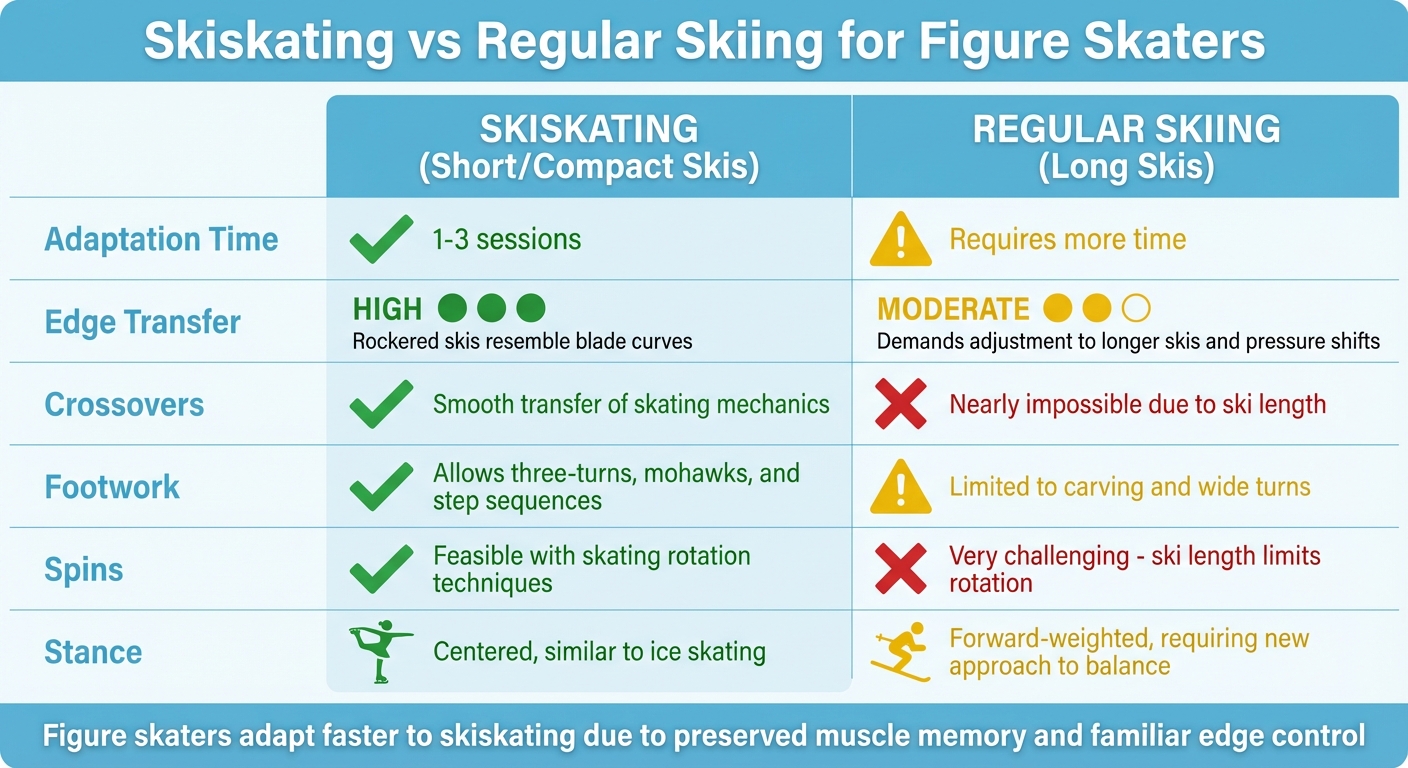
Skiskating vs Regular Skiing for Figure Skaters: Skills Transfer Comparison
Learning Curve and Skill Transfer
Figure skaters often find skiskating much easier to pick up compared to regular skiing. This is largely due to how closely skiskating mimics the movements and techniques used on the ice, making the transition feel natural. In contrast, regular skiing involves a steeper learning curve because of the significant differences in stance, weight distribution, and equipment design.
Here’s a quick breakdown of how figure skaters adapt to each:
| Skill / Metric | Skiskating (Short/Compact Skis) | Regular Skiing (Long Skis) |
|---|---|---|
| Adaptation Time | 1–3 sessions | Requires more time |
| Edge Transfer | High; rockered skis resemble blade curves | Moderate; demands adjustment to longer skis and pressure shifts |
| Crossovers | Smooth transfer of skating mechanics | Nearly impossible due to ski length |
| Footwork | Allows for three-turns, mohawks, and step sequences | Limited to carving and wide turns |
| Spins | Feasible with skating rotation techniques | Very challenging; ski length limits rotation |
| Stance | Centered, similar to ice skating | Forward-weighted, requiring a new approach to balance |
The key advantage of skiskating lies in its ability to preserve muscle memory. It lets figure skaters use familiar edge control, crossovers, and body positioning without having to relearn basic movements. On the other hand, regular skiing demands a complete shift in technique, which can feel counterintuitive for those accustomed to the precision of ice skating.
Conclusion
Figure skaters transition to skiskating with ease, thanks to their refined skills in balance, edge control, and coordination. As ONE Blades explains:
"Your body already knows how to lean into an edge, load it, and drive off it. That knowledge applies directly".
The right gear enhances this transition. Skiskates are engineered to mimic the mechanics of ice skating, featuring compact lengths and rockered geometry that replicate a blade's curved profile. This allows skaters to execute quick stops, sharp turns, and even spins using familiar techniques. Models like the ODR Skis Eclipse ($449.99) and R43 ($499.99) stand out with adjustable bindings and handcrafted European craftsmanship.
"The principles of balance, edge control, and the rhythmic dance with the surface remain remarkably consistent, creating an instant sense of familiarity for the seasoned ice skater." – ODR SKIS
Most figure skaters find themselves comfortable with skiskating after just one or two sessions. Their posture, core stability, and ice-honed precision translate seamlessly, minimizing the need for extensive relearning. The main adjustments involve adapting to increased friction on snow, which requires more frequent pushes, and fine-tuning for the slightly different surface feel during landings.
For figure skaters looking to broaden their winter activities, skiskating offers a natural and exciting progression.
FAQs
What terrain is best for my first skiskating session?
The best place to try skiskating for the first time is on a flat or slightly sloped, snow-covered surface. Ideal spots include snow trails or open fields. These gentle conditions allow you to concentrate on mastering balance and control before moving on to more challenging slopes.
What boots and bindings do I need for Skiskates?
To try skiskating, you’ll need a pair of compact skiskates (priced from $190), snowboard or ski boots, and bindings that are compatible with your setup. The bindings play a crucial role, keeping the skiskates firmly attached to your boots for better control and stability. Ensure everything is properly adjusted so you can smoothly transition your skills from the ice to the snow.
What safety gear should figure skaters wear when skiskating?
Figure skaters should prioritize safety by wearing protective gear while skiskating. Key items like wrist guards, elbow pads, knee pads, and gloves can significantly lower the chances of injuries. These pieces of equipment offer added protection during slips or falls, ensuring a safer experience on the ice. Investing in the right gear helps make the transition to skiskating much more secure.

Leave a comment
This site is protected by hCaptcha and the hCaptcha Privacy Policy and Terms of Service apply.