

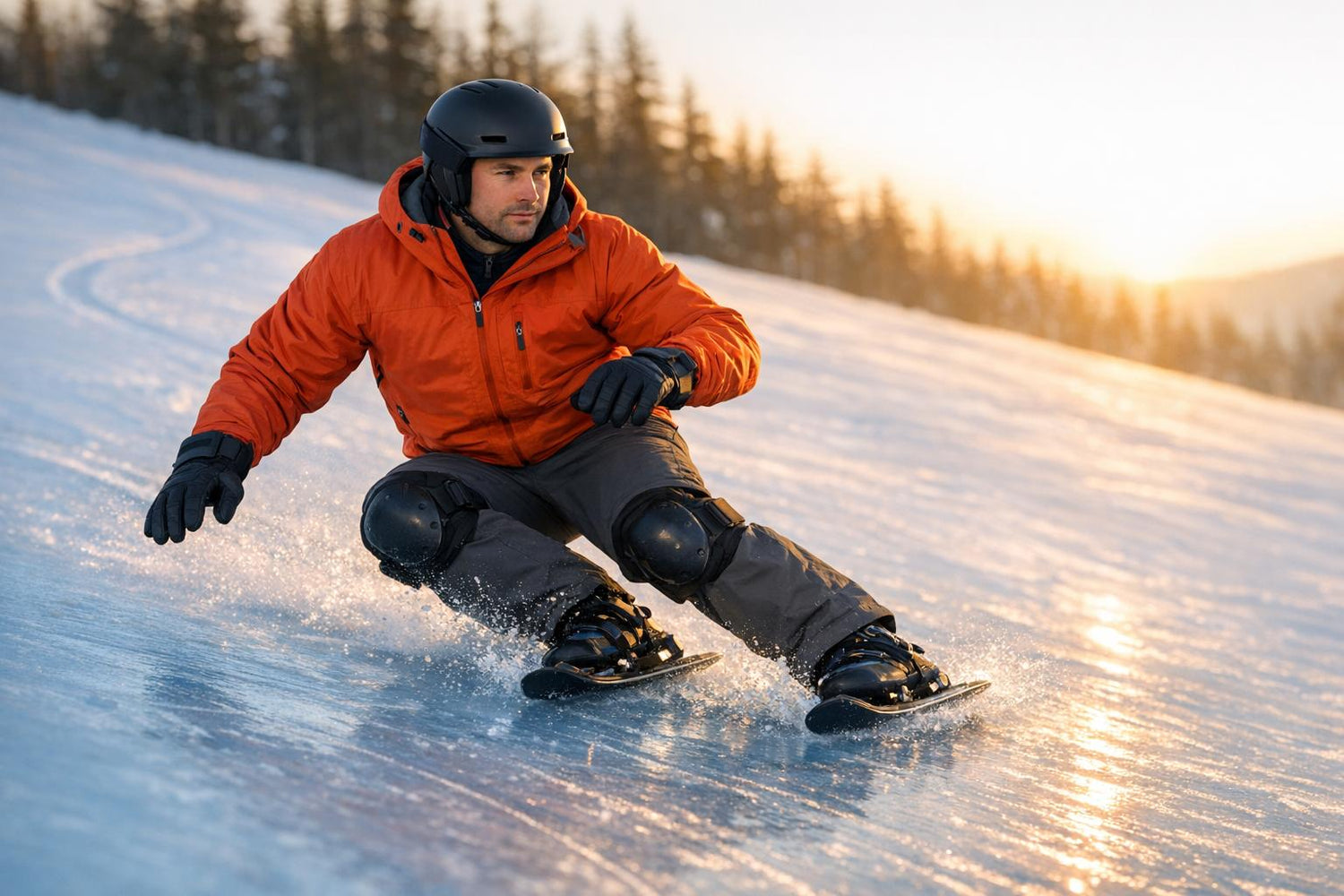
Mastering skiskates on icy slopes is all about preparation, technique, and balance. Unlike traditional skis, skiskates are compact, combining the agility of ice skates with the grip of skis. They’re designed for precision on hard-packed ice, making them a great choice for slick terrain. Here’s what you need to know:
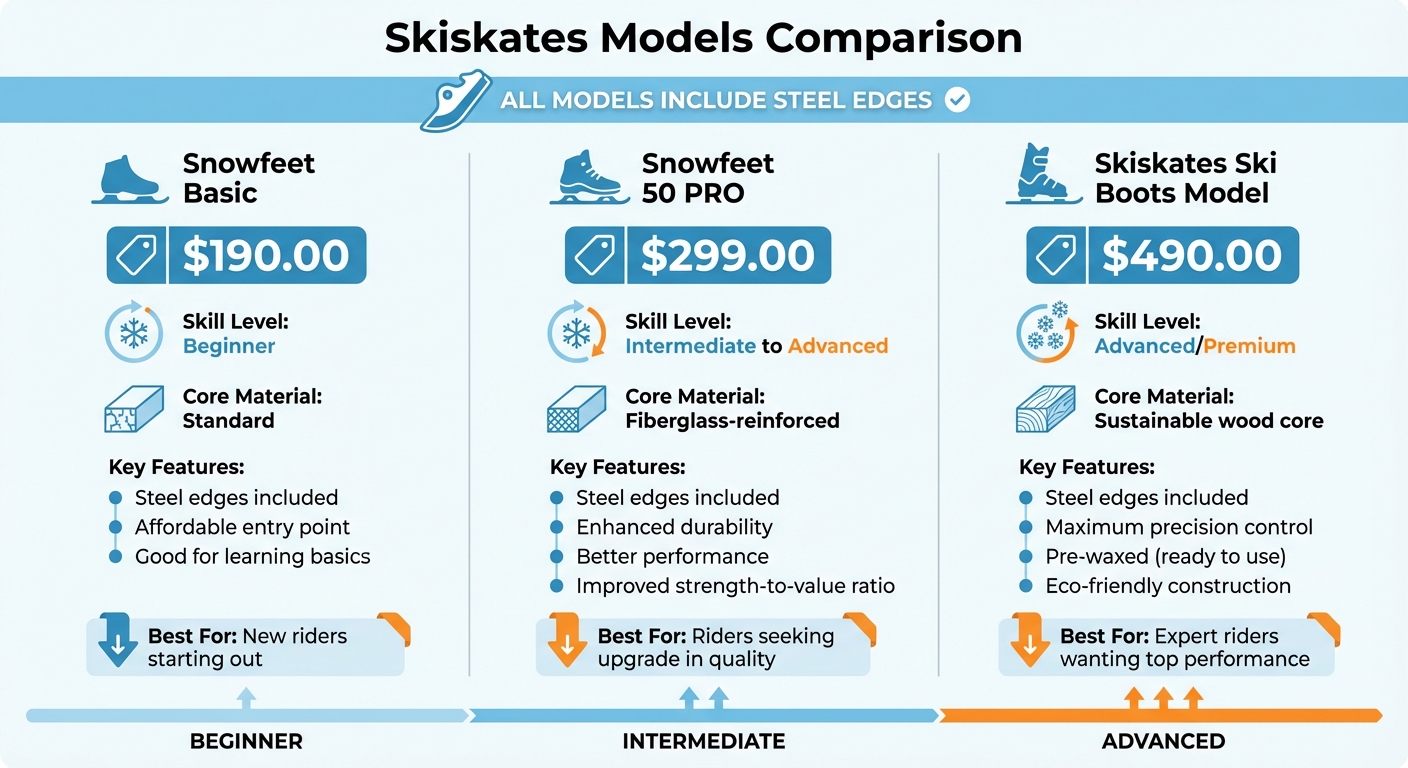
- Gear: Choose skiskates with metal edges for grip. Beginner models like the Snowfeet Basic ($190.00) are affordable, while advanced options like the Snowfeet 50 PRO ($299.00) offer better durability and performance. Keep edges sharp and bindings secure for optimal control.
- Safety: Wear a helmet, goggles, and layered clothing. Use ski or snowboard boots for stability.
- Techniques: Start with a wide stance, knees bent, and weight centered. Practice on flat ice to build balance before moving to slopes. Use controlled, short turns and sideslipping to manage speed.
- Stopping: Beginners can use the wedge stop (snowplow), while advanced riders can try the hockey stop for faster braking.
- Advanced Skills: Step turns and carving help with precise edge control. For steeper terrain, focus on gradual movements and a strong core to maintain balance.
With practice and the right gear, icy slopes become manageable and enjoyable.
Snowfeet* & Skiskates Tutorial - How to Become a PRO Skiskater
sbb-itb-32287b2
Gear and Preparation for Icy Slopes
Skiskates Models Comparison: Features and Pricing Guide
Skiskates Models and Accessories
When tackling icy slopes, having metal edges on your gear is non-negotiable. Every Skiskates model includes steel edges, giving you the grip you need to confidently carve turns and stop on the hard-packed ice found at most ski resorts. This feature is a game-changer for maintaining control on slick terrain.
Skiskates come in a range of models tailored to different abilities and preferences. The Snowfeet Basic ($190.00) is an excellent starting point for beginners. For those seeking a step up in durability and performance, the Snowfeet 50 PRO ($299.00) features a fiberglass-reinforced core, delivering a solid mix of strength and value. If you're aiming for maximum precision, the Skiskates Ski Boots Model ($490.00) offers a sustainable wood core and comes pre-waxed, so it's ready to hit the slopes right out of the box.
To keep your Skiskates in peak condition, regular maintenance is key. Sharpen the metal edges frequently, dry them thoroughly after use, and apply oil to prevent rust. For fiberglass core models, using liquid wax on the base can enhance speed and stop snow from sticking - especially useful on groomed trails. Also, check that your bindings are equipped with anti-slip surfaces to keep your boots securely locked in place.
Once your gear is ready, shift your attention to safety and personal protection.
Safety Gear
Navigating icy conditions requires the right safety gear. Start with an ASTM-certified helmet to protect against hard impacts during falls. A snug fit is crucial - your helmet should stay firmly in place even during sudden movements.
Ski goggles are another must-have, shielding your eyes from wind, ice, and glare while improving visibility in flat light. To avoid compatibility issues, bring your helmet when shopping for goggles to ensure a seamless fit with no gaps. Pair this with waterproof gloves that keep your hands warm and allow you to adjust your gear easily.
Layering your clothing is essential for staying comfortable. Use a moisture-wicking base layer, an insulating mid-layer, and a waterproof outer shell to keep warm and dry. For added protection, consider wearing wrist guards and knee pads to soften the impact of falls on icy surfaces.
Footwear for Stability
The right footwear plays a pivotal role in ensuring control and stability on ice. Snowboard boots provide excellent ankle support and adapt well to varied terrain, while ski boots deliver the aggressive control needed for precision on slopes. For casual outings, winter shoes might work, but for icy conditions, secure, supportive boots are essential.
To guarantee a proper fit, adjust your bindings at home with the exact boots you'll be wearing. Skiskates are compatible with ski boots sized 4.5–14.5 US and snowboard boots sized 6–14.5 US, offering flexibility for a wide range of users.
Balance and Starting Position
Stance and Posture
Getting your stance right is key when you're on the ice. Start by keeping your feet at least as wide as you would naturally stand on uneven ground. Laurie Todd, a CSIA Level 4 instructor, puts it this way:
"A wider stance, at least as wide as you would stand naturally on an unstable floor, will give you a fighting chance".
To stay agile, keep your ankles, knees, and hips slightly bent at all times. Center your feet, lift your hips just enough to maintain shin contact with your boots, and place your hands forward so your shoulders line up over your toes. Focus on shifting your weight over your outside (downhill) foot - this keeps your muscles relaxed and ready for small adjustments while the edges of your skates grip the ice. Resist the urge to lean back or "hug" the hill, as these habits reduce the pressure needed on your edges for effective grip. Practicing this posture on flat ice will help you build the control you need when tackling slopes.
Practicing on Flat Ice
After mastering your stance, move to flat ice to develop dynamic balance and weight-shifting skills. Begin by shifting your weight slowly from one foot to the other while maintaining a hip-width stance. Try single-leg stands and the tandem or "scissor" stance, where one foot is positioned directly in front of the other, heel-to-toe, to challenge your stability. For single-leg stands, aim to hold the position for 10–30 seconds at first, eventually working up to 60 seconds to improve balance and reduce the risk of falling.
Once you're comfortable with static positions, take short, shuffling steps while keeping your knees bent and your center of gravity low. Cory Absey, PT, DPT at Summit Orthopedics, highlights the importance of this:
"It all comes down to managing your center of mass... keep the bulk of your body weight right between your feet".
These foundational exercises on flat ice are crucial for building confidence and control before moving on to more advanced techniques.
Speed Control and Stopping
Speed Control Methods
Controlling your speed on icy surfaces requires intentional, smooth movements. Imagine navigating a slick, frozen road - any sudden jerks or rapid adjustments can cause you to lose your grip. The trick lies in gradually altering your edge angle to avoid skidding.
A widely used technique for speed management is sideslipping. This involves a controlled sideways drift, achieved by flattening your skates. Adjusting how much your edges "bite" into the ice gives you control over your speed. To maintain stability, keep your shins pressed forward so the tips of your skates grip the ice effectively. Laurie Todd, a CSIA Level 4 instructor at AllTracks Academy, highlights the importance of this approach:
"Standing on the outside ski is important in any situation, but it becomes essential when the slope gets icy".
Another effective strategy is using short, rhythmic turns with firm edge engagement. This approach helps maintain a steady pace and prevents excessive speed buildup on slippery slopes. Look for softer snow or chalky patches to execute turns more easily, and be ready to slide neutrally when encountering shiny, hard ice. For added stability, adopt a wider stance - at least shoulder-width apart - and keep your knees and ankles flexed. This stance gives you the mobility to adapt to unexpected icy spots.
Once you’ve got your speed under control, it’s time to focus on stopping effectively.
Braking: Wedge and Hockey Stop
To stop, you can rely on either the wedge stop or the hockey stop.
The wedge stop, also known as the snowplow, is ideal for beginners. Start by bending your knees, angling your toes inward, and pushing your heels outward to form a V-shape. The inside edges of your skates will create the friction needed to slow down. Be sure to apply pressure gradually to avoid skidding - abrupt movements on ice can cause your skates to slip out from under you.
For more advanced skaters, the hockey stop provides greater stopping power but requires practice. To execute it, pivot both skates sideways at roughly a 45-degree angle to your direction of travel. The key is to flatten your skates during the pivot, then engage the edges to scrape the ice without digging in too deeply. As explained by The Editors at Skiing Magazine:
"To stop quickly, you must be well balanced over the middle of your skis. You must also flatten your skis... to suddenly pivot them beneath you".
On icy surfaces, scraping the ice is more effective than trying to dig in. Too much edge pressure can cause your skates to catch, potentially throwing you off balance.
For both stopping methods, remember to keep your weight centered over the balls of your feet, your knees flexed, and your head up. A study by Carv in January 2026 revealed that 45% of skiers struggle with control due to a narrow stance and leaning too far back. Skier Aidan Williams, for example, improved his "Ski:IQ" score from 126 to 140 in just one day by practicing the Garland drill. This drill involves alternating between releasing and re-engaging edges, guided by coach Tom Waddington.
| Stopping Method | Ease of Learning | Speed Control | Ice Suitability |
|---|---|---|---|
| Wedge (Snowplow) | High (Beginner) | Best for slow to moderate speeds | Excellent for stability and consistent friction |
| Hockey Stop | Low (Advanced) | High stopping power; immediate | Best for rapid stops; requires precise edge control to avoid catching |
Turns and Advanced Techniques
Step Turns
Step turns are a go-to technique for gaining control when navigating icy terrain. To execute a step turn, start by reducing your speed. Lift one skiskate and angle it in the direction you want to turn. Step down firmly to engage the edge, then lift your other skiskate and position it parallel to the first. Repeat this sequence until you complete the turn.
The trick is keeping your weight over the outside (or downhill) skiskate. This allows the metal edge to grip the ice securely rather than sliding out. Adopting a wide, athletic stance - about shoulder-width apart - provides stability. Keep your ankles, knees, and hips slightly bent for balance. As Ken Knapp, REI Editor, puts it:
"Being proficient and remaining balanced atop one foot is a trait shared by advanced skiers".
If balance feels tricky during step turns, try dragging the tip of your downhill pole in the snow. This small adjustment helps align your upper body over the downhill skiskate, improving control.
Once you've got step turns down, you can move on to carving techniques, which offer even greater precision on ice.
Carving on Ice
Carving is all about edge control and requires a combination of ankle and knee movement. To carve effectively on ice, roll your ankles and knees toward the big toe of your outside skiskate. At the same time, drive that knee toward the toe piece, flexing the skiskate and embedding its edge firmly into the ice. On icy slopes, it's crucial to engage your edges earlier in the turn than you would on softer snow to avoid skidding.
Keep your weight centered over the outside skiskate to maintain balance and structure. Avoid leaning your upper body too far, as this can cause you to lose grip. On steeper or icier terrain, focus on bending at the hips to create sharper edge angles, rather than relying solely on your ankles and knees.
Since icy slopes often feature uneven patches, stay alert for "islands" of softer snow. These spots provide better grip for sharper turns. When you hit slick, glassy sections, prepare to slide in a controlled manner. As CSIA Level 4 Instructor Laurie Todd explains:
"Every turn I make on ice is a mixture of carving and sliding. Once you can accept that some slide slipping is inevitable while you make a turn this becomes fun".
Advanced Maneuvers for Icy Terrain
Once you’ve mastered step turns and carving, it’s time to tackle more advanced maneuvers for icy conditions. Retraction turns are a great next step. These involve flexing your legs at the crossover point of a turn to absorb forces and maintain constant contact with the ice. The key is the crossover movement - shifting your body’s center of mass from one skiskate to the other. As Bill Jones, a Certified Professional Ski Instructor, describes:
"The heart of modern skiing".
For even more technical moves like spins, jumps, or skiing backward, core strength is essential. Tighten your core muscles to stabilize your upper body while your legs handle the intricate movements. A strong core allows your legs to stay agile, making the micro-adjustments needed to handle unpredictable icy terrain.
On hard-packed ice, every motion counts. Slow, deliberate transitions are your best friend for maintaining control. Always keep your shins pressed against the front of your boots to avoid shifting your weight backward, which can lead to losing control as your speed increases.
Conclusion
Mastering skiskates on icy slopes boils down to three key factors: the right equipment, proper technique, and consistent practice. To keep control sharp, ensure your skiskates have well-maintained edges and a secure boot fit. Regularly tune your skiskates using a tuner or have a technician sharpen them before hitting the slopes. Tightening your boots also improves power transfer and edge control.
Focus on staying balanced over the outside (downhill) skiskate, keeping your knees and ankles bent in a wide, athletic stance. Avoid sudden movements. As Laurie Todd, a CSIA Level 4 Instructor, explains:
"Ice is slippery and very firm, so rather than compacting snow to make a ledge, you have to balance on a knife-edge. Those few millimeters of metal on the edge of your ski are all that will penetrate the surface".
Start with the basics - step turns, controlled side-slipping, and gradual edge engagement - before moving on to more advanced techniques. Pair your skills with safety precautions to navigate icy terrain effectively.
Always wear a helmet and consider additional protective gear, especially when trying advanced tricks. Adhere to FIS rules, which prioritize the skier ahead, and remember that about 10% of skiing accidents involve collisions on the slopes.
Skiskates have a fast learning curve - many riders feel comfortable after just one day. Thousands of riders have already experienced their reliability. Whether you opt for the entry-level Snowfeet Basic ($190.00) or the advanced Snowfeet 50 PRO ($299.00), skiskates offer a compact, versatile winter sport option that fits conveniently in your backpack.
FAQs
What are the best ways for beginners to stop safely on icy slopes while using skiskates?
To stop safely on icy slopes while using skiskates, beginners can try two reliable techniques:
- The Snowplow Stop: Slightly bend your knees, point your toes inward, and push your heels outward. This motion increases friction against the ice, helping you slow down and come to a gradual stop.
- The T-Stop: Position one skiskate behind the other at a right angle and gently drag it along the ice. This method helps you control your speed while maintaining balance.
Start practicing these techniques on mild slopes to gain confidence and improve your control on icy terrain.
How do I properly maintain my skiskates for the best performance on icy slopes?
To keep your skiskates in top shape for those icy slopes, make it a habit to check the blades regularly for rust or signs of wear. After each use, dry them completely to ward off corrosion. Using protective blade guards when you're not on the ice is a smart move to prevent accidental damage. Don't forget to sharpen the blades periodically - this helps you maintain better grip and control on slippery surfaces. Lastly, store your skiskates in a cool, dry spot to preserve their condition and extend their lifespan. With these simple steps, you'll enjoy a safer and smoother ride every time!
What safety gear do I need for skiskating on icy slopes?
To stay safe while skiskating on icy slopes, having the right protective gear is a must. Start with a well-fitted helmet to shield your head in case of a fall. Adding knee and elbow pads can soften the blow from unexpected impacts and help prevent injuries. For better grip and stability on slippery surfaces, think about using traction-enhancing gear like cleats or crampons specifically made for icy conditions.
Layering your clothing is another smart move. It helps you stay warm without overheating, while insulated, waterproof gloves ensure your hands stay both warm and functional in freezing weather. Investing in proper safety gear not only boosts your confidence but also makes skiskating on icy terrain a lot more enjoyable.


Leave a comment
This site is protected by hCaptcha and the hCaptcha Privacy Policy and Terms of Service apply.