

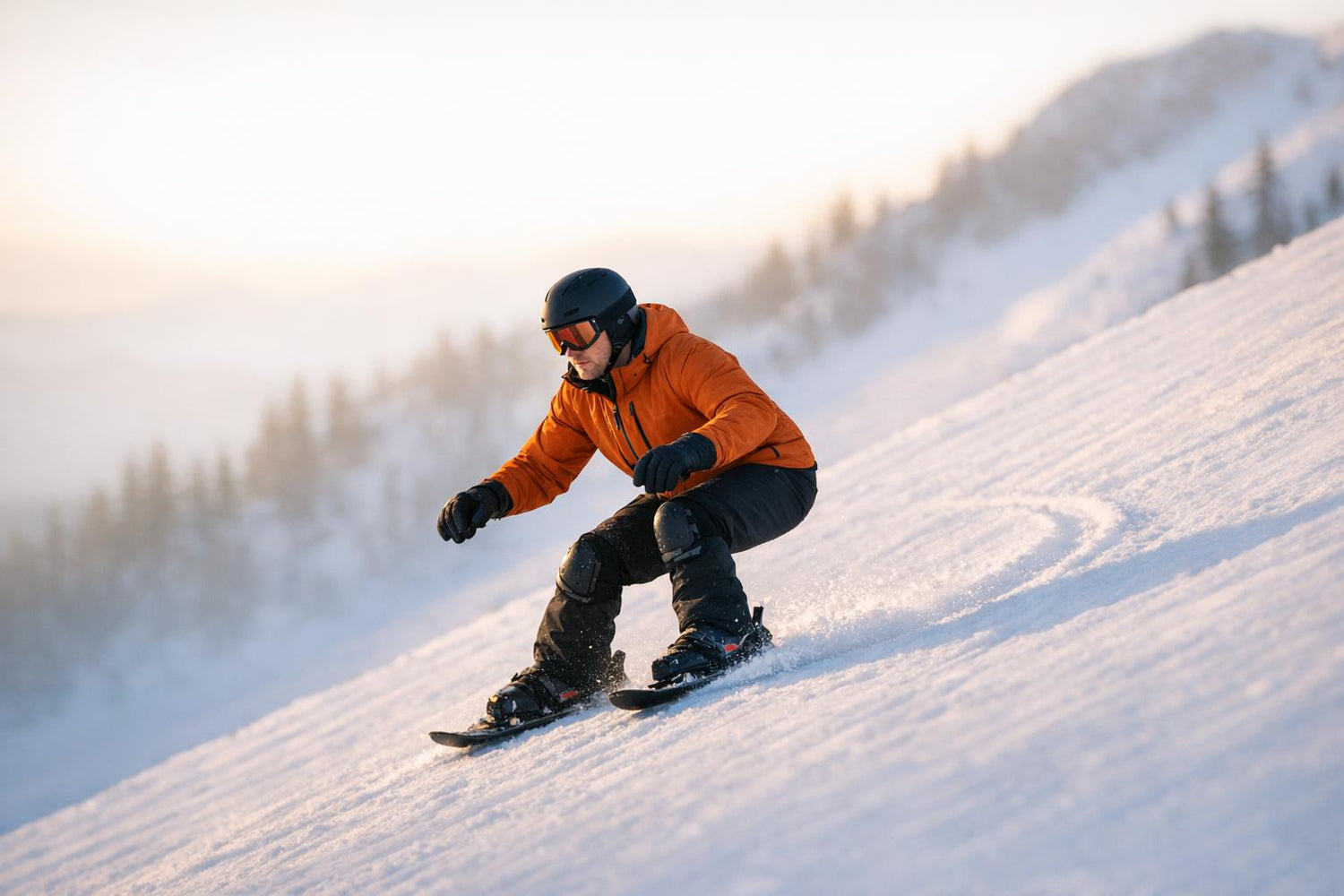
Skiskates, often called "skates for snow", are compact, lightweight skis (17–20 inches long) designed for agility and control. They excel on steep slopes (30°–40° gradients) by enabling sharp turns, quick pivots, and controlled slides. Their small size makes them ideal for tight spaces and narrow runs.
Key points for using skiskates on steep terrain:
- Edge Control: Use side-slipping and skid turns for speed management. Avoid over-engaging edges to prevent acceleration.
- Body Position: Stay forward, weight on the downhill skiskate, and avoid leaning back or into the slope.
- Speed Control: Practice short-radius turns, side-slipping, and hockey stops for effective braking.
- Navigation: Use traversing for diagonal movement and kick turns for direction changes on steeper slopes.
Safety tips include maintaining sharp edges, checking bindings, and practicing self-arrest techniques. Start on moderate slopes to build confidence before tackling steeper terrain.
How Skiskates Perform on Steep Slopes
Skiskates are impressively agile on steep terrain, largely due to their compact design. They allow for quick 180° pivots using just your legs - an essential skill for handling slopes that range between 30° and 40°, commonly classified as "steep".
Their lightweight construction makes it easy to lift them off the ground. By pushing up from the balls of your feet with a controlled extension, you can clear obstacles or change directions swiftly. Ski technique expert Warren Smith highlights this advantage:
"The skis will become very light and much easier to manoeuvre on the steeper terrain".
Features That Enhance Maneuverability
The shorter length of skiskates plays a big role in their superior maneuverability. It allows for quicker edge release, making skid turns safer and more controlled. Unlike carving, where edges dig aggressively into the snow, skid turns let you slide the skiskates across the slope, helping to manage speed and avoid the sidecut catching too forcefully.
In tight spaces - such as narrow corridors about 2 meters (6.5 feet) wide - skiskates shine. They enable slow, precise pivots without needing the room required for wide, sweeping turns.
Performance in Challenging Conditions
Skiskates adapt well to tricky surfaces like ice and uneven terrain. On icy slopes, subtle ankle movements help quickly adjust the shorter edges for better grip without over-committing. On rough or bumpy ground, their lightweight design makes jump turns easier and allows for sharp stops - a critical safety feature. Warren Smith elaborates:
"Ideally you should be able to steer your skis 180 degrees from the extremity of one turn and then back to the other. If you have this skill it will give you 100% control on the steeper slopes".
This ability to steer sharply and set edges quickly means you can stop on a dime when hazards appear. These responsive traits make skiskates a great tool for mastering steep-slope techniques with confidence.
sbb-itb-32287b2
Control Techniques for Steep Slopes
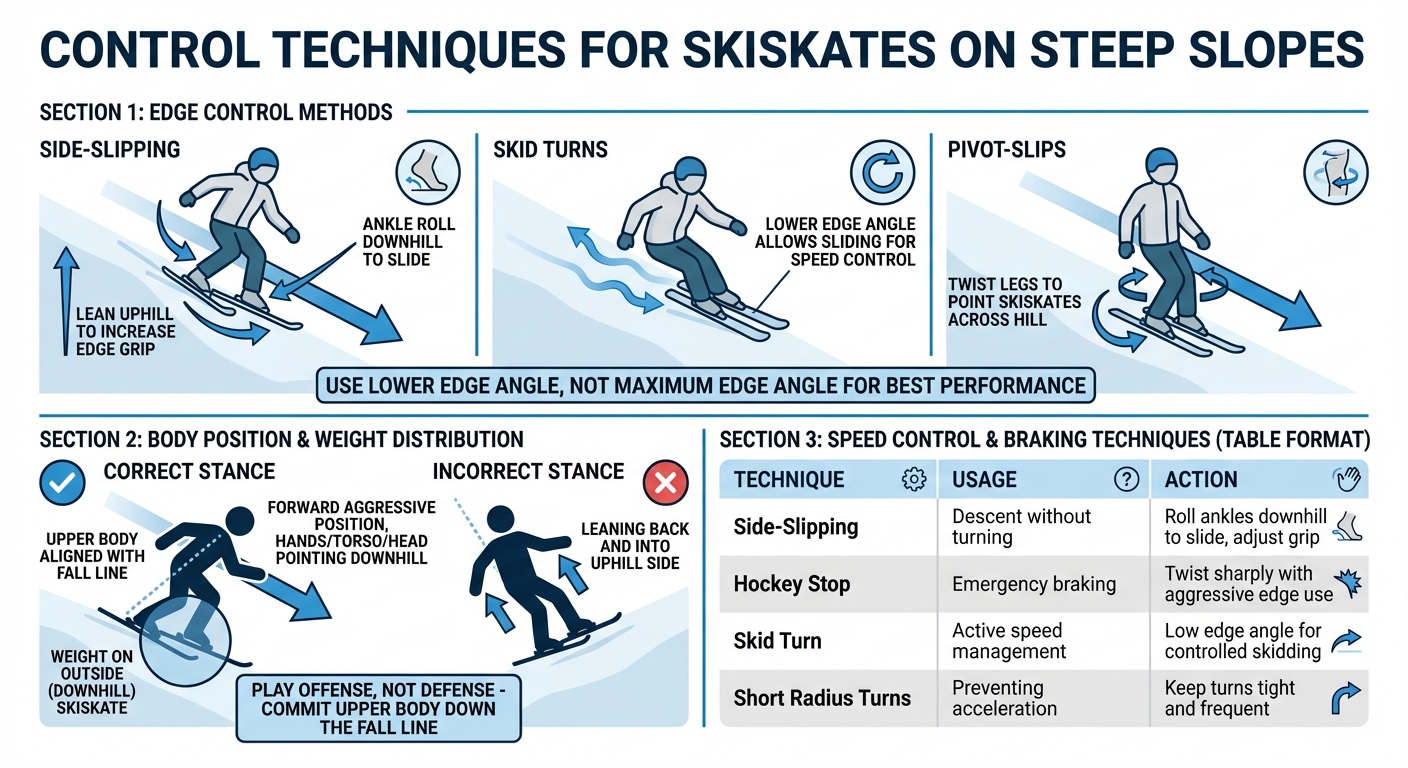
Essential Control Techniques for Skiskates on Steep Slopes
Building confidence on steep slopes with skiskates comes down to mastering precise edge work, maintaining proper body alignment, and managing your speed wisely. These techniques work together to help you stay in control when the terrain gets challenging.
Edge Control Methods
Edge control is about finesse, not brute force. Over-engaging your edges can make your skiskates grip too aggressively, causing unwanted acceleration across the hill. As professional ski instructor Eric Lipton explains:
"Getting the best performance out of the skis is about finding the right edge angle, not necessarily the most edge angle."
One essential technique for steep descents is side-slipping. To do this, position your skiskates perpendicular to the slope and gently release your edges by rolling your ankles downhill. This allows you to slide down the slope in a controlled way. If you need to slow down or stop, lean your body uphill to increase edge grip, or "edge bite."
On steep terrain, skid turns are often more effective than carving. Skid turns use a lower edge angle, which allows your skiskates to slide across the snow. This approach gives you better control over your speed and makes it easier to release your edges for the next turn. A great way to practice this is with pivot-slips: twist your legs to point your skiskates across the hill while keeping your upper body facing downhill, then release the edges to let them slide.
Strong edge control sets the foundation for stability on steep slopes.
Body Position and Weight Distribution
Your body position plays a huge role in maintaining control. A common mistake is leaning back and putting weight on your uphill skiskate, which can throw you off balance. Eric Lipton points out:
"The most common mistake I see skiers make in the steeps is skiing too defensively - leaning back and on their uphill ski. Steep terrain rewards skiers who are playing offense, not defense."
To stay in control, adopt a forward, aggressive stance. Keep your hands, torso, and head pointing downhill. Even when your skiskates are angled across the slope, your upper body should stay aligned with the fall line. Place your weight on the outside (downhill) skiskate for better edge grip.
Avoid leaning into the slope, even though it may feel like the natural thing to do. Pro skier Erik Roner explains:
"The natural reaction of the brain and body on a steep slope is to lean uphill into the slope. But when you lean uphill, you reduce your edge grip and control. Commit your upper body down the fall line and stay over your feet."
Distribute your weight evenly over the entire sole of your foot - don’t lean too far forward or back. Keep your hands out in front; if they drift behind your downhill foot, you’re likely leaning too far back.
Once your stance is balanced, you’ll be ready to tackle speed control with confidence.
Speed Control and Braking
Managing your speed on steep slopes requires a mix of techniques. Side-slipping, as described earlier, is great for gradual speed adjustments. Small ankle movements can help you control your descent. Short-radius turns are another key tool - frequent, tight turns prevent your skiskates from pointing downhill for too long, which helps you avoid picking up too much speed.
For emergency braking, the hockey stop is a must-know move. Twist both skiskates sharply across the hill and dig in your edges to come to a quick stop.
Pole plants also come in handy for speed control. Plant your downhill pole firmly just before releasing your edges to start a turn. This not only provides a pivot point but also helps you shift your weight smoothly for better maneuvering.
| Technique | Usage | Action |
|---|---|---|
| Side-Slipping | Descent without turning | Roll ankles downhill to slide, then adjust grip |
| Hockey Stop | Emergency braking | Twist sharply with aggressive edge use |
| Skid Turn | Active speed management | Use low edge angle for controlled skidding |
| Short Radius Turns | Preventing acceleration | Keep turns tight and frequent |
Navigation Methods for Steep Terrain
Once you've got a handle on edge control and managing your speed, the next challenge is figuring out how to navigate extremely steep slopes. When the terrain gets too steep for continuous turns, you'll need to rely on techniques like traversing and kick turns. These methods allow you to move diagonally across the slope and change direction without constantly descending downhill.
Traversing Across the Slope
Traversing diagonally is a key way to maintain control and manage your speed. Start by positioning your skiskates perpendicular to the slope, using their uphill edges for grip. Keep your knees bent and your hips centered over the edges to ensure stability.
To move forward, shift your weight onto your front foot, flatten it slightly, and keep your upper body facing downhill. If you need to slow down or stop, lean back onto the uphill edges and increase the angle by rolling your ankles into the slope.
On slopes steeper than 25%, you might notice your legs tire more quickly. To counter this, adjust your stance to reduce strain. Position your uphill skiskate slightly ahead of the downhill one, keeping most of your weight on the downhill edge for better balance and control.
Kick Turns for Direction Changes
When the slope gets even steeper - over 35° - making precise directional changes becomes crucial. Kick turns are your go-to technique here, allowing you to rotate 180 degrees while staying stationary and secure.
Start by setting a stable, shoulder-width stance with your skiskates across the slope. Plant your poles on the uphill side, about a foot above you - one pole in front of your torso and the other behind - to create a solid frame. Shift your weight fully onto the uphill skiskate, then lift the downhill skiskate. Swing it around so the tail rests near the tip of the uphill skiskate, turning your foot, knee, torso, and poles smoothly toward the new downhill direction.
Once the downhill skiskate is secure in its new position, shift your weight onto it. Then lift and swing the uphill skiskate to bring it parallel.
Kick turns can take time to master, but they’re invaluable for navigating narrow chutes or avoiding obstacles on steep terrain. Your poles are essential for balance during the weight transfer, so focus on deliberate, controlled movements to stay steady.
Safety Tips and Skill Development
Once you’ve nailed control and navigation on steep terrain, it’s time to shift your focus to safety and refining your skills. A solid grasp of edge control and speed management is your foundation for tackling steeper slopes with confidence. Start by mastering the basics on moderate slopes - adjusting your turns, controlling your speed, and perfecting techniques like the hockey stop or a controlled side-slip. For context, a steep slope typically has a gradient of about 30°, with black diamond runs often exceeding 40% and extreme terrain reaching gradients of 50° or more. Build your skills progressively, starting with gentler slopes to ensure you’re ready for the challenges of steeper descents.
Start on Gentle Slopes
Ease into skill development by practicing on less intimidating terrain. Work on side-slipping on moderate slopes to gain control over your sliding. This practice helps you develop automatic speed control, which is crucial for steeper and more technical runs. Another helpful drill is practicing narrow corridor turns - aim to keep your turns within a 6.5-foot-wide (about 2-meter) space. This mimics the constraints of steep, narrow trails. Before attempting steeper runs, always warm up on moderate slopes to fine-tune your techniques.
Common Challenges and Solutions
One common error is leaning too far back or excessively into the uphill side, which reduces your edge grip and overall control. Instead, focus on keeping your weight centered or slightly forward, with your shoulders facing downhill. This positioning allows your lower body to twist naturally for turns. If you notice your edges slipping, it might be due to over-edging or uneven weight distribution. In such cases, try skid turns with a lower edge angle to better manage your speed on steeper gradients.
Equipment Preparation and Maintenance
Your technique is only part of the equation - proper equipment maintenance is just as critical for staying safe on steep slopes. Make sure your edges are sharp to handle icy patches or hard-packed snow. Regularly check your bindings and plan your route carefully, identifying potential hazards like icy spots, obstacles, and safe stopping areas. Lastly, be prepared for emergencies: learn how to self-arrest. If you fall, immediately rotate so your skiskates face downhill, perpendicular to the slope, and dig your edges firmly into the snow to stop your slide.
Conclusion
Skiskates offer a way to handle steep terrain with ease, allowing for quick turns and nimble movement. This agility is especially useful when controlling speed on slopes steeper than 40 degrees.
Tackling these challenging slopes starts with mastering the basics - maintaining an aggressive stance and keeping your weight centered over the downhill ski.
Beyond technique, safety should always be the top priority. Regularly check your equipment to ensure it's in good shape, and practice self-arrest techniques in case of a fall. Start practicing these skills on easier slopes until they become instinctive.
FAQs
How do skiskates perform on steep slopes compared to traditional skis?
Skiskates are a fun way to hit the slopes, offering agility and excitement on moderate terrain. Thanks to their compact size, they’re easy to maneuver, making them a great choice for lighter, technical conditions. However, when it comes to steep, icy, or rough surfaces, they can be harder to control compared to traditional skis.
Traditional skis, with their longer length and better stability, shine in more advanced terrain. They provide greater control and safety, especially in deep powder or on unpredictable slopes. So, if you're planning to take on challenging conditions, traditional skis are the better option. That said, skiskates are still a thrilling choice for less extreme adventures.
What safety tips should I follow when using skiskates on steep slopes?
When using skiskates on steep slopes, safety should always be your top priority. Start by checking that your gear is in excellent condition. Make sure your bindings and boots fit snugly and are securely adjusted - loose or worn-out equipment can seriously affect your control and stability.
Before you take on a descent, take a moment to assess the terrain and snow conditions. Look out for hazards like icy patches, hidden rocks, or uneven surfaces that could throw you off balance. As you head downhill, focus on using proper technique: maintain a forward lean and keep your weight evenly distributed. This posture helps you stay in control, even on challenging slopes. If you're new to steep terrain, build your confidence by starting small and working your way up to tougher runs.
For added safety, always let someone know your planned route and when you expect to return, especially if you're venturing into advanced areas. Practicing controlled turns and staying aware of your surroundings will not only keep you safer but also make your experience more enjoyable.
How can I improve edge control when using skiskates on steep slopes?
To get better at edge control with skiskates on steep slopes, focus on techniques that improve your precision and stability. Start with leg steering, which means moving your legs to guide your turns without twisting your hips. This helps you stay balanced and make smoother, more controlled turns. Keep your movement focused on your legs, avoiding too much upper body involvement.
Another important tip is to maintain a centered stance. Keep your weight directly over your skiskates and ensure your shoulders are facing downhill. This posture not only boosts your control but also lowers the chances of slipping. When initiating turns, try extending your legs forward and upward - this engages your edges and gives you better grip on the slope.
For the best results, practice these techniques on moderate slopes first. As you gain confidence and control, you’ll be better prepared to tackle steeper terrain with ease.


Leave a comment
This site is protected by hCaptcha and the hCaptcha Privacy Policy and Terms of Service apply.