

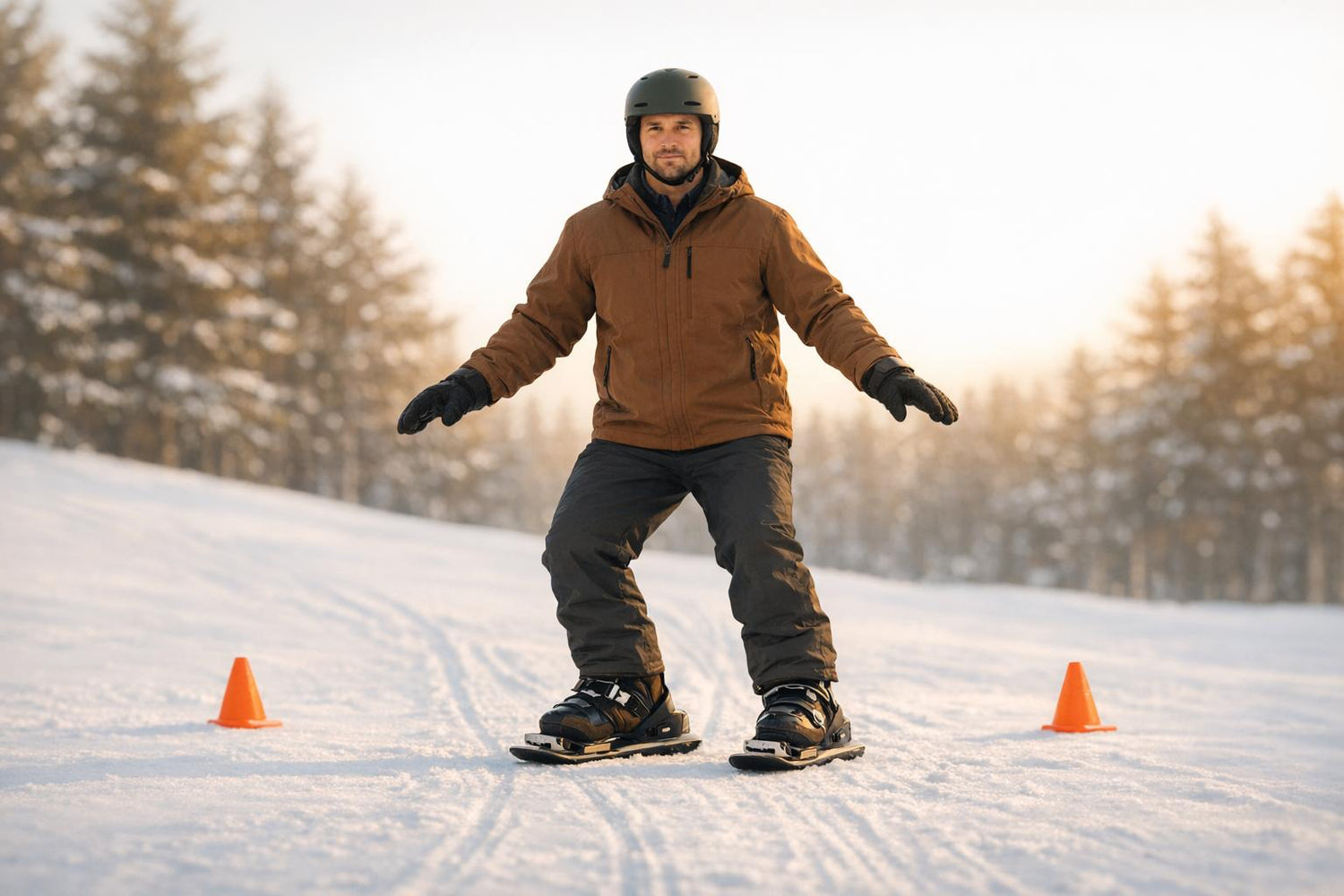
Balance is the foundation of skiskating success. To glide smoothly and avoid common issues like wobbling or leg fatigue, mastering body alignment, weight distribution, and stability drills is key. Here’s what you need to know:
- Correct Stance: Slightly bend your ankles, knees, and hips. Keep your weight centered over the middle-back of the blades.
- Weight Shifting: Fully transfer your weight to one foot at a time for better control. Use the "nose-knee-toes" alignment for stability.
- Upper Body Control: Keep your torso steady, shoulders back, and arms slightly forward to maintain balance.
- Balance Drills: Practice one-foot stands, side-to-side weight transfers, and turning drills to build strength and coordination.
- Terrain Tips: Adjust your stance for slopes or narrow trails, and use safety gear like helmets and pads for confidence and protection.
How to Stand Correctly on Skiskates
Proper Skiskate Stance and Balance Technique Guide
Mastering the right stance is key to maintaining control on skiskates. Let’s break it down.
Body Position Fundamentals
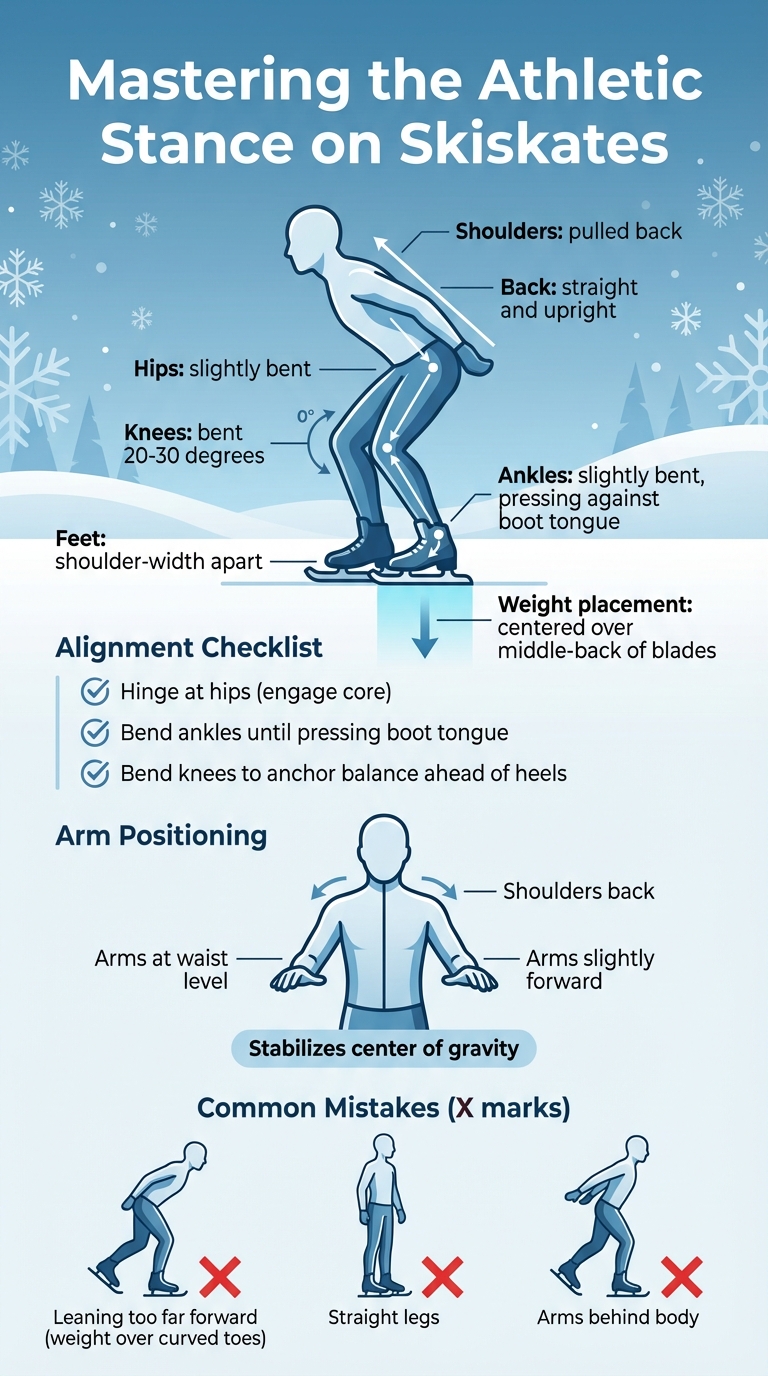
The secret to staying balanced lies in adopting the athletic stance - a go-to position for many sports because it keeps you ready to move in any direction. To get it right, keep your ankles, knees, and hips slightly bent for a stable foundation.
"An athletic stance involves a wide stance, with the ankle, knees and hip slightly bent. The arms move out to the side and slightly forward." - Morgan Engel, CSIA Level 4 Instructor
Start by placing your feet shoulder-width apart. Bend your knees about 20-30 degrees - enough to feel active but not so much that you’re in a deep squat. Straighten your back, keep your upper body upright, and pull your shoulders back. Avoid leaning forward, as this shifts your weight over the curved toes of the blades, making balance harder to maintain.
Weight placement is crucial. Aim to center your weight over the middle to back portions of the blades, just in front of your heels. This keeps you from tipping forward or leaning too far back.
Before moving, follow this quick checklist to align your body:
- Hinge at your hips while engaging your core.
- Bend your ankles until they press against the front (tongue) of your boot.
- Slightly bend your knees to anchor your balance just ahead of your heels.
This sequence ensures your body is prepped and aligned for smooth gliding.
Where to Position Your Arms
Once your lower body is set, your arms play an equally important role in maintaining balance. Keep them at waist level and slightly forward to help you make quick adjustments. This positioning stabilizes your center of gravity and prevents your upper body from tilting backward.
"Holding the upper body still is critical for balance and control in skating." - Laura Stamm, Author and Skating Expert
As you move, focus on keeping your shoulders back and your upper body steady. Avoid relying on poles for balance - they’re there to help with propulsion, not to support your stability. True balance comes from how you position your body, not from external aids.
sbb-itb-32287b2
How to Distribute Your Weight
Getting your weight distribution right can mean the difference between gliding smoothly and constantly wobbling. The trick? Shifting your weight fully - not partially - from one foot to the other.
How to Shift Weight Between Feet
Focus on transferring your entire weight to your support skate, rather than splitting it between both feet. This allows your free leg to push or maneuver without disrupting your balance.
A great way to ensure proper alignment is the nose-knee-toes checkpoint. Picture a vertical line running through your nose, the knee of your gliding leg, and your toes. Keeping this alignment ensures your skate stays upright, giving you the stability you need.
"This aligns your nose, right knee and toes vertically, which ensures the wheels remain upright rather than tilted. This is how you get full support coasting." - Liz Miller
To practice, try the "scooter" drill. Plant one foot firmly with a bent knee while pushing sideways with your other leg. Make sure your support skate stays aligned. After each push, touch the inside of your pushing knee to the inside of your support knee - this helps confirm your weight is centered. Mastering this technique is crucial for maintaining balance and control.
How to Keep Your Center of Gravity Balanced
Once your weight is fully shifted, your center of gravity becomes the key to staying steady. It’s located just above your hips and plays a big role in balance. Here’s an important fact: around 65% of your body mass is in your upper body. Even small movements in your torso can have a big impact on your stability.
"Small movements of the upper body have a disproportionately large effect on a skier's balance and the distribution of force and pressure on the skis. That's why the best skiers keep their upper bodies quiet." - Ron LeMaster, Author
To stay balanced, align your head, shoulders, and hips over your support skate. Let your legs do the work while keeping your upper body steady - think of it as using your torso for balance while your legs handle the motion. Maintain a consistent knee bend on your support leg to absorb vibrations and keep your base stable.
Balance Exercises for Skiskates
Practicing balance off your skiskates is a great way to build the muscle memory and strength needed for smooth performance. Dedicate 10–15 minutes a day to these drills to sharpen your skills and prepare your body for the slopes. Let’s dive into some specific exercises that can help.
One-Foot Balance Drill
Strengthen your ankles and improve stability with the one-foot balance drill. Simply lift one foot a few inches off the ground and hold the position for 20–30 seconds before switching legs. Keep your core engaged and maintain an upright posture - just like the body alignment techniques used in skating. Fix your gaze straight ahead to reinforce proper form.
Want to make it harder? Try closing your eyes or standing on an uneven surface, like a cushion. This adds an extra layer of challenge, mimicking the focus and ankle control needed when navigating slopes.
Side-to-Side Weight Transfer Drill
For better lateral stability, the side-to-side weight transfer drill is a must. Lay a strip of tape on the floor to act as a narrow "balance beam." Walk along the tape heel-to-toe, then mix it up with side steps or cross steps, all while keeping your core tight.
If you’re up for more of a challenge, carry a light object or add arm movements. These variations train your brain and body to stay steady on narrow surfaces, which is crucial for handling the slim profile of skiskates.
Circle and Figure-8 Turning Drill
To master directional changes, try the circle and figure-8 turning drill. Stand on one leg, extend your arms, and twist your torso left and right for 10–12 reps. This movement engages your core muscles, which are key for maintaining balance during quick turns. The stronger your core, the smoother and more controlled your turns will be on the slopes.
How to Fix Common Balance Problems
Even after practicing stability drills, you might still face specific balance challenges. These issues are common, even for seasoned skiskaters, and often have simple solutions. Below, we’ll address a few frequent problems and their fixes.
Why You Should Keep Your Knees Bent
A proper athletic stance is key, and keeping your knees slightly bent is crucial for maintaining balance. This position allows you to adjust your center of gravity as the terrain changes. As Skate Dave Skate explains:
"Keeping your knees bent helps you keep your balance by allowing you to adjust your center of gravity and can help prevent you from falling".
Think of your bent knees as built-in shock absorbers. They help you handle bumps and uneven surfaces without losing your footing. However, don’t overdo it. Ski instructor Jens Nyström advises against excessive knee bending:
"Stop obsessing over bending your knees too much... [think about] a more nuanced way to think about our joint to better manage our balance and control".
The key is flexibility and dynamic adjustment - not a deep squat. To practice, try the "hand on knees" drill: place your hands on your knees while riding, observe how your joints move, and use a small pop between turns to reset your posture.
How to Stop Wobbling
If you’re wobbling, it’s likely because your weight is too far back. Most stability issues come from insufficient forward weight distribution. When you lean back, your skiskates lose proper contact with the snow, leading to bouncing or vibrating.
The fix? Shift your weight forward. Your shins should press against the tongues of your boots, and your hands should remain extended in front of you to pull your center of gravity forward. As prarden points out:
"If you have straight legs the force just goes through them and causes your ski to judder. Relax and bend your legs at the end of the turn, legs are your suspension".
Another tip: tighten your boots. Loose boots can interfere with effective weight transfer, making wobbling worse. Avejohnp explains:
"The shin, the front of your leg, should push against the boot. The boot should be done up tight enough to transfer that pushing force, down onto the ski. The front of the ski will now push into the snow and you will not wobble about nor vibrate".
How to Turn Without Poles
Once your weight is properly balanced and wobbling is under control, you can execute smooth turns without relying on poles. Your upper body and ankles take the lead here. Rotate your torso in the direction you want to turn while flexing your ankles to engage the edges of your skates. Your hips and legs will naturally follow.
During the turn, aim to form a "C" shape with your body. Keep your hips closer to the slope while angling your upper body away. This positioning helps your edges grip the snow and stabilizes your movement. Additionally, extend your arms in front of you for balance. Even without poles, this technique keeps your center of gravity forward and improves control throughout the turn.
Balance Tips for Different Terrains and Safety Gear
How to Ride on Easy Slopes and Narrow Trails
Adjusting your balance to match snow conditions is key. On packed powder, keep your knees slightly bent and your weight centered over the balls of your feet. To initiate turns, shift about 60% of your weight to your downhill foot. For fresh snow, widen your stance to shoulder-width and lean back slightly - about 10–15° - to keep your tips from diving into the snow.
Narrow trails demand quick, active balance adjustments. Extend your arms with relaxed elbows to help counterbalance, and shift your weight side-to-side in a steady 50/50 rhythm. This approach makes it easier to handle tight paths under 4 feet wide. Maintain a responsive knee bend to make quick corrections, which can reduce wobbling by up to 30%. On groomed hardpack, a lower center of gravity with knees bent at a 45-degree angle helps improve edge grip. For icy patches, lean forward, placing around 70% of your weight on your edges to maintain control.
To build confidence, try the "slope snake drill": traverse an easy slope in a zigzag pattern at 5-7 mph, shifting your weight fully to the outside foot with each turn. Repeat this drill 10 times. For narrow trail practice, focus on riding a 3-foot-wide path for 50 yards, using your arm swings to maintain balance. Just 20 minutes of daily practice can boost your stability by 40%.
While adapting your stance to the terrain is crucial, wearing the right safety gear can further enhance both your confidence and balance.
What Safety Gear to Wear
Pairing solid balance techniques with proper safety gear is a smart move. Start with a helmet certified to ASTM F2040 standards, which reduces the risk of head injuries by 85%, according to CDC data. Add knee and elbow pads (CE Level 1 rated) to soften falls, and wrist guards to prevent fractures during unexpected tumbles. For extra protection, padded shorts safeguard your tailbone - a common impact point when trying new skills.
Wearing safety gear doesn’t just protect you; it also helps you ride with more confidence. When you're equipped with protective gear, you're more likely to experiment with deeper knee bends and bolder weight shifts without hesitation. Research shows that riders using proper gear can maintain balance 25% longer in changing snow conditions compared to those without protection. For winter conditions in the U.S., typically between 20-40°F, layering moisture-wicking base layers under your gear improves both comfort and mobility.
Conclusion
Building balance for skiskating takes consistent practice and the right techniques. By focusing on the methods outlined earlier - like one-foot balance drills and side-to-side weight transfers - you can strengthen your ankles and stabilize your core, two essentials for navigating any terrain. These foundational skills, paired with targeted exercises, set you up for success on the slopes.
"Balance is like a muscle - the more you train it, the stronger it gets." - C7Skates
When practicing, keep your core engaged and your eyes forward to mimic real skating conditions. This helps avoid the common pitfall of staring at your feet. As you improve, add challenges like balancing on unstable surfaces or closing your eyes during single-leg exercises. Combined with proper safety gear and terrain-specific techniques, these habits build confidence and control.
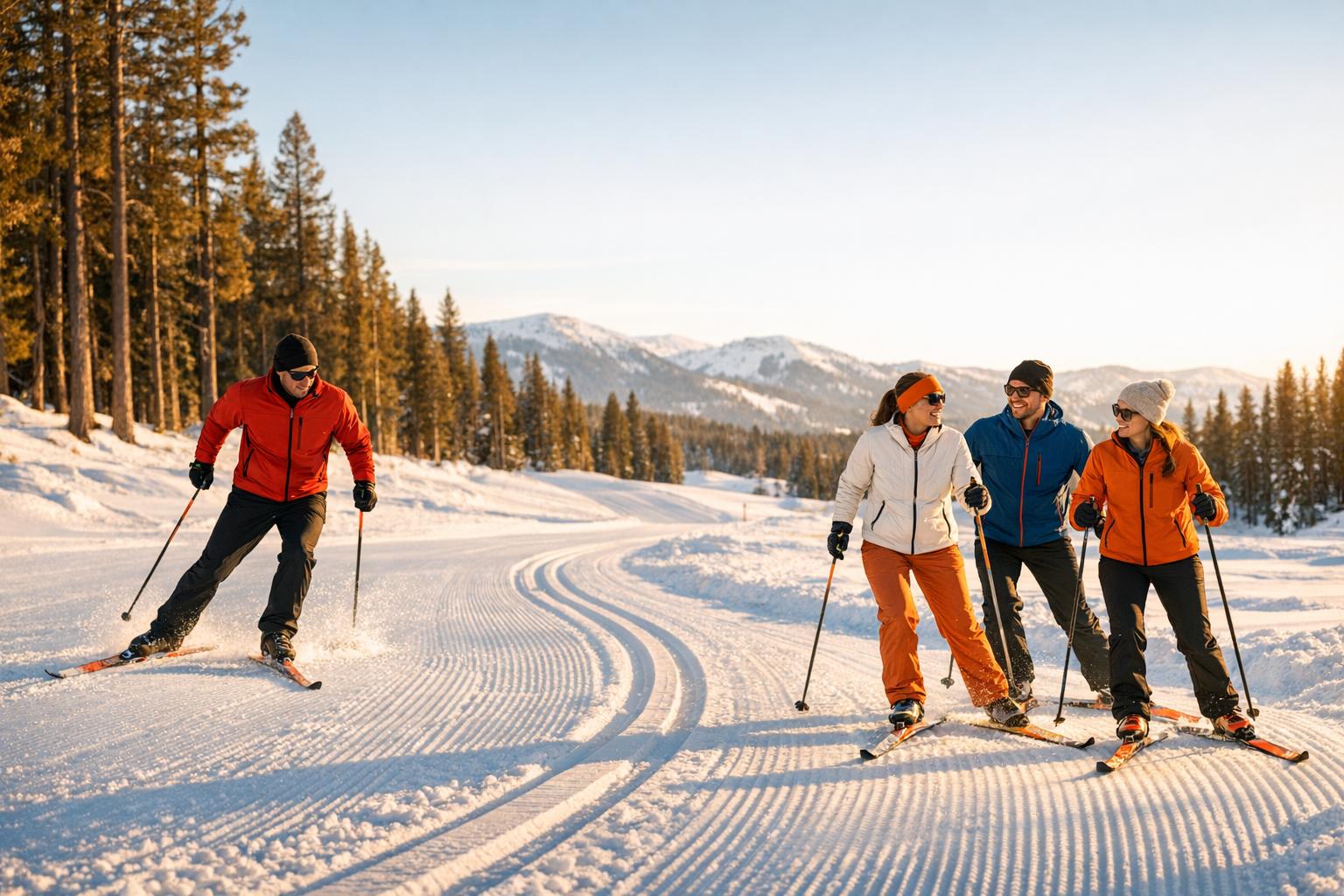
Skiskates’ compact and lightweight design makes them perfect for winter adventures. Whether you’re carving through groomed trails or tackling narrow paths, mastering balance and using the right safety gear can make your experience more enjoyable.
"With better balance comes better control, smoother strides, and way more fun on skates!" - C7Skates
The drills and tips shared here not only enhance your skiskating performance but also elevate your overall enjoyment of winter sports. Refer back to specific sections whenever you need a refresher to keep improving your skills.
FAQs
How do I know if my weight is too far forward or too far back?
To maintain proper weight distribution on skiskates, focus on your balance. Leaning too far forward can lead to a loss of control, while leaning too far back might make you unstable. Strive to keep your weight evenly distributed by adjusting your hips slightly forward or backward as needed. If you feel unsteady, fine-tune your posture until you find a stable, centered stance that allows for smoother and more controlled movement.
What’s the fastest way to build skiskate balance if I’m a beginner?
The fastest way to improve your skiskate balance as a beginner is to stick to simple drills on flat, smooth ground. Start with one-footed glides while practicing shifting your weight directly over each skate. Pay attention to your posture: keep your nose, knees, and toes aligned over your supporting skate. With consistent practice and the right safety gear, you'll build stability much faster.
How should I adjust my stance for icy snow versus deep powder?
To handle icy snow, maintain an upright and centered posture. This helps you stay balanced and react quickly on slippery terrain. For deep powder, lean slightly forward and shift your weight toward the front. This adjustment improves your ability to float and maintain control in the snow.
Remember: upright and centered for icy conditions, forward-leaning for deep powder.

Leave a comment
This site is protected by hCaptcha and the hCaptcha Privacy Policy and Terms of Service apply.