

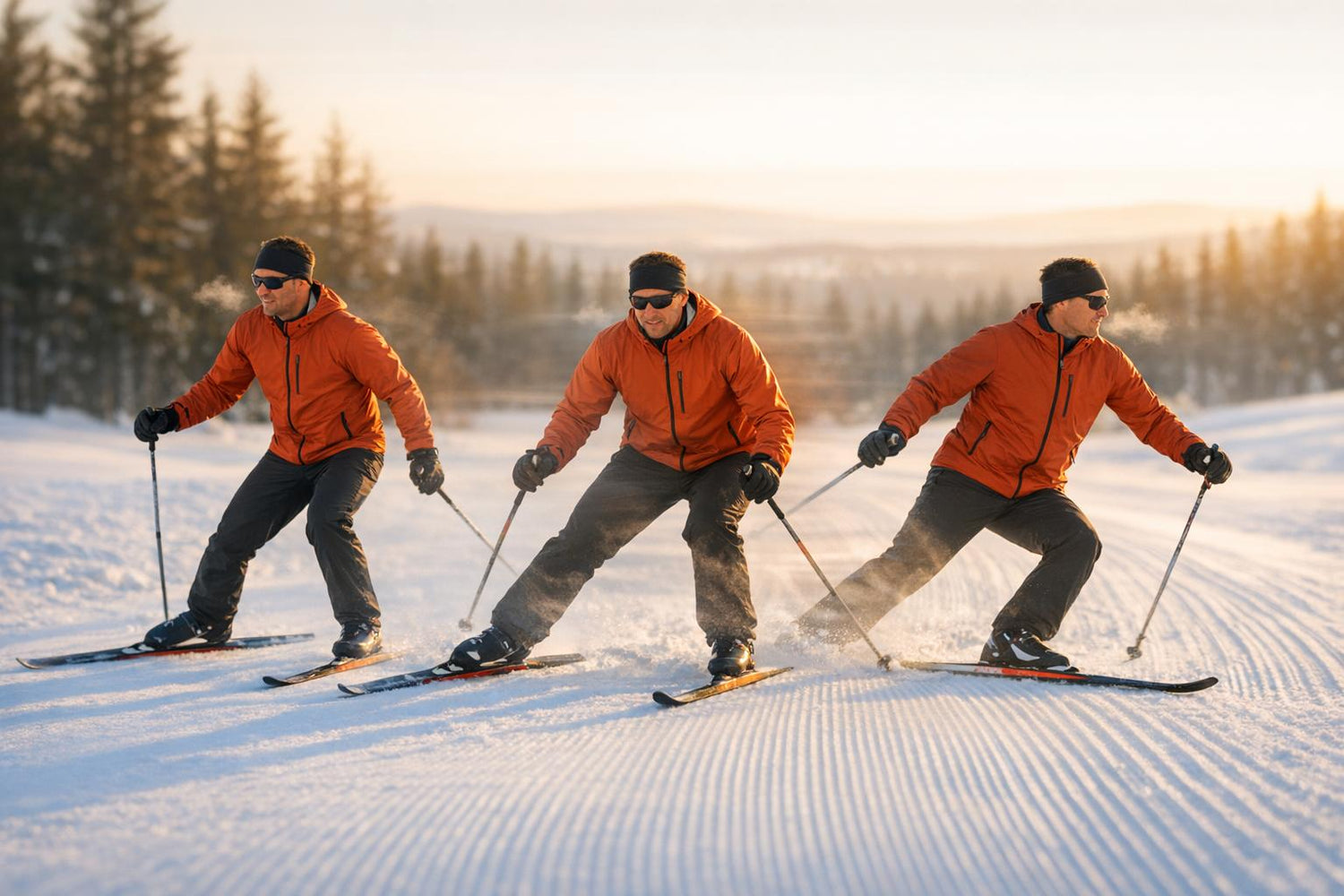
Yes, you can learn skiskating basics in one day! Skiskating combines skiing and ice skating using short, lightweight skis called Skiskates. Here's what you can achieve in just one day:
- Morning: Master balance and gliding on flat terrain.
- Late Morning: Learn speed control using the snowplow technique and practice basic turns on gentle slopes.
- Afternoon: Link turns smoothly on green runs and develop a steady rhythm.
- Late Afternoon: Build confidence with simple tricks, like side-slipping and hop steps.
Your success depends on factors like your fitness level, previous skiing or skating experience, and slope conditions. Beginners benefit from professional lessons for faster progress, but self-guided practice allows for a relaxed pace. Safety gear, proper clothing, and a warm-up are essential for a safe and enjoyable experience.
How to Ski in a Day | 20 Tips
sbb-itb-32287b2
Gear and Preparation Before You Start
Having the right gear before hitting the snow can make all the difference - especially on your first day. A proper setup ensures you can focus on learning rather than dealing with discomfort or safety concerns.
Choosing the Right Skiskates Model

Skiskates come in two versions: one tailored for ski boots and another for snowboard boots, both priced at $490. Choosing the right model is straightforward - just select the one that matches the boots you already own. Both versions share key features, including adjustable, tool-free bindings, a lightweight design, and a compact size that easily fits into a backpack. This portability saves you from lugging around bulky gear.
For beginners, softer boots are recommended. Men should look for boots with a flex rating of 60–80, while women should opt for 50–70. These softer boots make turning easier and help reduce fatigue. Avoid stiffer boots (120+), as they require more precise control and can be challenging for beginners to manage.
Once you have the right skiskates, the next step is ensuring safety with proper protective gear and clothing.
Protective Gear and Winter Clothing
Falling is part of the learning process, so protective gear is non-negotiable. Start with a helmet that meets safety standards like ASTM, CPSC, or EN-1078 for reliable side-impact protection.
Equally important are wrist guards, as wrist injuries are the most common among skaters. Why? People instinctively brace themselves with their hands during a fall.
"Wrist guards redistribute impact force, reducing fracture risks." - Recto Skates
Padded impact shorts (also called fall pants) are great for protecting your hips and tailbone during those inevitable hard landings. Add knee and elbow pads to shield your joints and allow for easier sliding on snow without skin abrasions.
When it comes to clothing, layering is key. Start with a moisture-wicking thermal base layer, add an insulating mid-layer, and finish with a waterproof outer shell to keep you warm and dry. Don’t forget gloves to protect your hands from cold burns.
Warm-Up Before Hitting the Slope
A proper warm-up can prevent injuries and help you feel ready to tackle the slopes. Spend 10–20 minutes loosening up your muscles before starting.
"Taking 5–20 min to warm up and stretch (dynamic) before lacing up your skates can help prevent injury as well as help you mentally prepare for your skating session." - Stephanie Siclari, Figure Skating Coach
Begin with 5 minutes of light cardio, like brisk walking or high knees, to get your heart rate up. Follow this with dynamic stretches such as walking lunges, leg swings, and ankle circles to improve balance and prepare for turning.
With the right gear, safety equipment, and a proper warm-up, you’ll be set up for success as you start learning the basics of skiskating.
A Step-by-Step Plan for Your First Day
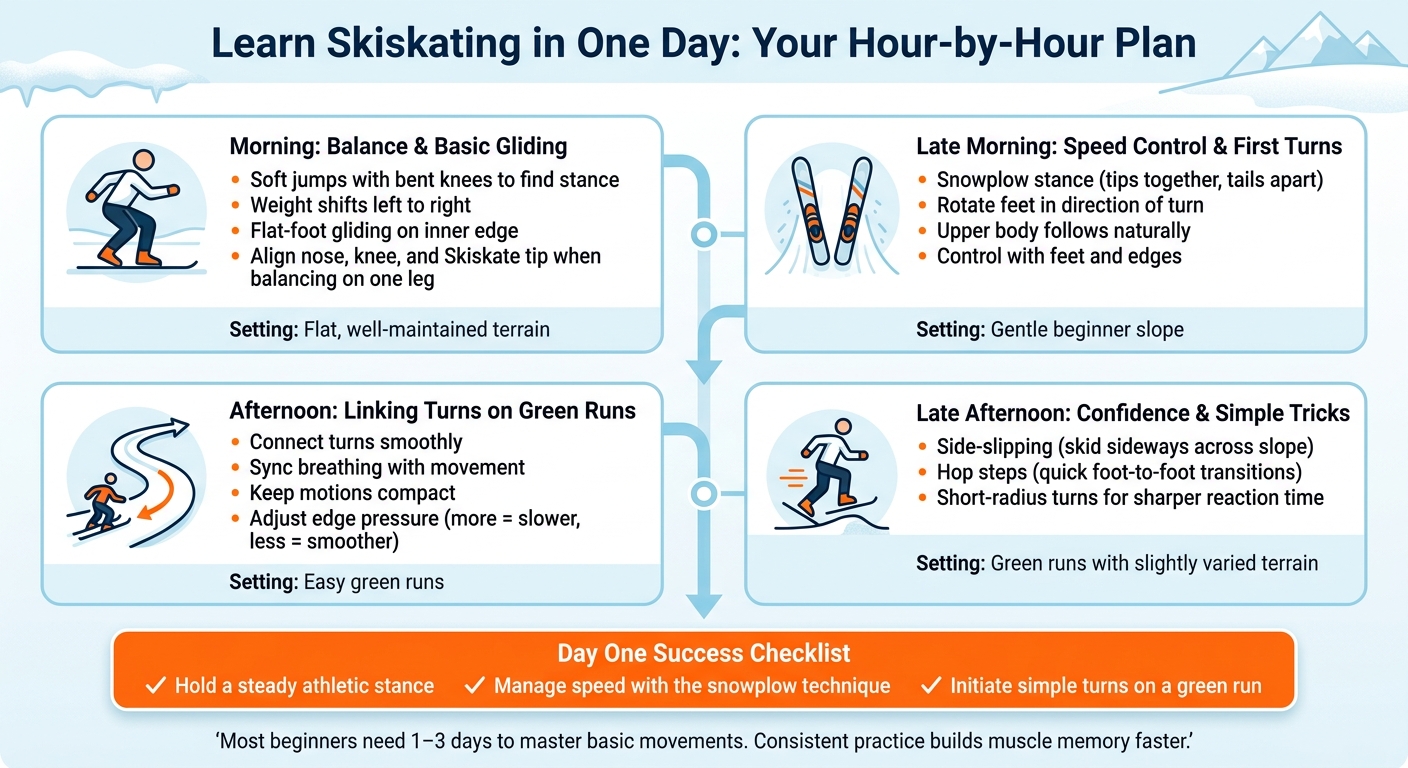
Learn Skiskating in One Day: Hour-by-Hour Beginner Plan
Your first day on Skiskates works best when you approach it step by step instead of rushing through. Each session builds on the last, so it's important to take your time and enjoy the process.
Morning: Balance and Basic Gliding
Start on flat, well-maintained terrain before attempting any slopes. Before clipping into your Skiskates, try a few soft jumps with bent knees to find a relaxed, flexible stance. Once you're clipped in, keep your ankles, knees, and hips slightly bent for an athletic posture. Standing too tall or stiff can make you unstable. As Carrie McCusker, Level 2 TrainingPeaks Coach, explains:
"A stiff, upright skier falls easily while a relaxed, poised skier absorbs terrain changes with less issue."
Practice shifting your weight slowly from one foot to the other. Aim to align your nose, knee, and Skiskate tip vertically when balanced on one leg. When you start gliding, avoid rolling from heel to toe. Instead, keep your foot flat or press through the inner edge of your Skiskate.
Once you've got the hang of balancing and gliding, move on to controlling your speed and making your first turns.
Late Morning: Speed Control and First Turns
Head to a gentle beginner slope and practice the snowplow (or wedge) stance. Bring the tips of your Skiskates together while pushing the tails apart to create friction, which helps slow you down. To make your first turns, rotate your feet in the direction you want to go, allowing your upper body to follow naturally. The key is to control the turn with your feet and edges, not by leaning your whole body.
Once you feel confident with speed control, start linking turns together on easy green runs.
Afternoon: Linking Turns on Green Runs
In the afternoon, focus on connecting your turns smoothly. On gentle green runs, work on finding a steady rhythm by syncing your breathing with your movements. Keep your motions compact - avoid large arm or leg gestures that could throw off your balance. Adjust the pressure on your Skiskates during turns: more pressure slows you down, while less pressure allows for smoother, more fluid movement.
Late Afternoon: Building Confidence and Trying Simple Tricks
With your basic turns and rhythm in place, use the final part of the day to improve agility and edge control. Practice side-slipping by positioning your Skiskates across the slope so you can skid sideways in a controlled way - this technique is especially handy on steeper terrain. Try hop steps, which are quick transitions from one foot to the other, to boost your agility and confidence. You can also experiment with short-radius turns to sharpen your reaction time.
Don't overthink this last session. Moving naturally and taking small risks is a great way to build confidence and end your day on a high note, celebrating the steady progress you've made.
Factors That Affect How Fast You Learn
How quickly you get the hang of skiskating depends on several key factors. Knowing these in advance can help you set realistic goals and make the most of your first day on the slopes.
Your Background and Physical Condition
If you’ve tried ice skating, inline skating, or skiing before, you’re already a step ahead. These activities help train your body for lateral movement and edge control - both essential for skiskating. That said, being generally fit doesn’t guarantee you’ll adapt quickly.
"Even individuals that are active and fit in one sport can have difficulty with a new activity that requires the use of different muscle groups." - Dr. Jessica Buja, Physical Therapist
The fitness areas that matter most are core strength, balance, and lateral agility. A strong core helps you maintain balance and move your legs independently, while single-leg balance and lateral agility are crucial for shifting your weight smoothly from one foot to the other on uneven snow. Endurance also plays a part, as it lets you practice longer and pick up skills faster.
Want to prep before you hit the slopes? Exercises like lateral hops, single-leg stance holds, and low plank hip dips are excellent for building the strength and agility you’ll need.
Terrain, Snow, and Weather Conditions
The slope you choose on your first day is more important than you might think. Wide, groomed green runs with a gentle gradient are ideal - they give you room to practice and recover from mistakes without too much pressure. On the other hand, narrow or crowded trails can make it harder to focus on your technique.
Snow conditions also make a difference. Packed powder or groomed corduroy (those neat ridges on freshly groomed trails) provide consistent grip and predictable feedback, making them beginner-friendly. Icy patches or wet, heavy snow, however, can make edge control trickier and increase the chances of slipping. If possible, aim for morning runs when the snow is freshly groomed.
As for weather, clear, calm days are best. Wind or poor visibility can add stress and distract you from learning the basics.
Finally, how you approach learning - whether on your own or with an instructor - can significantly impact your progress.
Self-Guided Practice vs. Taking a Lesson
Your learning method is another critical factor. Both self-guided practice and professional lessons have their benefits, but they lead to different outcomes, especially on your first day.
Professional lessons offer a structured approach, guiding you through posture, balance, turns, and speed control. With an instructor, many beginners can progress from a basic snowplow to parallel turns in just one session. Plus, instructors can catch and correct mistakes - like leaning back too much or locking your knees - before they become habits.
Self-guided practice, on the other hand, is slower but gives you the freedom to learn at your own pace. You can focus on what feels enjoyable. As Charlotte Ogden, a retired Nordic Ski Team member, puts it:
"Just getting outside and having fun is always more important than having perfect technique."
Here’s a quick comparison of the two approaches:
| Feature | Self-Guided Practice | Professional Instruction |
|---|---|---|
| Time to Basic Proficiency | Slower; relies on trial and error | Faster; parallel turns possible in one day |
| Confidence Level | Builds gradually through personal experience | Higher; instructor manages progression safely |
| Safety & Etiquette | Higher risk of developing poor habits | Includes speed control and slope etiquette guidance |
| Technical Focus | Emphasis on fun and time on snow | Emphasis on posture, edge control, and rotation |
Each method has its strengths, so the best choice depends on your goals and how you prefer to learn.
Safety, Limits, and What Comes Next
Once you’ve got your gear in place and practiced the basics, it’s time to focus on safety and setting achievable goals. These steps will help you progress steadily and confidently.
Safety Rules and Slope Etiquette
Before you hit the slopes, it’s crucial to understand safety guidelines and proper etiquette. The National Ski Areas Association’s 10-principle Responsibility Code emphasizes that you’re responsible not only for your safety but also for the well-being of others around you. Here are some key points to keep in mind:
- Yield to others downhill: Always give the right of way to skiers and riders who are further down the slope.
- Check uphill before starting: Before merging onto a trail or heading downhill, look uphill and wait for a clear opening.
- Stop in safe spots: Avoid stopping in blind areas like behind knolls or sharp turns. Instead, pull over to a visible and safe location.
- Signal after a fall: If you’re uninjured after taking a tumble, tap your helmet to let others know you’re okay.
Fatigue is a common risk factor on the slopes. As your legs tire, your form can falter, and your reaction time may slow. To stay safe, take breaks before reaching the point of exhaustion. These precautions will help you stay in control and enjoy your time on the mountain.
Setting Realistic Goals for Day One
Your first day on the slopes isn’t about mastering every skill - it’s about laying a solid foundation for future progress. As Luca Signorelli from SkiTutor puts it:
"The key goals are to have fun, stay safe, and build confidence. If you can slide, stop, and initiate a gentle turn by day's end, you've succeeded!"
Start with wide, groomed green runs. Research shows that most beginners need 1 to 3 days to get comfortable with basic movements like balancing, stopping, and making simple turns. Focus on these gentle slopes until you feel confident in the fundamentals.
By setting realistic expectations, you’ll not only enjoy your first day but also prepare yourself for what’s next.
Planning Your Next Steps After Day One
Your first day is just the beginning, and it sets the tone for everything that follows. The good news? Yes, you can learn the basics of skiskating in one day, and that initial progress becomes the foundation for your journey ahead. Consistency is key - skiing 10 to 15 days in a single season leads to much faster improvement compared to sporadic trips spread over months. Frequent practice helps build muscle memory, making each session more productive.
Once you’re comfortable on green runs, aim to refine your technique. Start by transitioning from wide wedge turns to a wedge Christie, where your turn begins in a wedge and ends with your skis parallel. From there, you can work toward full parallel turns and eventually carving. As Charlotte Ogden, a retired Nordic Ski Team member, explains:
"The key to skate skiing fast is preserving your forward momentum and letting gravity do all of the work for you, even if you are heading up a hill."
Here’s a quick look at how your progress might unfold, from day one to long-term goals:
| Skill Category | Day One Benchmarks | Long-Term Goals |
|---|---|---|
| Control | Reliable stopping and basic speed management on green runs | Carving at higher speeds on varied terrain |
| Terrain | Wide groomed green trails | Blue/black runs, icy patches, and moguls |
| Technique | Basic gliding, wide turns, and a stable stance | Efficient carving and advanced weight transfer |
| Safety | Uphill checks before starting and correct stopping positions | Instinctive navigation of high-traffic areas |
| Endurance | 1–2 hours of active practice with frequent breaks | Full-day sessions across the entire mountain |
Conclusion: What You Can Realistically Achieve in One Day
One day is plenty of time to establish a solid starting point for your skiskating journey. By the end of your first session, you’ll likely be able to hold a steady athletic stance, manage your speed using the snowplow (or wedge) technique, and even begin making simple turns on a green run. It’s a great way to kick off your learning experience.
The right gear and preparation can make a big difference, helping you adapt more quickly. Combine that with a positive mindset, and you’ll stay motivated as you take on new challenges. Remember, it’s about enjoying the process - each glide is a step forward, and celebrating small victories, like your first smooth turn or controlled stop, will keep your spirits high.
Be careful to avoid common mistakes such as leaning back too much or keeping your legs too straight, as these can make it harder to stay in control and absorb shocks effectively. Addressing these habits early will set you up for smoother progress.
Your first day is all about laying the groundwork. Skills like balance, weight transfer, and basic speed control are the foundation for advancing to more complex techniques, like parallel turns. As Stio wisely puts it, "Skiing is about finesse, not force". With that in mind, your initial efforts pave the way for future success, proving that meaningful progress can happen in just one day.
FAQs
What should I book or plan before my first skiskating day?
Before heading out for your first skiskating adventure, make sure to secure all the necessary gear. This includes helmets, goggles, gloves, and boots, which can either be rented or purchased ahead of time. Don’t forget to dress appropriately - opt for moisture-wicking base layers, waterproof outerwear, and insulated gloves to stay warm and dry. It’s also a good idea to have a trail map or guide handy to help you navigate the slopes. By arranging these essentials in advance, you’ll set yourself up for a safer and more enjoyable experience.
How do I know which boot flex is right for Skiskates?
When picking the right boot flex for Skiskates, think about your experience level and how you like to ski. If you're just starting out, a softer flex is a good choice - it offers more comfort and makes controlling your movements easier. On the other hand, experienced skiers might lean toward a stiffer flex, which provides better power transfer and quicker responsiveness. Since Skiskates are designed to be approachable for beginners, opting for a softer flex can make balancing and learning the basics a smoother experience.
When should I move from flat practice to a green run?
When you're feeling steady with your balance and have nailed the basic movements on flat terrain, it's time to move on to a green run. By this point, you should feel comfortable controlling your speed, making turns, and coming to a stop without any issues. Tackling these gentle slopes not only boosts your confidence but also helps you gain practical experience while solidifying your skills.


Leave a comment
This site is protected by hCaptcha and the hCaptcha Privacy Policy and Terms of Service apply.