

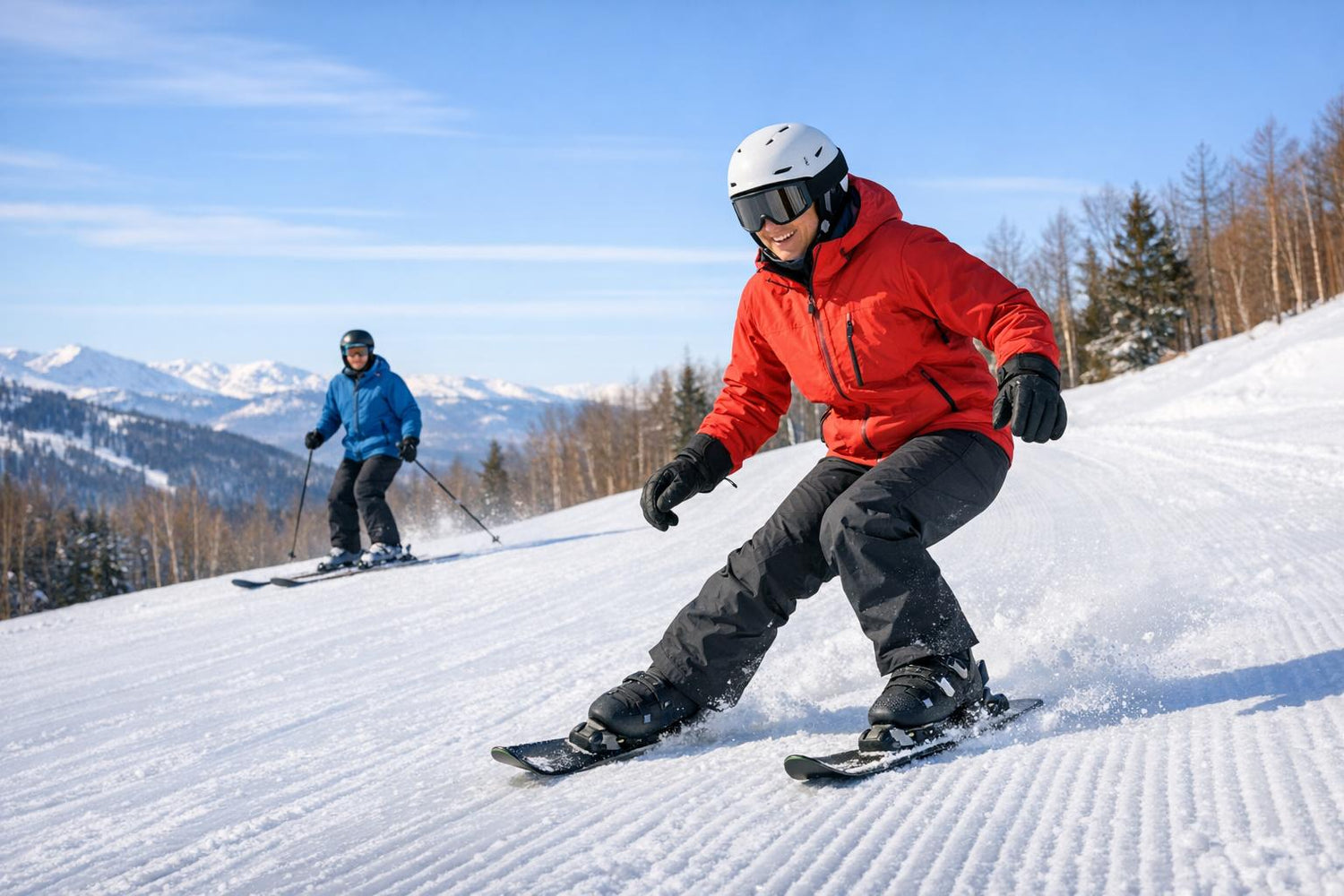
If you’ve ever felt that traditional skis are cumbersome or hard to learn, Skiskates offer a compact and user-friendly alternative. At just 17 inches long, these mini skis mimic the movements of ice skating or rollerblading, making them easier to pick up - especially for skaters and hockey players. They’re lightweight, fit in a backpack, and work with regular ski or snowboard boots.
Key Highlights:
- Size & Portability: Skiskates are 44 cm (17 inches) long, compared to skis that are 150–200+ cm. They’re light and easy to carry.
- Learning Curve: Most users feel comfortable in minutes, unlike skis which can take days or weeks to master.
- Terrain: Ideal for groomed slopes, snow parks, and narrow trails. They handle light powder but struggle in deep snow.
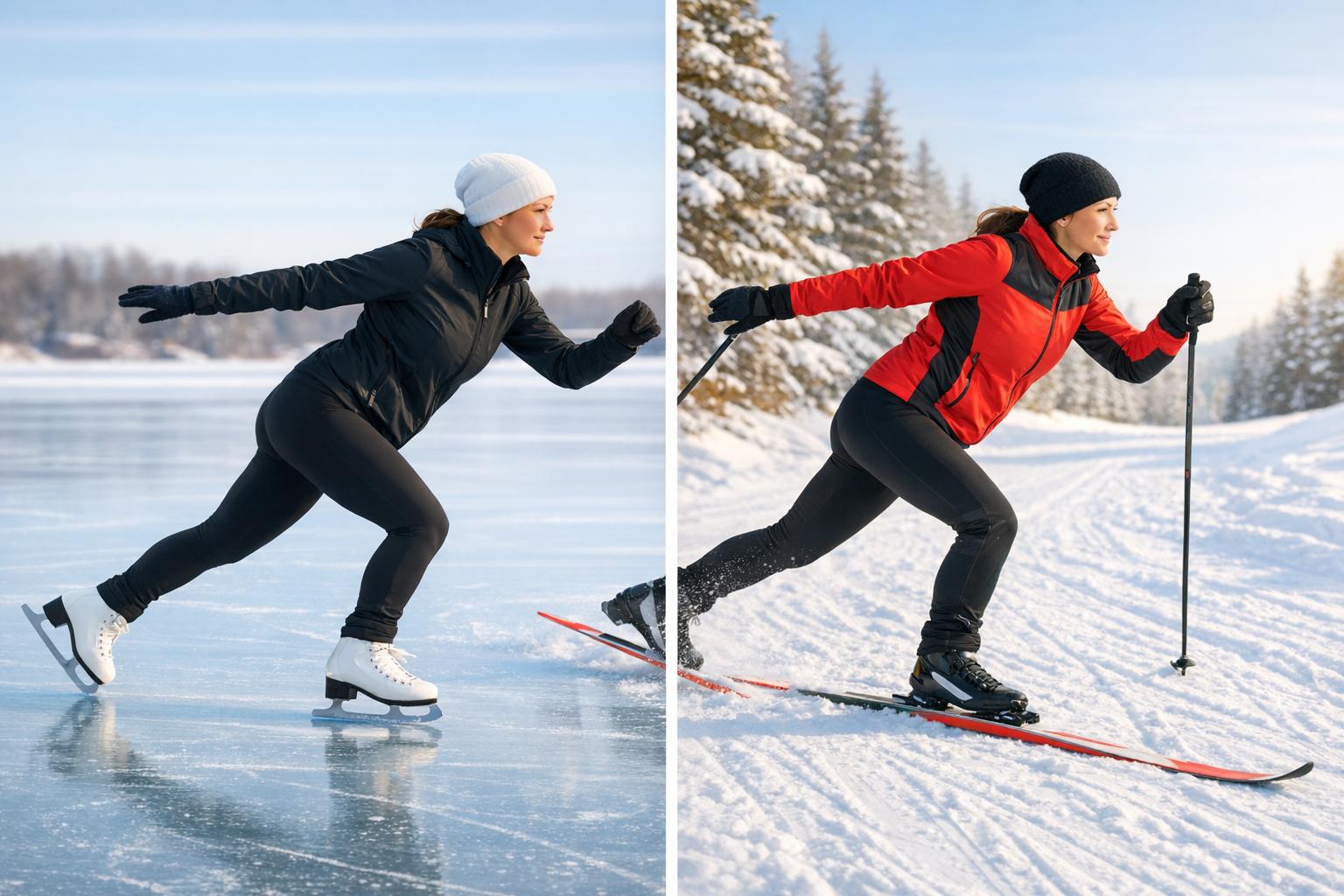
- Movement Style: Skating-like strides make them intuitive for those with skating experience.
- Price: $330–$490, more affordable than many ski setups.
Quick Comparison:
| Feature | Skiskates (17 in) | Skis (150–200+ cm) |
|---|---|---|
| Portability | Backpack-friendly | Requires roof racks |
| Learning Time | 5–15 minutes | Days to weeks |
| Best Terrain | Groomed slopes, trails | Deep powder, steep runs |
| Movement Style | Skating/hockey-like | Linear gliding |
| Price Range | $330–$490 | $400–$1,200+ |
Skiskates are perfect for beginners, freestyle enthusiasts, or anyone seeking a portable, easy-to-use snow sport option. Skis, however, remain the better choice for high-speed runs and deep powder. Your choice depends on what kind of winter experience you’re after.
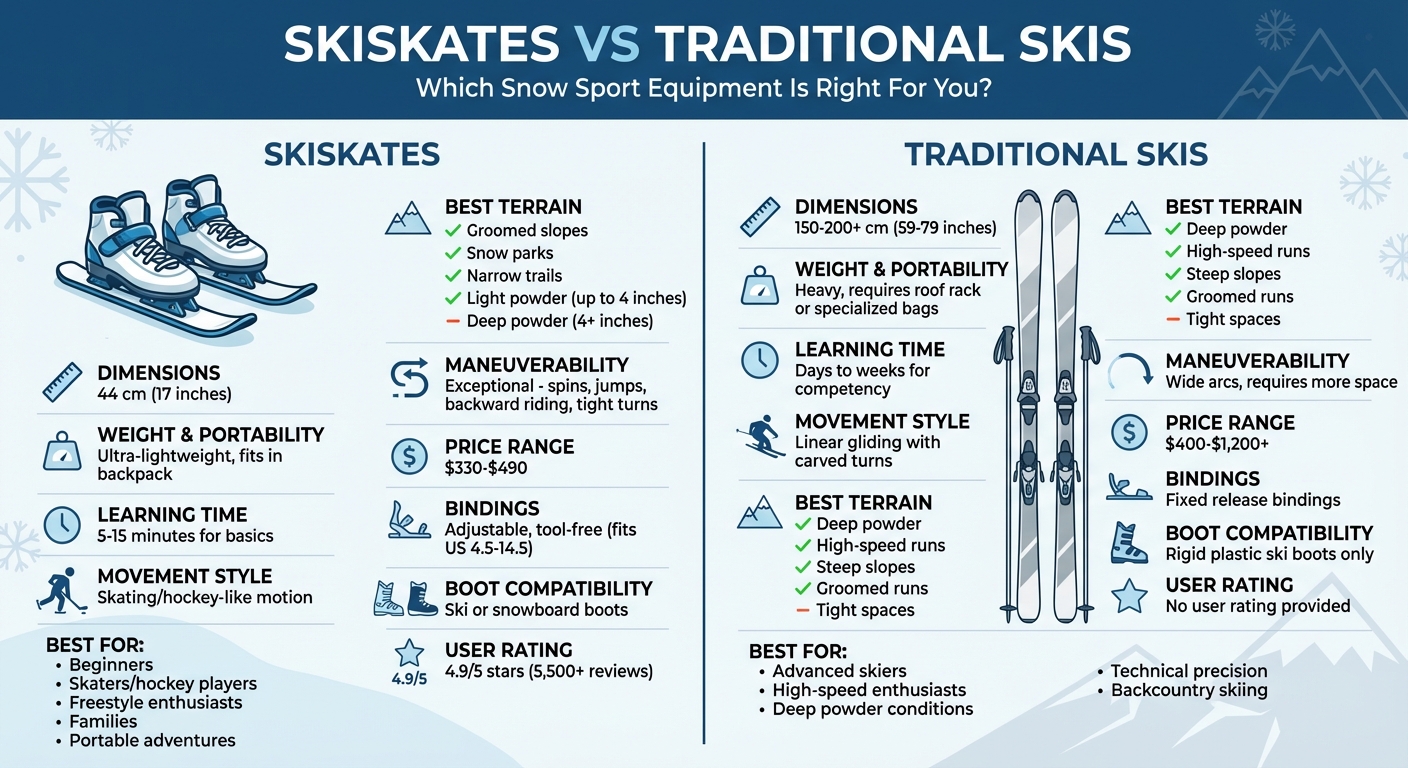
Skiskates vs Traditional Skis: Complete Comparison Guide
How similar are skates and skiboards? | Summit Friends
Skiskates: Design and How They Work
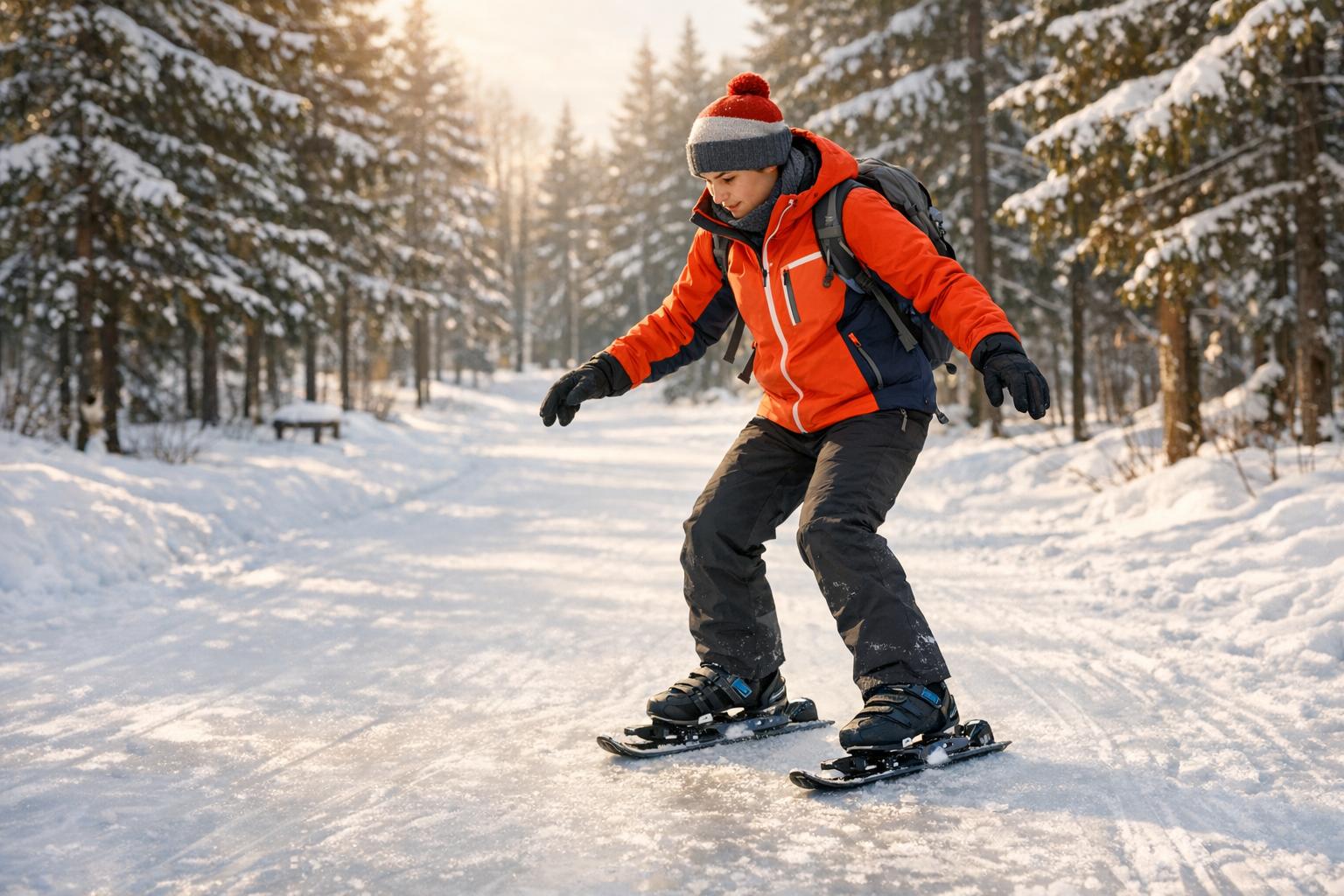
Skiskates combine a compact design with advanced ski technology, offering a skating-like experience on snow. At just 44 cm (17 in) long, these are among the shortest options available, enabling a smooth, skating-inspired motion on snowy terrain.
Their construction mirrors that of high-quality skis. A sustainable wood core serves as the foundation, encased in cap construction for added durability. Steel edges enhance carving precision on hardpack and groomed snow, while also providing a tighter turning radius. A sintered base ensures smooth gliding across various snow conditions.
One standout feature is the adjustable, tool-free binding system. Unlike traditional ski bindings that often require professional adjustments, Skiskates adopt a "one size fits all" approach. They accommodate US sizes 4.5–14.5 (EU 36–49) for ski boots and US 6–14.5 (EU 38–49) for snowboard boots. The bindings are non-release and come with safety leashes - essential for many ski resorts - offering flexibility regardless of footwear choice. Plus, the lightweight design fits easily into a standard backpack, eliminating the need for bulky carriers and making it ideal for remote trails, public transit, or simple storage.
"In my opinion, Skiskates is the best product for slopes we developed so far. I love how easy they are to ski and skate and how many different kinds of tricks I can perform without much effort." – Zbyněk, Founder, Snowfeet
The following sections explore the key features and practical advantages that make Skiskates stand out.
Main Features of Skiskates
The compact 44 cm length enhances portability while mimicking the fluid motion of ice skating or rollerblading on snow.
Steel edges on both sides provide excellent grip on icy surfaces and enable quick stops, as well as sharp carving on groomed trails.
The sustainable wood core, combined with cap construction, creates a lightweight yet responsive design. This premium construction, typically found in full-sized skis, is scaled down for a more compact experience.
A parabolic shape with a narrow waist ensures smooth, natural turns without the need for a wide stance.
These features contribute to the ease of use and remarkable maneuverability discussed in the next section.
Benefits of Using Skiskates
Quick to learn. Many users feel confident after just 5 minutes, especially those with experience in ice skating, inline skating, or hockey. The familiar motion makes it easy to transition your skills to snow.
Exceptional maneuverability. Skiskates allow for spins, reverse riding, and navigating tight spaces with ease. Each foot moves independently, giving you incredible control.
Access to more terrain. Skiskates are perfect for narrow hiking trails, forest paths, and tight backcountry areas where traditional skis might be too cumbersome.
Lightweight convenience. Carrying Skiskates feels more like carrying a pair of shoes than traditional skis. This makes chairlift rides easier and reduces the risk of injuries from carrying heavy equipment.
Versatile performance. Whether you're on groomed slopes, sledding hills, snow parks, or hiking trails, Skiskates excel on packed snow and can handle light powder up to about 4 inches deep.
With a 4.9/5 rating from over 5,500 verified reviews, Skiskates have earned consistent praise from users.
Comparison Table: Skiskates vs Traditional Skis
| Feature | Skiskates | Traditional Skis |
|---|---|---|
| Length | 44 cm (17 in) | 150–190 cm (59–75 in) |
| Weight | Ultra-lightweight; backpack-portable | Heavy; requires roof rack |
| Bindings | Adjustable, tool-free (ski or snowboard) | Fixed release bindings |
| Core Material | Sustainable wood core with cap construction | Wood, composite, or metal laminates |
| Movement Style | Skating/hockey motion | Gliding/carving motion |
| Learning Time | 5–60 minutes for basics | Several days to weeks |
| Turning Radius | Extremely tight; spin-capable | Wide arcs; requires more space |
| Portability | Easily fits in a standard backpack | Requires specialized carriers |
| Price Range | $330–$490 (wood core models) | $400–$1,200+ |
Traditional Skis: Design and How They Work
Traditional skis, typically ranging from 150 cm to over 200 cm (59 to 79 inches) in length, are known for their heavier and bulkier build. This added length provides a longer, firmer base, which is perfect for high-speed stability and handling deep powder. The larger surface area ensures better flotation in soft snow. However, this design favors smooth, sweeping turns and wide-open spaces, making it less suitable for tight, technical runs like tree skiing.
Three key design elements shape their performance:
- Camber: This upward curve in the middle of the ski helps distribute weight evenly along the edge, offering stability and excellent grip on groomed trails.
- Rocker: Found at the tips and tails, this upward curve improves flotation in soft snow and allows for quicker, more responsive turns.
- Sidecut: The hourglass shape of the ski affects how it turns. A smaller sidecut radius (under 14 m) enables sharper turns, while a larger radius (over 22 m) provides stability for long, high-speed arcs.
"Camber, rocker, and sidecut. When we design skis, these 3 elements dictate a vast amount of a ski's performance and feel on snow." – Cyrus Schenck, Founder, Renoun
The waist width of a ski also plays a critical role in determining its ideal terrain. Wider skis (over 100 mm) excel in deep powder, while narrower skis (under 85 mm) provide better control and quick edge transitions on groomed trails or icy conditions. Traditional skis are paired with rigid plastic boots and precise bindings to ensure efficient power transfer, though these boots are often criticized for being less comfortable and more restrictive compared to snowboard or winter boots.
While these design features maximize performance at high speeds and on specific terrains, they can feel less intuitive and agile compared to skiskates. Each design element contributes to the unique performance characteristics of traditional skis.
Main Features of Traditional Skis
The sidecut radius varies depending on the ski's purpose. All-mountain skis generally have a radius between 16–19 m, making them versatile for different snow conditions. Meanwhile, big mountain skis often exceed a 22 m radius, prioritizing stability for high-speed descents. The waist width further defines performance: narrower skis excel on groomed slopes with better edge grip and precision, while wider skis shine in off-piste or powder conditions, preventing the skier from sinking.
A combination of camber and rocker creates distinct ride characteristics. Camber delivers "pop" and solid edge grip on hard-packed snow, while rocker provides a "surfy" sensation and prevents the tips from diving into deep powder. Additionally, squared-off tails add stiffness and energy, enhancing power transfer during aggressive turns.
These design choices work together to deliver a unique skiing experience, tailored to specific conditions and performance needs.
Drawbacks of Traditional Skis
Despite their strengths, traditional skis come with their own set of challenges.
One major downside is the longer learning curve, which can be intimidating for beginners. The extended edges increase the likelihood of "crossed tips", a common mishap that often leads to falls. It can take days or even weeks of practice before new skiers feel comfortable and confident.
Another drawback is the physical effort required. The weight and length of traditional skis can strain the legs during long sessions, and executing turns or carving requires significant strength. Skiing for just an hour can burn between 470 and 700 calories, depending on body weight, highlighting the sport's physical demands.
Portability is another issue. With lengths ranging from 150 cm to over 200 cm, traditional skis are cumbersome to transport. They often require roof racks or specialized bags, making them inconvenient for public transit or easy storage. The accompanying rigid plastic ski boots add to the hassle, being uncomfortable for walking and awkward to wear when not skiing.
"Skiing is surprisingly daunting. If you don't believe me, try strapping two planks to your feet and hurtling down a slippery hill." – Veronika Paluch, Photographer and Skiing Enthusiast
While traditional skis deliver exceptional performance in specific conditions, their weight, learning curve, and portability challenges make them less user-friendly for casual or beginner skiers. Each of these factors plays a role in shaping the overall skiing experience.
Why Skating on Snow Feels More Natural with Skiskates
Skiskates are compact and designed to mimic the natural movement patterns of ice skating or rollerblading. Unlike traditional skis, which limit you to a straightforward gliding motion, Skiskates allow you to push off with your edges in a genuine skating stride. This eliminates the hassle of crossed tips, tangled tails, and the cumbersome feel of longer skis.
Thanks to their lightweight design, Skiskates let you lift your feet naturally with each stride, much like you would in ice hockey or inline skating. Over 40,000 skiskaters worldwide have found this familiarity makes transitioning to snow effortless. Their shorter base also unlocks new possibilities - spinning, jumping, riding backward, or weaving through tight forest paths feels as easy as skating on ice. This design blends the techniques you already know with the freedom to explore snow in a whole new way.
Easy Movements and Faster Learning
Skiskates are all about making movement intuitive and learning quick. Most users pick up the basics in under 5 minutes, a stark contrast to the days or even weeks it can take to learn traditional skiing. This rapid progress is possible because the movements mirror those of skating, something many people are already familiar with.
Good body positioning is key to this ease of use. Keeping your legs shoulder-width apart, bending your knees slightly, and leaning your upper body forward - similar to an ice skating stance - helps maintain balance. Beginners can improve stability further by placing one foot slightly ahead of the other.
Traditional skiing, on the other hand, often requires mastering complex techniques like V1 rhythms and double-poling, which can feel completely foreign. But with Skiskates, if you know how to skate, moving on snow feels second nature.
Comparison Table: Movement and Learning
| Aspect | Skiskates | Traditional Skis |
|---|---|---|
| Length | 44 cm (17 inches) | 150–200+ cm (59–79 inches) |
| Movement Style | Skating/hockey-like push-off | Linear gliding with carved turns |
| Learning Time | 5–15 minutes for basics | Days to weeks for competency |
| Turning Method | Quick steps, spins, hockey stops | Carved arcs or wedge turns |
| Physical Effort | Uses familiar skating muscles | Requires technical weight transfer and endurance |
| Balance Focus | Front-back stability (short base) | Side-to-side edge control |
| Backward Riding | Easy and intuitive | Requires advanced skill and twin-tip skis |
| Portability | Fits in a backpack | Requires roof racks or large bags |
sbb-itb-32287b2
Maneuverability and Terrain Performance
Skiskates are all about agility, especially in tight spots and tricky terrain. Thanks to their compact 44 cm length, these mini skis excel where traditional skis can’t. Whether you’re weaving through narrow forest paths or tackling winding hiking trails, Skiskates give you precise control. In snow parks, their design opens up endless possibilities for spins, jumps, and even backward riding.
On groomed slopes, Skiskates let you make quick, sharp turns with movements similar to skating. Traditional skis, on the other hand, require wider turns and more advanced carving techniques to achieve comparable maneuverability.
While traditional skis shine when it comes to high-speed stability and floating through deep powder, their length can be a drawback in confined areas. For terrains like groomed slopes, snow parks, local sledding hills, or narrow trails, Skiskates stand out for their nimbleness. This ability to handle a variety of terrains makes them a versatile choice for those looking to explore beyond the typical ski experience.
Best Terrains for Skiskates
Skiskates perform best on groomed ski slopes, where the packed snow creates the perfect surface for skating. Snow parks are another ideal playground, letting you focus on tricks without worrying about sinking into the snow. Even local sledding hills or backyard slopes are fair game, offering a hassle-free way to enjoy the winter.
Light powder, up to about 4 inches deep, is manageable with Skiskates, but anything deeper can be a challenge due to their smaller surface area. Where they truly shine is on narrow hiking trails and forest paths, allowing you to access areas that traditional skis simply can’t navigate. However, for steep backcountry terrain or powder deeper than 4 inches, traditional skis are the better option. It’s also worth noting that extremely steep slopes with big bumps or holes can be tricky for Skiskates, as their shorter base demands more active balance control.
Comparison Table: Performance on Different Terrains
Here’s a quick breakdown of how Skiskates stack up against traditional skis across various terrains:
| Terrain Type | Skiskates (17 inches) | Traditional Skis |
|---|---|---|
| Groomed Runs | Excellent - quick turns and skating motion | Excellent - stable carving at speed |
| Snow Parks | Exceptional - ideal for tricks and spins | Good - may need park-specific models |
| Narrow Trails | Excellent - easy to navigate | Poor - too long and bulky |
| Light Powder (up to 4 inches) | Good - manageable with technique | Excellent - natural flotation |
| Deep Powder (over 4 inches) | Poor - limited surface area | Excellent - designed for flotation |
| High-Speed Runs | Moderate - balance required | Excellent - built for stability |
| Tight Spaces | Exceptional - agile and responsive | Limited - wide turns needed |
| Backward Riding | Easy and intuitive | Difficult - not typically designed |
Skiskates bring a whole new level of flexibility to winter sports, making them a great choice for those who value agility and versatility over traditional high-speed or deep-powder performance.
When Skiskates Work Better Than Traditional Skis
For beginners, Skiskates are a game-changer. Their compact 44 cm length makes turning and stopping far easier than with traditional long skis. Plus, they eliminate the classic beginner headache of crossed ski tips. If you’ve got experience in ice skating, hockey, or rollerblading, you could pick up the basics in as little as five minutes. Some models even work with snowboard boots, adding an extra layer of comfort for those first snowy adventures.
Skiskates aren’t just for quick learning - they also make winter sports more enjoyable for the whole family. Their lightweight and portable design means you can toss them in a backpack and go. Adjustable bindings fit boot sizes from US 4.5 to 14.5, making it easy for family members to share a single pair. Scott, a verified user, shared his experience:
"With younger kids, I was getting tired of the same runs over and over, but these Snowfeet make all the difference. They are super fun, and spice things up even for the snowboarders out there".
For freestyle enthusiasts, Skiskates unlock a whole new world of possibilities. Their shorter length removes many of the physical limitations of traditional skis, making spins, jumps, and even backward riding feel effortless. It's the kind of freedom that fuels creativity on the snow.
And when it comes to spontaneous trips, Skiskates truly shine. Forget the hassle of lugging around bulky gear or planning for storage - just grab your backpack and head to the nearest hill. Compare this to the costs of traditional beginner setups: rentals often run about $80 for five days, and group lessons can add another $259. With Skiskates priced between $330 and $490, they offer a convenient and cost-effective alternative for winter fun.
Conclusion: Picking the Right Option for Winter Sports
Go for Skiskates if you're looking for a winter sports option that's easy to carry and feels natural to use. If you’re familiar with ice skating, hockey, or inline skating, you’ll appreciate how similar the motion feels on snow. Plus, their compact size means you can toss them into a backpack without lugging around heavy gear.
Skiskates are a great pick for beginners because they’re quick to learn. They’re also perfect for freestyle fans who love spins, jumps, and riding backward on groomed trails, snow parks, or hiking paths. You can even choose bindings that work with ski or snowboard boots, which is a nice perk if traditional ski boots aren’t your thing. On the other hand, traditional skis are unbeatable for high-speed stability and technical precision, especially on steep slopes or in deep powder conditions.
Ultimately, your decision should reflect your personal style and what you want from your winter sports experience. Over 5,500 verified reviews, averaging an impressive 4.9 out of 5 stars, highlight the freedom and control Skiskates offer. With prices ranging from $330 to $490, Skiskates provide an affordable alternative to traditional setups. If portability, smooth movement, and freestyle fun are your priorities, Skiskates are a fantastic choice. But if you’re after technical precision at high speeds or a better experience in deep powder, traditional skis are the way to go.
FAQs
Are Skiskates easier to learn than traditional skis?
Skiskates are often much easier for beginners to pick up than traditional skis. Thanks to their compact and lightweight design, they’re simpler to control, making it easier to turn and stop without much effort. Plus, unlike traditional skis, Skiskates don’t require those stiff, bulky boots, which means they’re a lot more comfortable and beginner-friendly.
Their shorter length and greater maneuverability also make it easier for newcomers to build confidence with balance and control. Traditional skis, on the other hand, often demand more advanced techniques like edging and weight shifting, which can take time to get the hang of. With Skiskates, the learning curve is smoother, letting you enjoy the slopes right from the start.
What kind of terrain works best for Skiskates?
Skiskates are engineered to excel on groomed snow surfaces, making them perfect for freshly prepared slopes. Thanks to their compact 17-inch design, they offer incredible maneuverability, allowing for sharp turns and smooth control. Their lightweight build also makes them a great choice for terrain parks, where you can easily carve, jump, and spin on features like rails, boxes, and half-pipes.
They’re also well-suited for artificial or icy snow, which is often found at resorts. Even without deep powder or challenging backcountry trails, Skiskates deliver reliable grip and stability, ensuring a fun and controlled experience.
To sum it up, Skiskates are perfect for:
- Groomed resort slopes
- Terrain parks (rails, jumps, half-pipes)
- Icy or compact snow conditions
These settings allow you to fully enjoy the natural, fluid feel of snow skating that Skiskates are designed to provide.
Can I use Skiskates with my ski or snowboard boots?
Skiskates come equipped with bindings that work seamlessly with most standard ski and snowboard boots. This means you won't need to invest in any specialized footwear - just use the boots you already have. For the best experience, make sure your boots fit snugly to ensure both comfort and top-notch performance on the slopes.

Leave a comment
This site is protected by hCaptcha and the hCaptcha Privacy Policy and Terms of Service apply.