

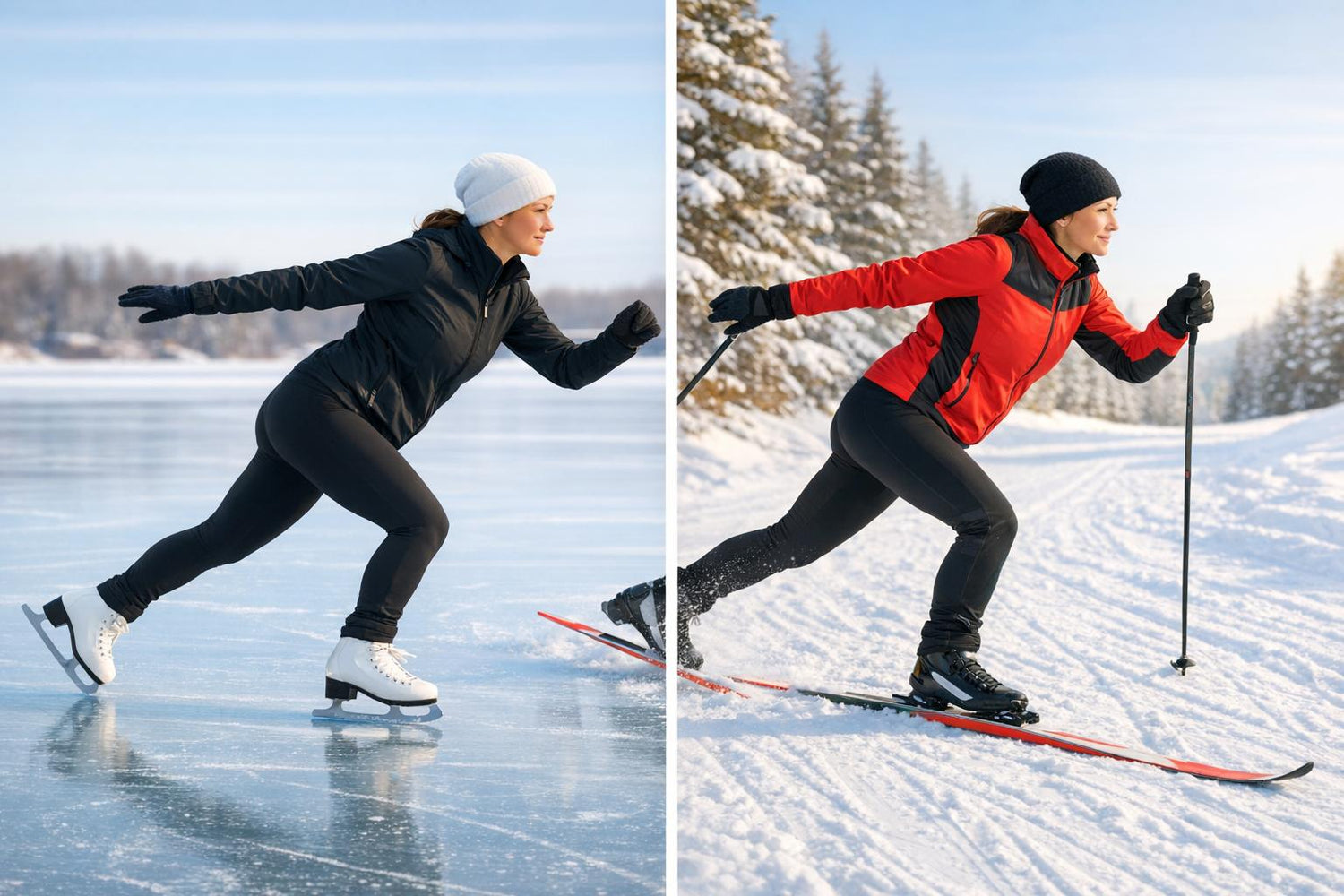
Skiskating and ice skating share a similar side-to-side motion but differ in terrain, equipment, and technique. Both require balance, core strength, and leg power, making skills transferable between the two. However, skiskating involves snow trails, poles, and longer skis, while ice skating uses metal blades on flat ice. Here's a quick breakdown:
- Similarities: Lateral push-offs, single-leg balance, core engagement, and gliding mechanics.
- Differences: Skiskating tackles varied snow terrain with poles and longer skis, while ice skating focuses on precision on smooth ice with shorter blades.
Quick Comparison
| Feature | Skiskating | Ice Skating |
|---|---|---|
| Surface | Groomed snow trails | Flat ice |
| Equipment | Short skis, poles, supportive boots | Metal blades, ankle-high boots |
| Learning Curve | Easier for ice skaters to learn | Harder for skiskaters to learn |
| Full-Body Workout | Yes, involves poles | Primarily lower body |
| Stopping | Wedge or snowplow | Hockey stop, T-stop |
Skiskating offers a dynamic workout across changing snow conditions, while ice skating emphasizes precision and speed on smooth surfaces. Transitioning between the two is easier for ice skaters, as the core techniques overlap.
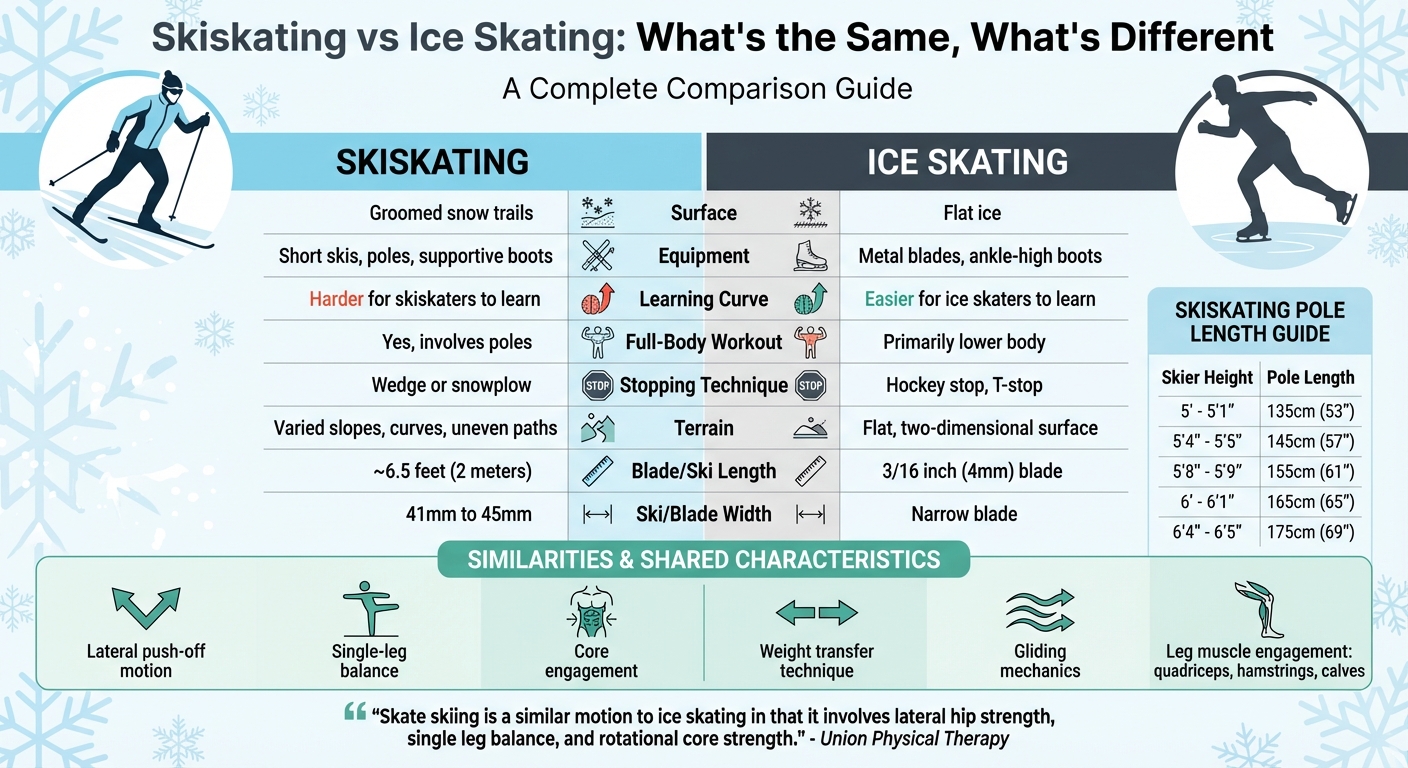
Skiskating vs Ice Skating: Key Differences and Similarities Comparison Chart
Is Skiing Similar To Ice Skating? - The Winter Sport Xpert
sbb-itb-32287b2
What Feels the Same Between Skiskating and Ice Skating
Even though skiskating and ice skating happen on completely different surfaces, they share some striking similarities. Both sports rely heavily on a lateral push-off, demanding comparable balance and muscle engagement.
Balance and Core Strength
At the heart of both activities is the need for balance and core strength. Whether you're gliding on a 3/16-inch (4 mm) metal blade or the edge of a ski, single-leg stability and continuous core engagement are non-negotiable . A strong, rotational core is especially important for transferring your weight smoothly and fully onto the sliding limb, which is essential for efficient movement .
"Skate skiing is a similar motion to ice skating in that it involves lateral hip strength, single leg balance, and rotational core strength."
– Union Physical Therapy
Your ankles and lower legs also play a major role in steering and maintaining control in both sports . For beginners, the challenge often lies in committing to the weight shift. Many keep their weight centered instead of fully transferring it to the sliding ski or skate, which can significantly reduce glide efficiency.
Gliding Motion and Speed Control
Gliding in both skiskating and ice skating depends on transferring your weight between feet. Each stride requires balancing on a single edge while the other leg pushes off . Speed builds through the same fundamental mechanics: flexing your knees and ankles to push off the inside edge.
"Being proficient and remaining balanced atop one foot is a trait shared by advanced skiers."
– Ken Knapp, REI Editor Emeritus
Even braking techniques feel alike. Both sports use the wedge or "pizza" technique - bringing the tips together and tails apart - to slow down. A wider V-shape creates more friction, giving you better control . Advanced skiskaters even incorporate an arm swing, similar to that of ice speed skaters, to maintain rhythm and balance during the glide. This precise rhythm, combined with strong leg engagement, is key to smooth and efficient movement in both sports.
Leg Muscle Engagement
Both skiskating and ice skating call for serious leg power. The quadriceps fuel the explosive push-off, while the hamstrings, calves, and ankles handle edge control and precision . A bent-knee athletic stance is crucial, providing both stability and the power needed for longer glides and maintaining speed efficiently .
What Feels Different Between Skiskating and Ice Skating
While both skiskating and ice skating share common elements like balance and gliding, the experience of doing each is surprisingly distinct. Differences in surface, terrain, and equipment create unique challenges that require specific techniques and adjustments.
Surface and Terrain
The surfaces you move on couldn’t be more different. Ice skating happens on rinks or frozen ponds, which are flat, hard, and have incredibly low friction. This allows for smooth, two-dimensional movement - forward, backward, and side to side. Skiskating, on the other hand, takes place on groomed snow trails where friction varies depending on snow conditions and temperature. This variability means you need to constantly adapt your glide and push-off.
But it’s not just the surface - terrain plays a big role too. Skiskating introduces slopes, curves, and uneven paths. Tackling these requires specialized techniques like V1 or V2 rhythms to navigate hills and turns effectively. The difference in stability is also worth noting. Ice skates have narrow blades that demand continuous ankle adjustments to maintain balance. In contrast, skate skis are much longer - about 6.5 feet (2 meters) - and distribute your weight over a larger area, offering more stability but requiring different movement dynamics. These terrain and balance factors set the stage for how gear and movement differ between the two sports.
Equipment and How You Move
The gear used for each sport fundamentally changes how you generate speed and control your movements. Ice skaters rely on the edges of their blades and leg power to propel themselves, while skiskaters use poles to engage their upper body and core for added propulsion. This makes skiskating a more full-body workout than ice skating.
Stopping techniques are also different. On ice, skaters use precise edge maneuvers like hockey stops or T-stops to shave the surface and slow down. Skiskaters, however, often use a snowplow or wedge position - bringing the ski tips together and pushing the tails apart - to create friction and reduce speed. The design of the equipment reflects these differences. Skate skis, with their alpine camber and widths of 41mm to 45mm, are optimized for efficient edge push-offs. Meanwhile, ice blades "lock" into their edges with precision, allowing for sharp, aggressive turns that skis simply aren’t built to replicate.
These equipment differences also influence how quickly someone can pick up each sport. Ice skates demand quick, precise ankle movements, while skate skis require more deliberate and broader inputs to control direction and speed.
Learning Curve and Skill Transfer
If you’re an ice skater trying skiskating for the first time, you might find the transition easier than the other way around. Ice skating skills - like balance and edge control - translate well to skiskating. However, the reverse isn’t as smooth. The longer skis and the need for coordinated pole use make ice skating feel more foreign to skiskaters.
"Skating is imo harder than skiing. If you can skate you can learn to ski pretty easily. Vice-versa not so much."
– Steve, SkiMangoJazz, SkiTalk
Terrain also plays a critical role in the learning process. Skiskaters often rely on the V1 rhythm - coordinating pole plants with ski strides - for more than 90% of their movements on varied terrain. This technique has no direct equivalent in ice skating, which is typically done on flat surfaces. Beginners in skiskating are encouraged to start on groomed Nordic trails, which mimic the consistency of ice, before progressing to steeper slopes. Techniques like the "Herringbone", where you form a wide V with your skis for better grip, are key for tackling challenging terrain.
Tips for Switching Between Skiskating and Ice Skating
Using Your Existing Skills
If you're already comfortable on ice skates, transitioning to skiskating can feel natural with a few adjustments. The balance and weight-shifting techniques you've mastered on ice carry over seamlessly. For skiskating, focus on transferring your full weight from one foot to the other while maintaining a "stacked and stable" posture over the gliding ski. Keep your nose, hip, knee, and toe aligned, and balance on the balls of your feet. The V-shape stance, familiar from speed skating or rollerblading, will also help ease the shift.
One key difference is how you position your weight. Unlike ice skating, where you might lean back slightly on the blade, skiskating requires you to center your weight over the balls of your feet to initiate a smooth glide. Adjust your arm movements to coordinate with pole plants, allowing your arms to swing directly forward. To prepare, practice one-foot balance exercises at home (often called "carpet skiing") to strengthen your core. These skills will help you adapt to the varied and unpredictable nature of snow.
Handling Different Snow Conditions
Snow conditions can be unpredictable, requiring constant adjustments to your technique. On well-groomed Nordic trails, where the surface feels smooth like ice, you can rely on movements you're already familiar with. However, when the terrain becomes steeper or the snow softens, you'll need to incorporate the V1 rhythm - a 3-1 push-off pattern that's essential for skiskating but not used in ice skating.
For downhill sections, crouch into a balanced stance with your hands forward and knees bent to control your speed. To slow down, use the wedge technique: push your heels outward and roll your ankles inward to dig the ski edges into the snow. Unlike ice skates, skate skis lack metal edges, so you'll need to tip them slightly to create the necessary friction. On steep climbs, switch to the herringbone technique. Form a wide V with your skis, roll your ankles inward to engage the edges, and take small, deliberate steps. With these techniques in mind, having the right gear becomes just as important.
Selecting the Right Gear
The right gear can make all the difference when transitioning to skiskating. Start with boots that offer high ankle support and stiff soles to handle the twisting forces of skating. Manual bindings are a better choice than automatic ones, as they provide a stronger connection and are less likely to freeze in varying conditions.
Poles should be about 90% of your height, reaching somewhere between your chin and lips, to help you engage your upper body and core for propulsion. Lightweight materials like composite or carbon fiber are ideal for a smoother swing. Make sure your boots fit snugly but leave enough room for wool socks to keep your feet warm. As Olympic Gold Medalist Jessie Diggins advises:
"If you get boots that are way too tight, your feet will get cold, and you won't enjoy it as much"
Here's a quick guide to help you choose the right pole length:
| Skier Height | Recommended Skate Pole Length |
|---|---|
| 5' - 5'1" | 135cm (53 inches) |
| 5'4" - 5'5" | 145cm (57 inches) |
| 5'8" - 5'9" | 155cm (61 inches) |
| 6' - 6'1" | 165cm (65 inches) |
| 6'4" - 6'5" | 175cm (69 inches) |
Lastly, maintain your skate skis with regular glide waxing every 4–6 weeks to keep the bases fast and prevent them from drying out. Unlike ice skates, which rely on sharp blades, skate skis depend on a smooth, waxed base for speed and traction. Proper maintenance ensures you'll have a more enjoyable and efficient experience on the snow.
Conclusion
Both skiskating and ice skating share a foundation in the V-shaped push-off motion, precise weight transfer, and core engagement, making these skills essential for excelling in either sport. Mastering the ability to glide on one foot is a key element, whether you're navigating icy rinks or snowy trails. These shared fundamentals highlight the connection between the two activities, while also showcasing how each presents its own unique challenges.
Ice skating takes place on flat, low-friction surfaces, where even the slightest weight shift is immediately noticeable. In contrast, skiskating demands constant adjustments to technique due to varied terrain and incorporates long poles to engage the entire body.
Skills like balance, weight transfer, and edge control in ice skating can make transitioning to skiskating more intuitive - and the reverse is also true. Ice skating focuses on precision and speed on smooth surfaces, while skiskating tests your endurance and adaptability across changing landscapes. Exploring both sports not only sharpens your winter skills but also deepens your appreciation for the unique demands and rewards of each.
FAQs
What are the key differences between skiskating and ice skating in terms of equipment and technique?
Skiskating and ice skating might seem similar at first glance, but they require completely different equipment and techniques. In skiskating, you use lightweight skate skis that are shorter than traditional skis, paired with boots that have free-heel bindings. To help with propulsion, long poles are essential. Ice skating, on the other hand, involves a single blade attached to a stiff boot where the heel is fixed in place - no poles needed.
The techniques are just as distinct as the gear. Skiskating features a V-shaped stride, where you push the skis outward and use the poles to generate momentum. It's a full-body workout that keeps you moving dynamically across the snow. Ice skating, however, focuses on blade edging. Skaters glide and turn by shifting their weight and pushing off the edge of the blade, requiring a strong sense of precision and balance. While skiskating feels like an energetic, snow-packed workout, ice skating is all about smooth, controlled movements on an icy surface.
What skills can you carry over from skiskating to ice skating?
Many of the skills you develop in skiskating transfer seamlessly to ice skating, making it easier to switch between the two. Both sports emphasize balance, edge control, and weight transfer - essential techniques for maintaining stability and control. Whether you're gliding on skiskates or ice, keeping a low center of gravity, staying relaxed, and smoothly shifting your weight from one foot to the other are critical for mastering both.
Edge control is another shared cornerstone. On skiskates, you push off using the inner edge, while on ice, you use both the inside and outside edges of the blade for turning and stopping. Techniques like the hockey stop or carving turns feel strikingly similar, making it easier to carry over these movements between the two.
The dynamics of turning and gliding also overlap. For example, executing a slalom turn on skis or a parallel turn on ice involves comparable patterns of weight shifting and edge pressure. Once you’ve nailed these basics in one sport, transitioning to the other becomes much smoother, freeing you to focus on the unique challenges and nuances of each surface.
Why is it easier to switch from ice skating to skiskating than the other way around?
Switching from ice skating to skiskating is often smoother because many of the skills you pick up on the ice - like balance, edge control, and maintaining a steady stance - carry over naturally to skiskating. The gliding motion in both activities is similar, and ice skating helps you develop the ability to shift your weight and stay in control - two essentials for skiskating.
However, moving from skiskating to ice skating can feel like a bigger leap. Ice skating demands more precise control of the edges and quicker balance adjustments due to the rigid, unforgiving surface. These differences mean skaters often need to fine-tune their movements and sharpen their technique to handle the unique challenges of ice.

Leave a comment
This site is protected by hCaptcha and the hCaptcha Privacy Policy and Terms of Service apply.