

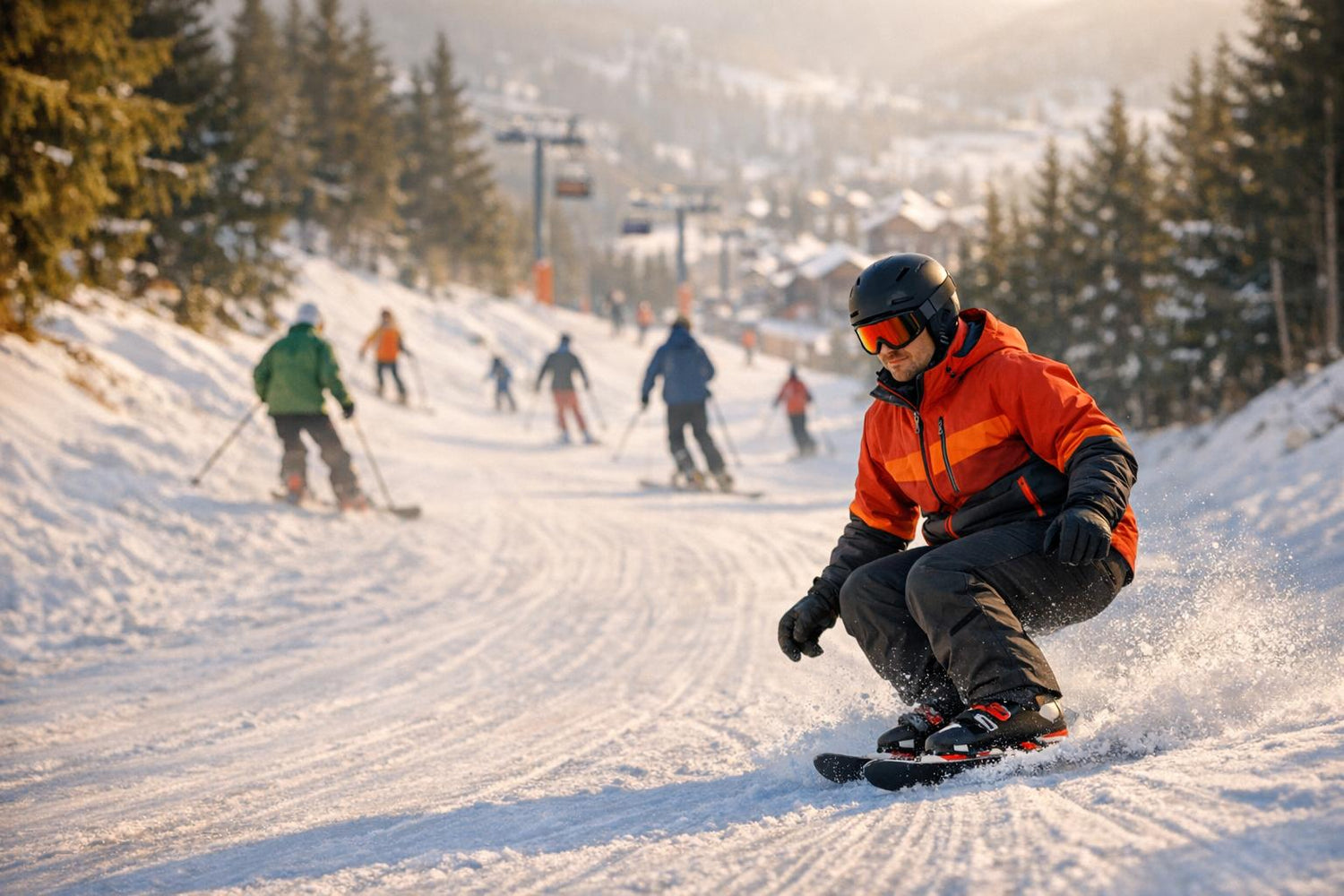
Skiskates are compact, short ski-like equipment designed for better control and agility on narrow slopes and crowded ski resorts. They range from 44 cm to 65 cm in length, making them far easier to maneuver than standard skis. Their lightweight build enhances responsiveness, allowing for quick turns and precise movements, especially in tight spaces or busy conditions.
Key Benefits of Skiskates:
- Compact Size: Easier to carry and handle, especially in crowded areas.
- Improved Control: Perfect for narrow trails with quick braking and turning capabilities.
- Lightweight Design: Enhances agility and reduces fatigue.
- Safety: Excellent stopping power and stability on busy slopes.
Mastering skiskates involves maintaining a forward stance, using flexibility for smooth movement, and practicing braking and turning techniques. They’re a great option for navigating steep or crowded terrain while keeping skiing fun and controlled.
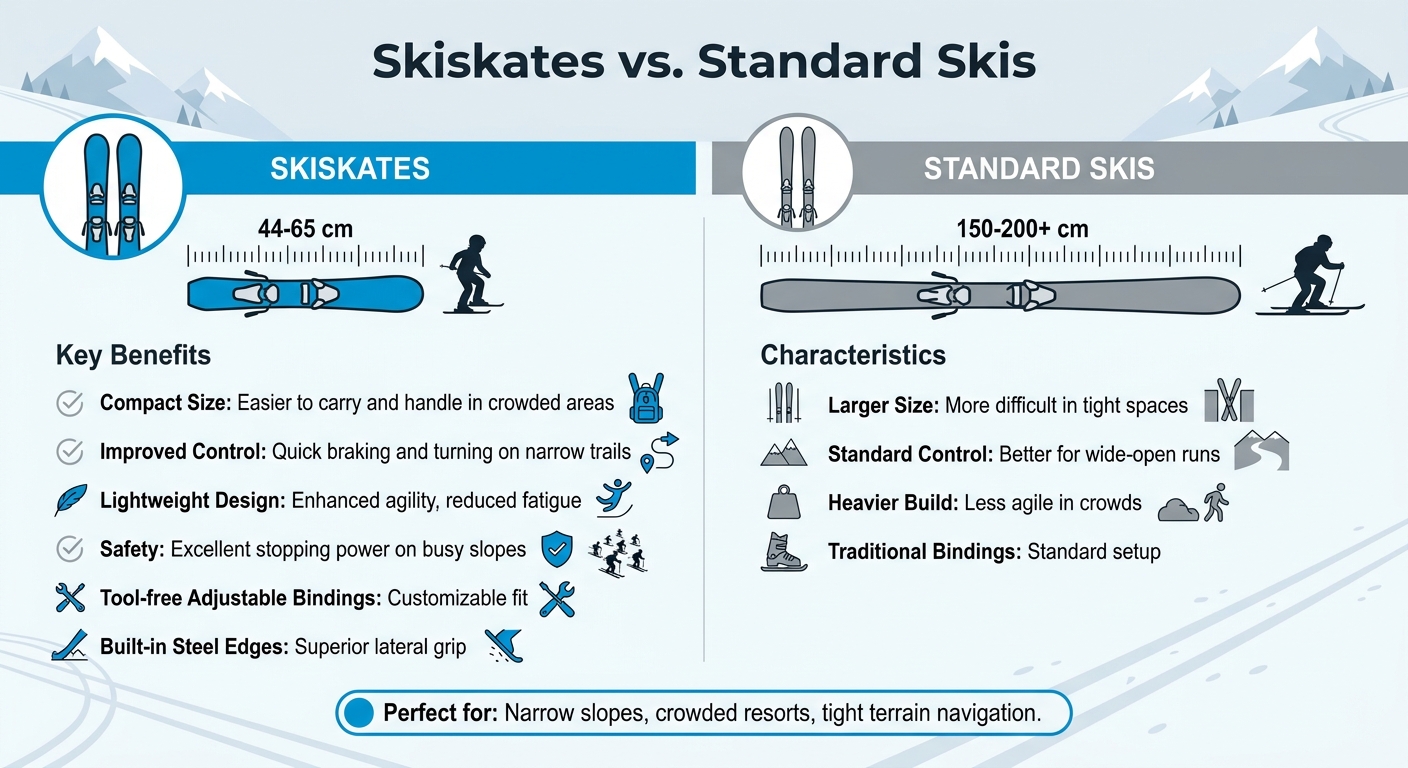
Skiskates vs Standard Skis: Size and Benefits Comparison
How to ski narrow trails | Skiing narrow slopes with more confidence | Narrow trail skiing with ease
sbb-itb-32287b2
Balance and Control on Narrow Slopes
Navigating narrow slopes calls for a different mindset compared to wide-open runs. Success here hinges on mastering body positioning and weight distribution. Aim to keep your balance centered over the balls of your feet. This forward alignment keeps you in control and ready to react quickly. Starting with these basics lays the groundwork for achieving the right stance and maintaining flexibility on tighter terrain.
The Right Stance for Stability
To stay stable, adopt an athletic stance: bend your knees, keep your body slightly crouched, and position your feet about hip-width apart (roughly 4–6 inches). This setup not only provides balance but also allows your legs to move independently - critical for navigating tight spaces. Extend your arms forward to help maintain stability. As Lasse Lyck puts it:
Keeping your arms away from your body and held in front of you... is absolutely decisive in helping you to keep your balance.
Avoid leaning back onto your heels, as this can lock your body and make steering difficult. Wind or nervousness might tempt you to shift backward, but staying consciously forward - eyes on the trail ahead, not your feet - keeps you in control.
Once your stance feels solid, improving flexibility can take your maneuverability to the next level.
Using Flexibility for Better Maneuverability
Bend at your hips, knees, and ankles to lower your center of gravity. This posture helps your core absorb shocks from uneven terrain while maintaining momentum. Charlotte Ogden, a former Nordic ski racer, explains:
The key to skate skiing fast is preserving your forward momentum and letting gravity do all of the work for you... you've got to bend at the ankles and knees to get your hips forward.
Controlling Speed and Direction
Once you're comfortable with your stance and flexibility, the next big step is managing your speed and direction. This becomes especially important on narrow trails or busy slopes - like Breckenridge or Vail Mountain, which attract around 1.5 million skiers every year. Skiskates, with their compact design, offer excellent agility, but your technique plays a critical role in maintaining control. Start by learning basic braking methods to keep your descent speed in check.
Snowplow and Wedge Techniques for Braking
The snowplow - commonly called the "pizza" position - is a beginner-friendly way to slow down. To execute it, push your heels outward to form a triangle shape, letting the inside edges of your Skiskates create friction with the snow. Want to speed up? Bring your skis closer to parallel. Need to stop more sharply? Widen the wedge. Always keep your weight forward and your knees bent; leaning back reduces your grip on the edges.
On narrow trails, avoid going straight downhill. Instead, traverse across the slope at a 90-degree angle to the fall line to naturally slow your speed. Picture a 2-meter (6.5-foot) corridor and make gradual pivots instead of wide, sweeping turns. Also, resist the urge to jam your poles into the ground to stop - it can lead to broken poles or injuries. Save your poles for controlled movements like planting them to initiate turns .
Once you've nailed braking, it's time to shift your focus to turning techniques for improved control.
Short Turns and Step Turns
Short and step turns are essential for navigating tight spaces. To master these, work on separating your upper body from your lower body. Keep your torso facing downhill while your legs do the steering. Austrian instructor examiner Benni Walch emphasizes this:
Body separation gives you more outside ski pressure, so more steering is happening and you'll have better speed control. This is especially important in short turns, where you have to make balance adjustments very quickly.
Instead of twisting your entire body, roll into each turn using your ankles and knees . A quick "up and forward" motion helps unweight your Skiskates, making it easier to pivot. Incorporating a solid pole plant at the start of each turn adds stability and keeps your rhythm steady . Practice these turns on gentle, confined slopes before attempting steeper or busier runs. Thanks to their shorter length, Skiskates are naturally nimble, but keeping forward pressure is key - leaning back into a "backseat" position will throw off your balance.
Using Skiskates in Crowded Resort Conditions
Navigating crowded resort slopes with skiskates demands precision and sharp awareness. Building on your speed and turning skills, skiskates shine in busy conditions thanks to their quick response, compact design, and built-in steel edges that provide excellent lateral grip. Their tool-free adjustable bindings make them adaptable to your boots, ensuring better control. To handle the chaos of a packed slope, keep your upper body facing downhill while your legs take the lead in steering. This stance improves your visibility and reaction time, helping you anticipate and respond to sudden movements around you.
Adjustable Bindings for Precision
The tool-free adjustable bindings on skiskates are key to achieving precise control. They allow you to customize the fit for your boots, enhancing how effectively you can engage the steel edges. For sharp, controlled turns, tilt your ankles and knees to transfer rotational force to the snow. Instead of skidding, shift your weight smoothly from one skiskate to the other. Need to slow down quickly? The wedge (snowplow) technique works wonders, with the steel edges providing dependable braking power - even when you're weaving through clusters of skiers near lift lines or base lodges.
Agility Drills for Quick Maneuvers
To up your game on crowded slopes, agility drills can sharpen your reflexes and movement control. Try lateral hops over a foam roller or sandbag to build coordination for quick direction changes. Agility ladder drills and box jumps are great for developing the speed and power needed for rapid maneuvers. For balance and motor control, exercises like balance board drills or single-leg stands are invaluable. As Red Bull explains:
Skiers need balance to tip their skis on edge without falling. Balance also comes into play for motor control and knowing how to move as terrain shifts.
Adding a yoga-based stretching routine can also help. Poses like the runner's lunge, pyramid pose, and standing lunge keep your muscles flexible and ready for sudden, dynamic moves on the slopes.
Advanced Techniques for Challenging Conditions
Once you're comfortable navigating crowded slopes, it's time to take your skiskating skills up a notch. Advanced techniques build on your existing balance and turning abilities, focusing on quick speed adjustments and dynamic movements. These skills are especially useful for tackling narrow, steep, or unpredictable terrain. Thanks to their compact design, skiskates are perfect for these precise maneuvers, but you'll need to work on some specific techniques to make the most of them.
Deceleration and Acceleration Techniques
Being able to stop quickly and regain speed is essential when facing tight spaces or unexpected obstacles. To maintain sharp edge control, steer your legs 180° between turns without rotating your hips. As professional ski instructor Warren Smith explains:
Ideally you should be able to steer your skis 180 degrees from the extremity of one turn and then back to the other. If you have this skill it will give you 100% control on the steeper slopes.
This technique keeps your upper body stable, preventing edge flattening and balance loss.
For edge-checked turns, push up from the balls of your feet while shifting your hips and shoulders forward. This movement lightens your skiskates, allowing for quicker transitions between edges. A strong pole plant can help stabilize your body during these transitions. To accelerate, focus on driving through your pole plants while keeping your hips forward. Nordic skier Charlotte Ogden emphasizes:
The key to skate skiing fast is preserving your forward momentum and letting gravity do all of the work for you, even if you are heading up a hill. To do this, you've got to bend at the ankles and knees to get your hips forward.
Start practicing these techniques on gentler slopes by simulating a 2-meter-wide corridor. This controlled environment helps you build the muscle memory and steering precision needed for steeper or busier terrain. Once you've mastered these core movements, adding tricks can take your skills to the next level.
Adding Tricks for Fun and Skill Development
Incorporating tricks into your practice not only makes skiskating more enjoyable but also improves your balance, spatial awareness, and edge control. Begin with switch reverts - moving smoothly from riding backward to forward - to develop centered balance and quick direction changes. Once you're confident riding switch, try T-setting 180s, where you rotate 180 degrees and land aligned. These moves sharpen your coordination and edge control.
To work on navigating obstacles and boosting your "pop", practice ollies over poles, small rails, or natural features on the slope. This skill is great for clearing unexpected bumps or debris in crowded areas. Another fun drill is the "Spin to Win" sequence, where you plan a series of spins during your run, focusing on smooth landings and maintaining your line. The steel edges on skiskates provide excellent grip, making these spins easier to control. These tricks not only add flair but also improve your performance on tough terrain, giving you the confidence to take on any challenge the mountain throws your way.
Conclusion
By honing your balance and refining your turning techniques, you're now equipped to handle narrow slopes and crowded resorts with confidence. The secret lies in independent leg steering, avoiding unnecessary hip rotation. This ensures your skis stay stable and don’t flatten out. As Warren Smith puts it:
Ideally you should be able to steer your skis 180 degrees from the extremity of one turn and then back to the other. If you have this skill it will give you 100% control on the steeper slopes.
Focus on practicing narrow turns and keeping a positive extension for quick, smooth transitions.
Skiskates are designed to shine in challenging conditions. Their compact, lightweight build and tool-free adjustable bindings make them highly maneuverable while providing secure footing for sharp, rapid pivots. These features, paired with advanced techniques, give you the confidence to navigate even the tightest slopes.
Don’t forget to rely on proven braking methods for controlled stops in high-traffic areas. Combining solid technique with the capabilities of Skiskates ensures you can confidently take on steep chutes and bustling resorts. Begin in controlled settings, then push your limits as your skills improve.
FAQs
Are Skiskates allowed at all ski resorts?
Currently, there’s no definitive rule about whether Skiskates are allowed at all ski resorts. Each resort may have its own policies, so it’s a good idea to contact the resort you’re planning to visit and confirm their specific guidelines.
What boots work with Skiskates bindings?
The information provided doesn't detail which boots work with Skiskates bindings. For accurate compatibility details, check the official guidelines or product documentation from Skiskates.
What’s the safest way to stop fast in crowds?
In crowded areas, the best way to stop quickly and safely is by using controlled techniques such as the snowplow or wedge stop. These methods help you slow down effectively while keeping control, which lowers the chances of accidents. Practicing these techniques ahead of time is crucial, so you can use them confidently when maneuvering through tight spaces or busy slopes.


Leave a comment
This site is protected by hCaptcha and the hCaptcha Privacy Policy and Terms of Service apply.