


Yes, you can start skiskating with no prior skiing experience. Skiskating uses short, lightweight skates that attach to your ski or snowboard boots, making it easier to learn compared to long skis. The movement is similar to ice skating, and beginners can grasp the basics in about 5 minutes without formal lessons. Skiskates are compact (under 5 lbs), easy to carry, and include heel brakes for added control. Starting at $190, they’re also more affordable than full ski setups.
Key Points:
- Quick Learning Curve: Basics can be learned in minutes.
- Beginner-Friendly Design: Short 44-cm skates prevent ski tips from crossing.
- Affordable: Entry-level models start at $190.
- Easy on Joints: Less strain compared to long skis.
- Versatile: Use on sledding hills, groomed trails, or slopes.
Skiskating offers a simple, fun way to enjoy winter sports without the steep learning curve of skiing. Whether you're completely new or looking for an affordable option, it's a great way to get started.
Why Skiskating Works for Beginners
Skiskates vs Traditional Skis: Beginner Comparison Guide
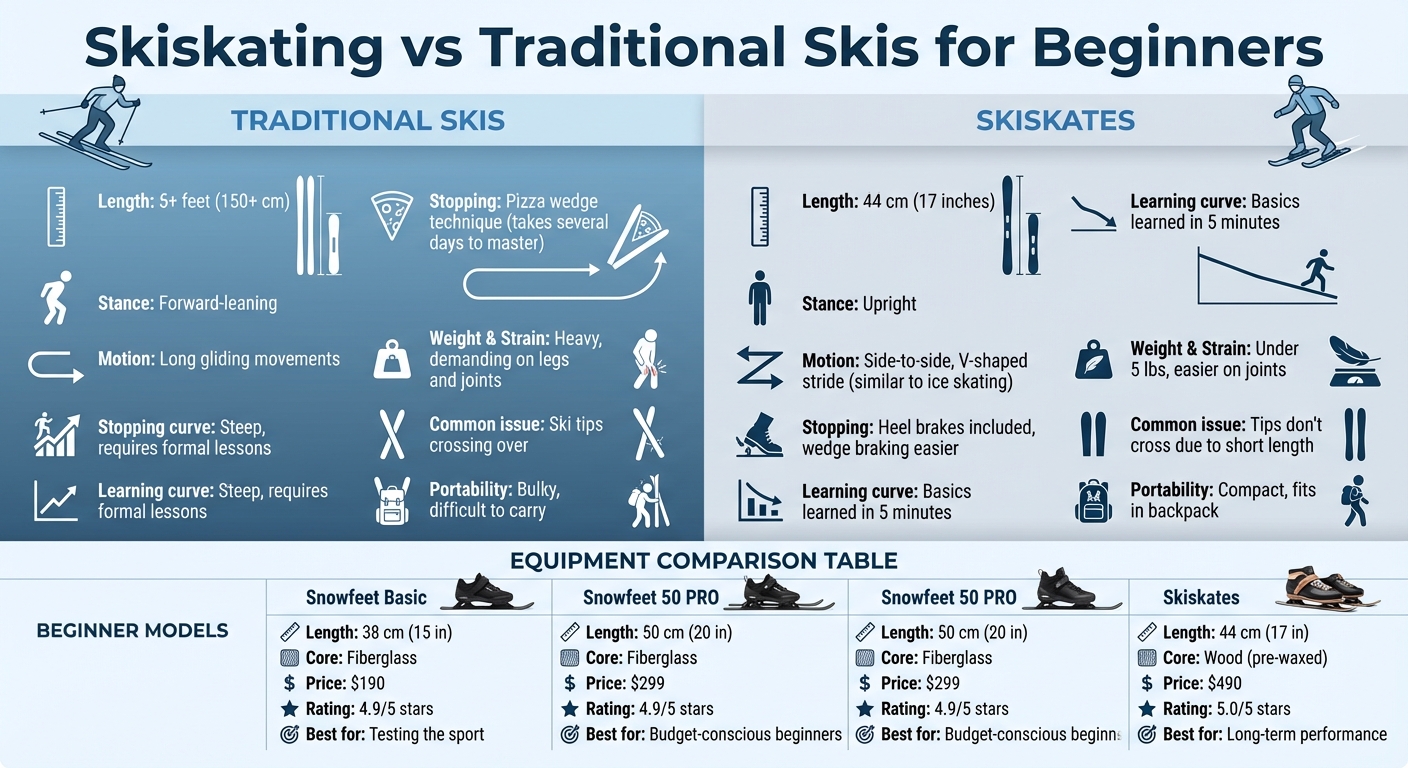
Skiskates' compact 44-cm (17-inch) length eliminates one of the biggest frustrations for beginners: ski tips crossing over. With traditional skis often exceeding 5 feet in length, managing them can feel like trying to control oversized planks, especially when you're still figuring out balance and coordination. Skiskates sidestep this issue entirely.
Their motion mimics familiar movements from ice skating or rollerblading, making the learning process much smoother for anyone with experience in those activities.
"Their short length doesn't burden your legs, increases the maneuverability and allows you to move with greater agility." - Snowfeet Team
How Skiskating Differs from Regular Skiing
The design of Skiskates introduces a fresh approach to navigating snowy terrain, breaking away from the traditional skiing style.
In conventional skiing, you adopt a forward-leaning stance, with your weight spread along the length of the skis. Stopping involves mastering the "pizza wedge" technique, where you push your heels outward while keeping the ski tips together - a skill that can take several days of practice on beginner-friendly slopes.
Skiskating, on the other hand, uses an upright stance with side-to-side motions. The shorter 44-cm length feels more like wearing skates on snow rather than managing cumbersome long skis. This natural V-shaped stride simplifies turns, requiring less effort to change direction since there’s less equipment to control.
Long skis demand significant leg strength to carve turns, especially at higher speeds. Skiskates, by contrast, are much easier on your legs and joints, allowing beginners to focus on refining their movements without the strain of heavy gear. This makes them a more approachable option for first-timers.
Why Skiskates Work Well for First-Timers
Skiskates come with tool-free adjustable bindings, so you can use your existing ski or snowboard boots without needing extra gear. Models like the Skiskates Ski Boots and Snowboard Boots versions, both priced at $490.00, are compatible with a range of boot sizes. If you already have the boots, you're ready to hit the slopes - no need for additional investment while you're testing the waters.
The wood core construction combined with steel edges ensures reliable performance on groomed trails. The steel edges provide solid grip on snow and ice, helping beginners practice proper turning techniques from the start. And as your skills improve, the same Skiskates can handle more advanced slopes or even snow parks. This beginner-friendly setup not only makes it easy to get started but also supports your growth as you gain confidence.
Mistakes are less daunting with Skiskates. Falling with long skis often leads to sprawling wipeouts, but the shorter Skiskates make it easier to regain your balance. You can start by practicing the "waddle skate" - a simple weight-shifting motion - on flat terrain. Once you're comfortable, you can gradually move to slopes without the intimidation of managing long skis.
These thoughtful design elements make it easier to learn skiskating basics and build confidence.
Equipment You Need to Start Skiskating
Getting started with skiskating begins with picking the right gear, and it’s easier than you might think. If you already have ski or snowboard boots, all you need to add is a pair of Skiskates.
For an affordable entry into the sport, consider the Snowfeet Basic, priced at $190.00. These compact 38-cm (15-inch) mini skates are lightweight, easy to pack, and rated 4.9/5. They’re a great way to test the waters before committing to a higher-end option.
Looking for better performance without breaking the bank? The Snowfeet 50 PRO, available for $299.00, is a solid choice for beginners. At 50 cm (20 inches) in length, this model offers a balance of durability and lightweight design. Keep in mind, though, that fiberglass cores like this one will need regular waxing.
If you’re ready to dive in fully, the Skiskates at $490.00 are the premium pick. Measuring 44 cm (17 inches), these skates are built for long-term use with pre-waxed wood cores and tool-free adjustable bindings that fit US sizes 6–13 (EU 38–47). With a perfect 5.0/5 rating, they’re available in two versions: Ski Boots and Snowboard Boots. Opt for the Snowboard Boots version for easier walking and all-day comfort.
Best Skiskates Models for Beginners
Each of the three beginner-friendly models comes with features designed to make learning smooth and enjoyable. These include steel edges for dependable grip, compact sizes that fit in a backpack, and compatibility with the boots you probably already own. Your decision will depend on your budget and the level of performance you’re looking for.
| Model | Length | Core Material | Price | Best For | Rating |
|---|---|---|---|---|---|
| Snowfeet Basic | 38 cm (15 in) | Fiberglass | $190.00 | Testing the sport, maximum portability | 4.9/5 |
| Snowfeet 50 PRO | 50 cm (20 in) | Fiberglass | $299.00 | Budget-conscious beginners, good value | 4.9/5 |
| Skiskates | 44 cm (17 in) | Wood | $490.00 | Serious beginners, long-term performance | 5.0/5 |
Wood core models like the Skiskates require less frequent maintenance compared to their fiberglass counterparts, thanks to their pre-waxed design. Whichever model you go with, you’ll be joining a growing community of over 50,000 skiskating enthusiasts, supported by more than 5,500 verified reviews averaging 4.9 out of 5 stars.
Once you’ve chosen your gear, you’re ready to dive into the techniques that make skiskating so much fun.
Basic Skiskating Techniques for First-Timers
First Skills to Learn
Start with an athletic stance: keep your feet shoulder-width apart, knees and ankles slightly bent, and your hips directly over your feet. This "skiing small" posture helps lower your center of gravity, giving you better control and stability. As Carrie McCusker, a Level 2 TrainingPeaks Coach, puts it:
"A stiff, upright skier falls easily while a relaxed, poised skier absorbs terrain changes with less issue".
Next, work on weight transfer. Shift your weight from one skiskate to the other, ensuring your nose, knee, and ski tip align vertically. To practice, try the "waddle skate", where you initiate movement from your hips while keeping your gaze forward. Skip the poles at first so you can focus entirely on balance and footwork.
When it comes to stopping, start with wedge braking. Push your heels outward to form a triangle, with your ski tips meeting at the front. Apply pressure to the inside edges of your skiskates to slow down or come to a stop. If you're familiar with ice skating, you can also try a hockey stop. And if you take a tumble, use the "dead bug" recovery method: roll onto your back, then to your side, and push yourself up with your hands and knees.
Once you're comfortable with these basics, you can move on to turning and managing your speed.
Learning to Turn and Control Speed
With your balanced stance in place, you can practice turning techniques. For flat terrain, use step turns: lift one skiskate, angle it in the direction you want to go, step down, and then align the other skate. For downhill sections, try wedge turns. Stay in a braking position and apply pressure to the inside edge of the skiskate on the side you're turning toward.
When skiing downhill, maintain a crouched position with a slight bend in your knees, ankles, and hips to absorb any bumps or changes in the terrain. Keep your hands out in front for balance and avoid standing fully upright, as this makes you less stable. On steeper slopes, take short steps in a wedge position instead of gliding straight down. To slow down, widen your wedge and press harder on the inside edges of your skates.
For climbing steep hills, use the herringbone technique. Form a wide "V" with your skiskates and dig the inside edges into the snow to prevent sliding backward. This method provides extra grip and keeps you moving upward with control.
sbb-itb-32287b2
How to Build Confidence and Improve
Practice Drills to Improve Your Skills
Once you've got the basics down, it’s time to fine-tune your balance and muscle memory with focused drills. Start off with the rocking drill - no skiskates needed. Simply shift your weight from one foot to the other, using your hips to guide the movement while keeping your eyes forward. This helps you master the essential motion pattern for gliding on snow.
Next, strap on your skiskates and try the split skate drill. Position your toes outward in a V-shape and move your hips forward, letting your skiskates naturally slide apart. This drill highlights how hip movement drives the glide. You can also refine your weight transfer by practicing an improved version of the waddle skate.
For a challenge, try the marathon skate drill. Here, one skiskate stays in a groomed track while the other pushes off from a flat skating surface beside it. Focus on using the "out" skiskate to propel the one in the track forward. Another great confidence-builder is the uphill no-pole drill - climb gentle slopes with your legs in a wide V-shape, concentrating on generating glide with each step rather than just walking uphill.
Using groomed trails can make a huge difference when practicing. Their smooth, even surfaces keep your skiskates aligned, reducing concerns about control by as much as 90%. Start on these trails to build confidence before tackling more difficult terrain. These drills are designed to help you feel in control and ready to explore advanced techniques.
Moving Beyond the Basics
Once you've nailed the foundational drills, it’s time to push your skills further with exercises that improve balance and agility. Experiment with fun challenges, like spinning 180 or 360 degrees while gliding, riding on one leg to test your stability, or even gliding backward in a "moonwalk" style to build comfort on the blades.
One of the standout features of skiskates is how quickly you can progress. As Olympic Gold Medalist Jessie Diggins explains:
"It's a steep learning curve. Once you get some of those skills down, you're off and skiing".
Thanks to their compact design and lighter weight, skiskates make it easier to develop skills compared to traditional long skis.
Pay close attention to weight transfer during each glide. Fully transferring your weight onto the gliding skiskate not only improves your technique but also gives your other leg a brief rest, helping to reduce fatigue. To practice this, try the "1-1-thousand" drill on flat terrain - count "1-1-thousand" as you balance and glide on one skiskate. This helps sharpen your balance and ensures proper weight transfer. Remember, your legs should be doing most of the work, contributing about 60% of your propulsion, with your arms playing a supporting role.
Conclusion
Skiskating offers an easy-to-learn experience that makes it approachable for those completely new to skiing. Its compact design and natural movement patterns help overcome many of the challenges often associated with traditional skiing, making it a great option for beginners.
FAQs
What makes skiskating different from traditional skiing?
Skiskating offers a fresh twist on winter sports, setting itself apart from traditional skiing with its unique gear and beginner-friendly approach. Instead of the long skis and specialized boots that skiing demands, skiskating relies on short, lightweight skis that easily attach to your regular winter shoes or snowboard boots. This makes them not only more manageable but also super portable - perfect for spontaneous snow adventures.
What really makes skiskating stand out is how easy it is to pick up. Traditional skiing often involves mastering tricky techniques like carving or controlling speed, which can be daunting for beginners. Skiskating, on the other hand, keeps things simple by focusing on balance and smooth gliding. This gentler learning curve means you can hit the snow and start having fun right away, making it a fantastic choice for anyone seeking a laid-back and enjoyable winter activity.
Do I need specific boots to try skiskating?
You don't need any fancy boots to dive into skiskating, but ski or snowboard boots are highly recommended. Why? They offer greater support, stability, and control - key factors that make learning smoother and safer.
If you're just starting out, prioritize comfort and a snug fit. A well-fitted pair of boots can boost your confidence on the snow and make the whole experience way more enjoyable. Many skiskaters swear that the right boots can take the fun and ease of skiskating to the next level.
How can skiskates help beginners feel more confident on the slopes?
Skiskates are an excellent choice for beginners because their shorter length makes them much easier to handle than traditional skis. This gives newcomers the chance to focus on key skills like balance, posture, and gliding without feeling overly intimidated.
Their compact design also minimizes the fear of falling, which can be a big hurdle for those just starting out. With equipment that's easier to manage, beginners can practice more comfortably, build confidence, and improve their technique step by step. This setup allows for a smoother learning curve and makes exploring new terrain feel less daunting.


Leave a comment
This site is protected by hCaptcha and the hCaptcha Privacy Policy and Terms of Service apply.