

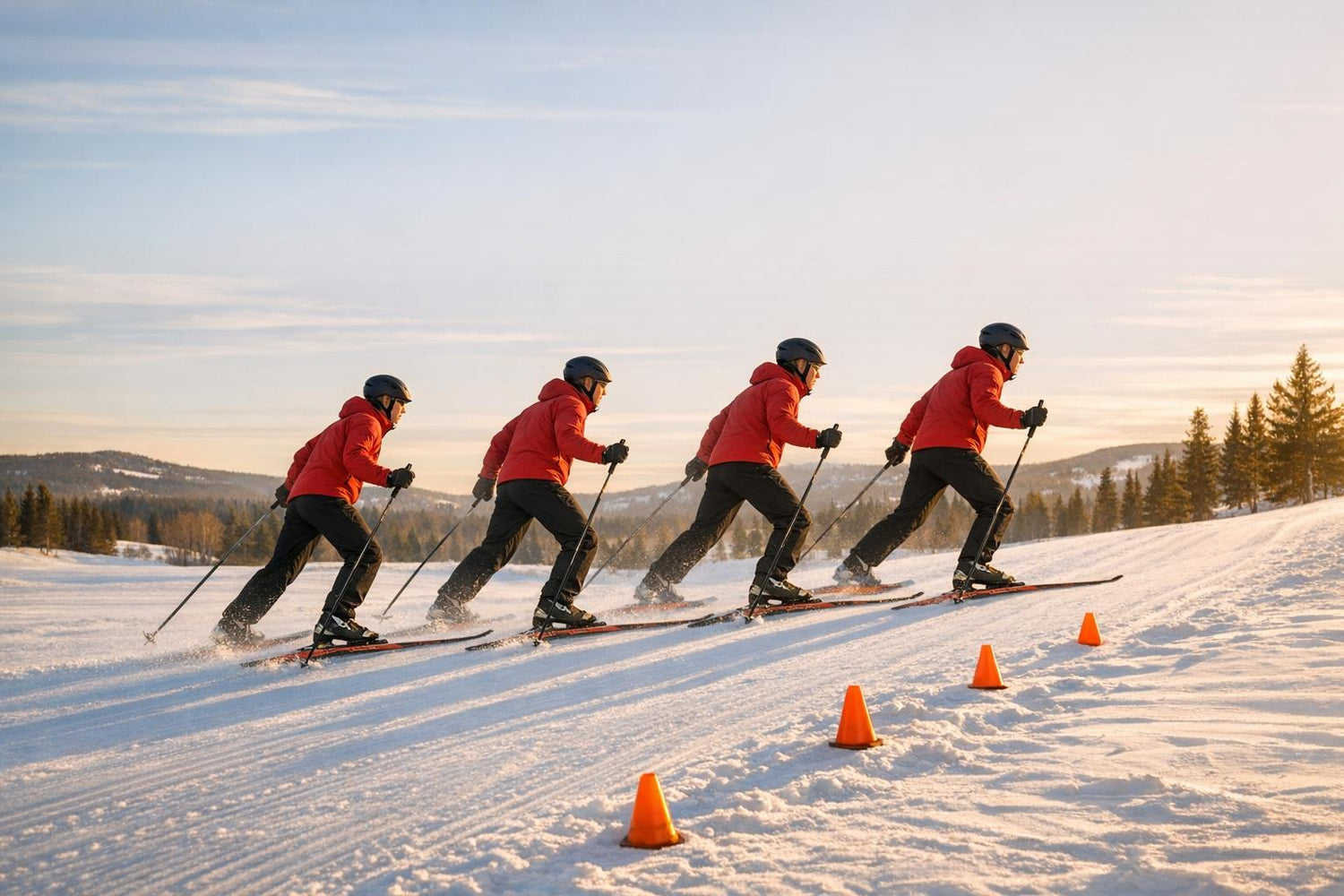
Yes, you can learn skiskating on your own. With the right gear, determination, and access to online resources, many beginners successfully teach themselves this dynamic winter sport. Here’s what you need to know:
- What is Skiskating? A hybrid of skiing and skating, skiskating uses a side-to-side “V” motion for speed and control, ideal for groomed snow trails.
- Why Self-Teach? Skipping formal lessons saves money and allows you to learn at your own pace. Observing skilled skaters, practicing consistently, and using online tutorials can help you progress.
-
Gear You’ll Need:
- Skiskates: Metal-edged models ($207–$590) for stability and control.
- Safety Gear: Helmet, wrist guards, knee/elbow pads, and gloves.
- Maintenance: Regular waxing and equipment checks.
-
Getting Started:
- Start on flat ground to practice balance and basic movements.
- Focus on a forward-leaning stance with bent knees for stability.
- Learn stopping techniques like the hockey or snowplow stop.
-
Challenges & Solutions:
- Practice safe falling and recovery techniques to avoid injuries.
- Build strength with exercises like wall sits and planks.
- Tackle slopes only after mastering flat terrain.
Online resources like video tutorials and community forums can further support your journey. Remember, the key is to enjoy the process and celebrate small wins as you improve your skills.
Required Gear for Self-Taught Skiskating
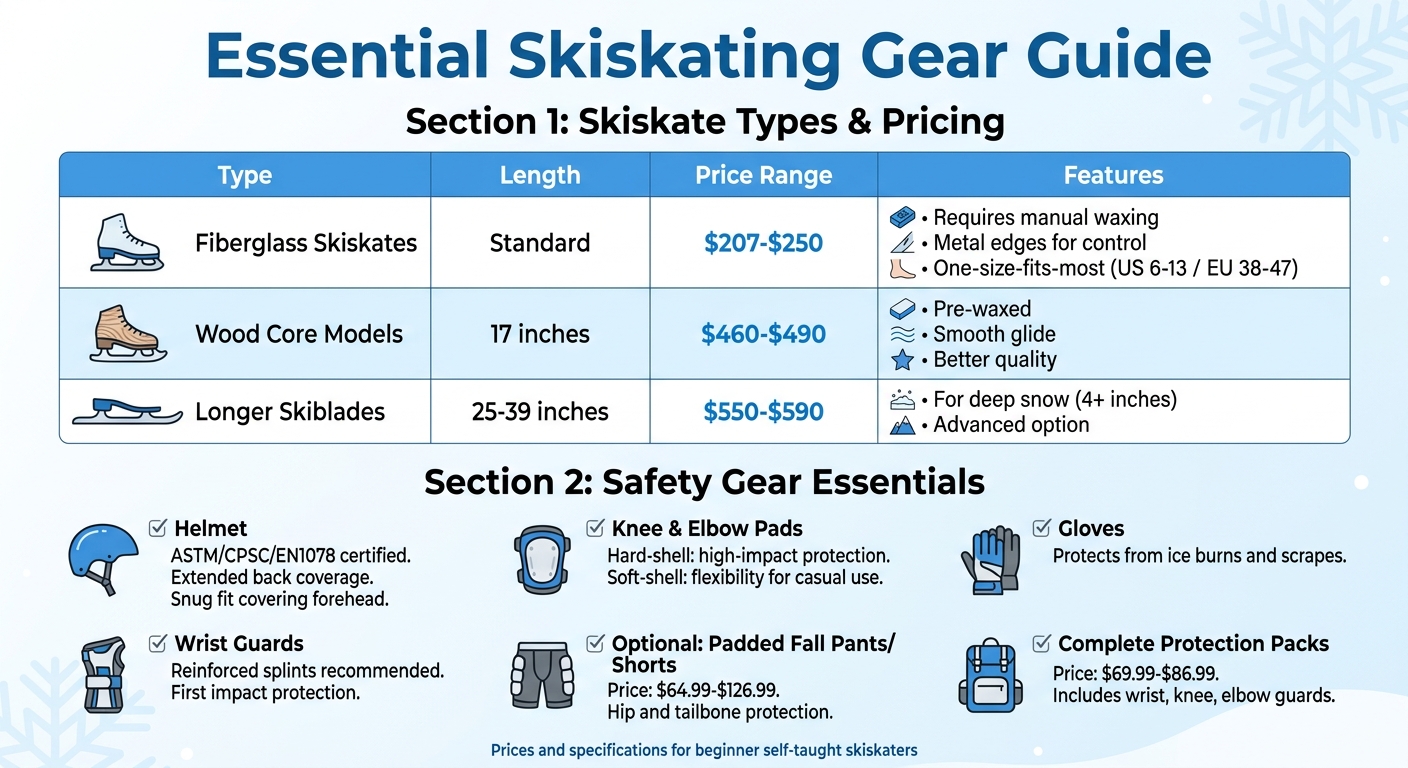
Skiskating Gear Guide: Types, Prices, and Specifications for Beginners
Having the right gear can make a huge difference when you're learning skiskating on your own. The good news? You don’t need to splurge on high-end ski boots or overly specialized equipment. Skiskating is relatively accessible, and you’ll primarily need three things: the skiskates, protective gear, and proper setup.
Choosing Your Skiskates
For beginners, adjustable skiskates are a solid choice. Look for bindings that work with winter shoes or snowboard boots. Models with metal edges are especially useful for better carving and stopping control. A compact, one-size-fits-most design is ideal, accommodating US shoe sizes 6 to 13 (38-47 EU). If you already own snowboard boots, skiskates with snowboard-specific bindings can improve flexibility and make walking easier.
Fiberglass skiskates are priced around $207–$250, but they’ll need manual waxing to ensure a smooth glide. On the other hand, wood core models, typically about 17 inches long and pre-waxed, cost between $460 and $490. If you’re planning to tackle deeper snow (over 4 inches), longer skiblades - ranging from 25 to 39 inches - might be a better fit, though they come with a higher price tag of $550 to $590.
Safety and Comfort Essentials
A certified helmet is a must. Opt for one designed for skating, with extended coverage at the back to protect the base of your skull during backward falls. Make sure it meets safety standards like ASTM, CPSC, or EN1078 and fits snugly, covering your forehead without shifting around.
Wrist guards are another essential since wrists are often the first to hit the ground during a fall. Advanced options with reinforced splints offer better protection against fractures. Knee and elbow pads are also recommended - hard-shell pads provide excellent protection for high-impact falls, while soft-shell versions allow more flexibility for casual use.
Don’t forget gloves to shield your hands from ice burns and scrapes. For extra comfort, padded fall pants or shorts can protect your hips and tailbone; these typically cost between $64.99 and $126.99. Alternatively, you can opt for complete protection packs, which usually include wrist, knee, and elbow guards, priced between $69.99 and $86.99.
Setting Up and Maintaining Your Gear
Proper setup is key. Adjust your bindings to ensure a snug boot fit, and if you’re using non-release bindings, attach safety leashes for added security. Check that your boots offer firm ankle support - if the plastic easily gives when squeezed, they likely won’t provide enough stability.
Regular maintenance is equally important. Inspect your skiskates for cracks, rough patches, or loose bindings. Fiberglass skates need periodic waxing to maintain their glide and prevent sticking to the snow. And don’t forget your helmet - replace it every few years or immediately after any significant impact, as its protective ability diminishes over time. Keeping up with these maintenance tasks not only enhances safety but also extends the lifespan of your equipment.
Once your gear is ready and properly maintained, you’ll be set to dive into the basics of skiskating.
sbb-itb-32287b2
Basic Techniques for Beginners
Practicing on Flat Ground
Start on groomed snow - it provides a stable and predictable surface. Think of skiskating as ice skating or rollerblading, but on snow. If you've ever played ice hockey or enjoyed inline skating, you'll find the movements and balance techniques familiar.
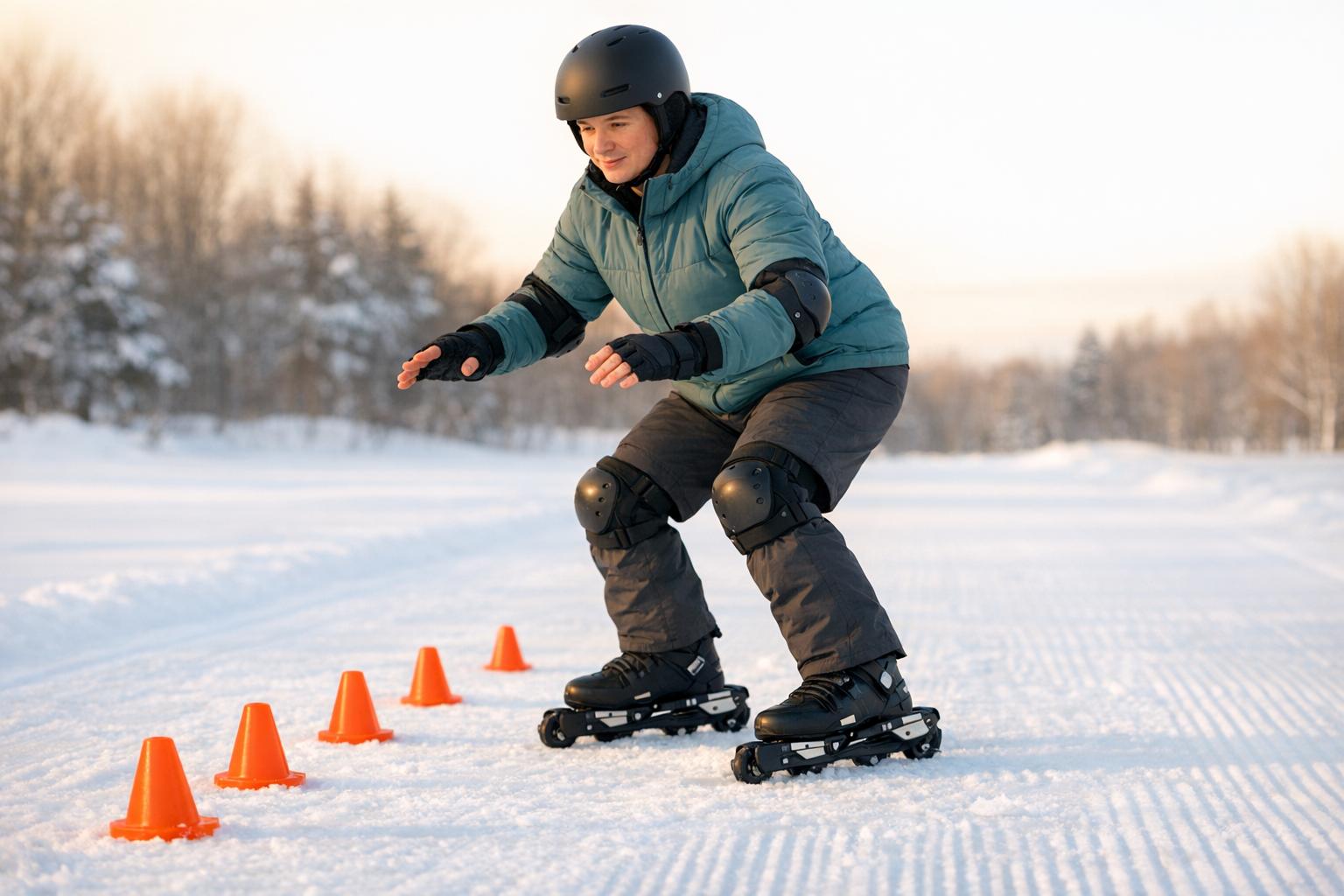
Begin by adopting an athletic stance: knees bent, a slight forward lean, and arms held at a 45° angle for balance. This position helps you absorb bumps and stay steady. Start with small steps, then gradually lift one foot to glide, followed by the other. Aim for a smooth, effortless glide.
One of the biggest hurdles? Front-to-back balance. Skiskates are much shorter than traditional skis, so it’s essential to keep your weight centered. Position your skiskates in a "V" shape, shifting your weight side-to-side. Press your knees forward toward the tips to initiate movement. And here’s a tip - keep your head up and eyes on the horizon. Looking down at your feet can throw off your balance.
Once you’ve mastered balancing on flat ground, you’ll be ready to dive into the core skating movements.
Learning Basic Skating Movements
Before anything else, learn how to stop. The hockey stop is a reliable technique: distribute your weight evenly and turn your skiskates perpendicular to your direction. Alternatively, try the snowplow stop by pressing the flat part of the blades against the snow to create friction. According to Snowfeet Store, 80% of readers found these self-taught methods effective for mastering basics like gliding and stopping.
When it comes to turns, lead with your dominant foot and lean your body toward the center of the turn. Keep your knees bent to maintain momentum. Falling is part of the learning process, so practice controlled lateral falls to protect your wrists. To stand back up, position your feet between your hands and push yourself upward. As Snowfeet Store wisely reminds us:
"Most importantly, don't forget that learning is effortless if you enjoy the ride".
Once you’re comfortable with these foundational movements, the next step is improving balance and control for smoother, more confident skating.
Improving Balance and Control
Good balance starts with proper alignment and weight transfer. Carrie McCusker, a Level 2 TrainingPeaks Coach, suggests maintaining a straight line between:
"your nose, knee, and the tip of your ski, with your shoulders squared over the ski".
Focus on shifting your weight from one foot to the other, starting with your hips. This creates smoother turns and gives you greater control than simply bending your knees.
Begin practicing without poles. This forces you to refine your glide and weight-shifting technique without relying on your arms for support. A simple drill? Try small jumps (with or without skiskates) to ensure you’re landing softly on the balls of your feet, keeping your knees bent. McCusker emphasizes:
"a stiff, upright skier falls easily while a relaxed, poised skier absorbs terrain changes with less issue".
The secret lies in staying relaxed and flexible. These exercises help you self-correct and build confidence in your skiskating skills. Stick to flat ground until these movements feel natural - then you’ll be ready to take on gentle slopes.
Common Challenges and Solutions
Handling Falls and Recovery
In self-taught skiskating, falls are part of the learning process. The goal isn't to avoid them entirely but to master falling safely and recovering quickly. A key tip is to fall sideways rather than backward and to bend forward during a fall. This protects your head and wrists while avoiding the instinct to extend your arms, which can lead to injury.
Your stance is crucial for maintaining balance and reducing the chances of falling. Leonid Feldman, a Certified Ski Instructor, emphasizes the importance of proper stance:
"To find your correct stance... stand in your boots so that the pressure from the tongue of the boot feels equally distributed from shin to calf".
By keeping your weight evenly distributed and identifying your "pitch points" - the spots where you're most likely to lose balance - you can better stabilize yourself. When tackling a slope, position your skiskates sideways across the hill to prevent sliding. Press the uphill edge firmly into the snow to create an anchor before standing up. On inclines, use small, deliberate sidesteps rather than large strides for more control and stability.
Once you've mastered safe falling techniques, improving your physical readiness will make skiskating even smoother.
Developing Strength and Stamina
Skiskating requires your muscles to work together in harmony. Kara, a Personal Trainer and Former US Ski Team Member, explains:
"Muscles that fire together wire together... if you haven't trained them to fire together in the gym... then they sure as heck won't fire together as efficiently as you want them to on the slopes".
To prepare, focus on exercises that mimic skating movements. Wall sits and planks build the endurance needed for stable positioning, while box jumps, squat jumps, and burpees develop the explosive power necessary for strong push-offs. A solid core is essential - weakness here can lead to "energy leaks", causing faster fatigue and increasing the risk of falls.
Start with a warm-up of 5 to 10 minutes to avoid soreness or cramping. Zheni Stavre, MD, advises:
"Doing a few warm-ups beforehand will help prevent soreness or cramping after you're done, as ice skating can be a workout".
Simple stretches, like leg stretches and arm rotations, are a great way to prep your body before hitting the snow. Consider following a 9- to 12-week training plan that gradually builds your strength, power, and endurance.
Approaching Slopes Safely
As your strength and balance improve, you’ll feel more confident tackling slopes. Speed control is critical for managing inclines. One effective technique is the wedge position, where the tips of your skiskates are closer together than the tails. This positioning helps slow you down or stop entirely. Keep your knees bent and maintain active pressure on the tongues of your boots - losing this contact can quickly lead to instability.
Standing too upright raises your center of gravity, making you more prone to falls. Instead, adopt a semi-sitting posture to stay balanced and absorb changes in terrain. Carrie McCusker, a TrainingPeaks Coach, highlights the importance of staying relaxed:
"A stiff, upright skier falls easily while a relaxed, poised skier absorbs terrain changes with less issue".
Keep your head up and focus on the horizon rather than looking down at your feet, which can throw off your balance. Worrying too much about falling can also disrupt your focus, so practice balance and recovery techniques on flat, low-traffic terrain before moving on to steeper slopes. This will help you build the muscle memory needed to handle more challenging conditions with confidence.
Using Online Resources for Self-Learning
Once you've got the basics down, online resources can take your skills to the next level. These tools let you learn on your own schedule, making it easier to build on what you already know.
Finding Quality Tutorials and Videos
Online tutorials make learning skating techniques more accessible than ever. For example, Nordic Ski Lab offers a comprehensive "Learn to Skate Ski" video program. It includes six courses, over 30 videos, and an impressive 40 hours of instruction. The lessons cover key techniques, demonstrated by World Cup and Olympic athletes, ensuring you're learning from the best.
The program is thoughtfully structured, starting with foundational skills like pushing and gliding, and advancing to techniques such as "One Skate" and "Offset". It also emphasizes uphill techniques like the "Diagonal Skate" early in the process, helping you avoid bad habits from the start. If you're looking for alternative resources, wikiHow offers a detailed ice skating tutorial that 80% of readers have found helpful.
Connecting with Skiskating Communities
Being part of a community can make a big difference in your learning experience. Sk8ly provides forums where you can dive into topics like "Skating Tips & Tricks", "Gear & Maintenance", and "Events & Meetups." They even have a video archive showcasing techniques in action. Similarly, wikiHow's Community Dashboard and Forums offer spaces to connect with other learners, ask questions, and share your progress.
As Sk8ly puts it:
"The best part of skating is the community".
Monitoring Your Progress
Tracking your progress is essential when learning independently, and Nordic Ski Lab makes it easy with their "Navigator" tool. This feature helps you see which courses you've completed, from "Basic Skills" to "Uphill 1", keeping you on track and motivated. These tools seamlessly integrate into your learning journey, ensuring you're always moving forward.
Conclusion
Learning skiskating on your own is entirely possible with the right approach and a focus on key techniques. Start by adopting a forward-leaning stance with bent knees and ankles to stay stable and use gravity to your advantage. Master the art of shifting your weight smoothly between skis for better control and balance.
Begin your practice on flat terrain without poles to get comfortable with your equipment. As Leonid Feldman wisely advises:
"If you don't feel comfortable there, please come back to practice on a flatter slope because the key to your future successes is there".
Take advantage of online resources like video tutorials and community forums to enhance your learning. Regularly practicing drills, tracking your progress, and wearing lightweight, breathable clothing will make your journey smoother. These strategies can help you build confidence and refine your technique.
And, as Charlotte Ogden reminds us:
"Just getting outside and having fun is always more important than having perfect technique".
Be patient with yourself, enjoy the process, and celebrate each milestone as you become a self-taught skiskater.
FAQs
How long does it take to learn skiskating on your own?
Learning to skiskate on your own largely depends on how much time and effort you dedicate to practicing. For most beginners, it takes about 2–4 weeks of consistent practice to pick up the basic skills. Some people might feel comfortable navigating easy slopes after just 2–3 days, but progress varies from person to person. The key to success? Regular practice and plenty of patience as you work on building your confidence and technique.
Where can I practice skiskating safely as a beginner?
Beginners looking to try skiskating can head to ice rinks or skating centers, which are perfect for practicing in a safe, controlled environment. These facilities often have rental skates available, making it easy to get started. Many local rinks also run programs tailored for beginners, offering guidance to help you learn the basics.
If you prefer practicing on your own, an ice rink is still a great choice. You can work on fundamental skills like gliding and stopping, all within a space specifically designed for skating. Plus, these venues usually have safety measures in place to make your learning experience more secure.
When should I move from flat terrain to slopes?
Once you've nailed down the basics on flat terrain - like maintaining the right body position, transferring your weight smoothly, and keeping forward momentum - it's time to tackle the slopes. Focus on drills such as keeping your hips forward and practicing weight shifts to fine-tune your control. When you're confident in managing your speed and balance on level ground, ease into gentle slopes or small hills to keep progressing.

Leave a comment
This site is protected by hCaptcha and the hCaptcha Privacy Policy and Terms of Service apply.