

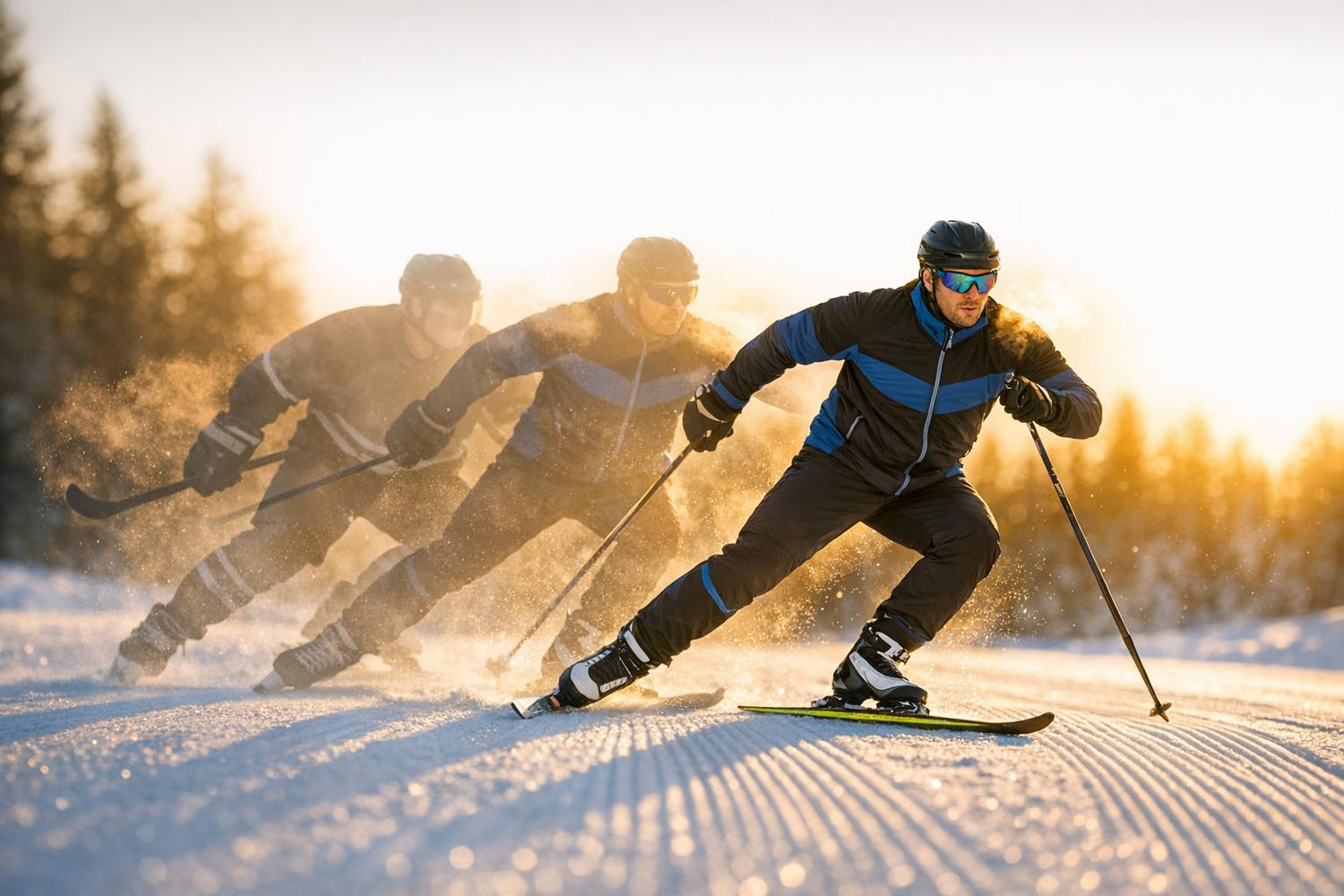
Skiskating combines skiing’s glide with ice skating’s lateral motion, making it an easy transition for hockey players. The movements - deep knee bends, lateral pushes, and weight shifts - mirror hockey skating techniques. Hockey players' muscle memory, edge control, and balance transfer seamlessly to skiskating. Key takeaways:
- Similar Mechanics: Both sports rely on knee flexion, weight shifts, and explosive strides.
- Edge Control: Hockey players excel at engaging edges for power and stability.
- Equipment: Skiskating gear, like stiff boots and narrow skis, supports lateral movement akin to hockey skates.
- Adjustments Needed: Longer glides, forward-backward arm movements, and snow-specific stops.
With minor technique tweaks, hockey players can excel at skiskating. The right gear, such as Snowfeet 50 PRO ($299.00) for agility or Skiblades 65 CM ($550.00) for stability, enhances the experience.
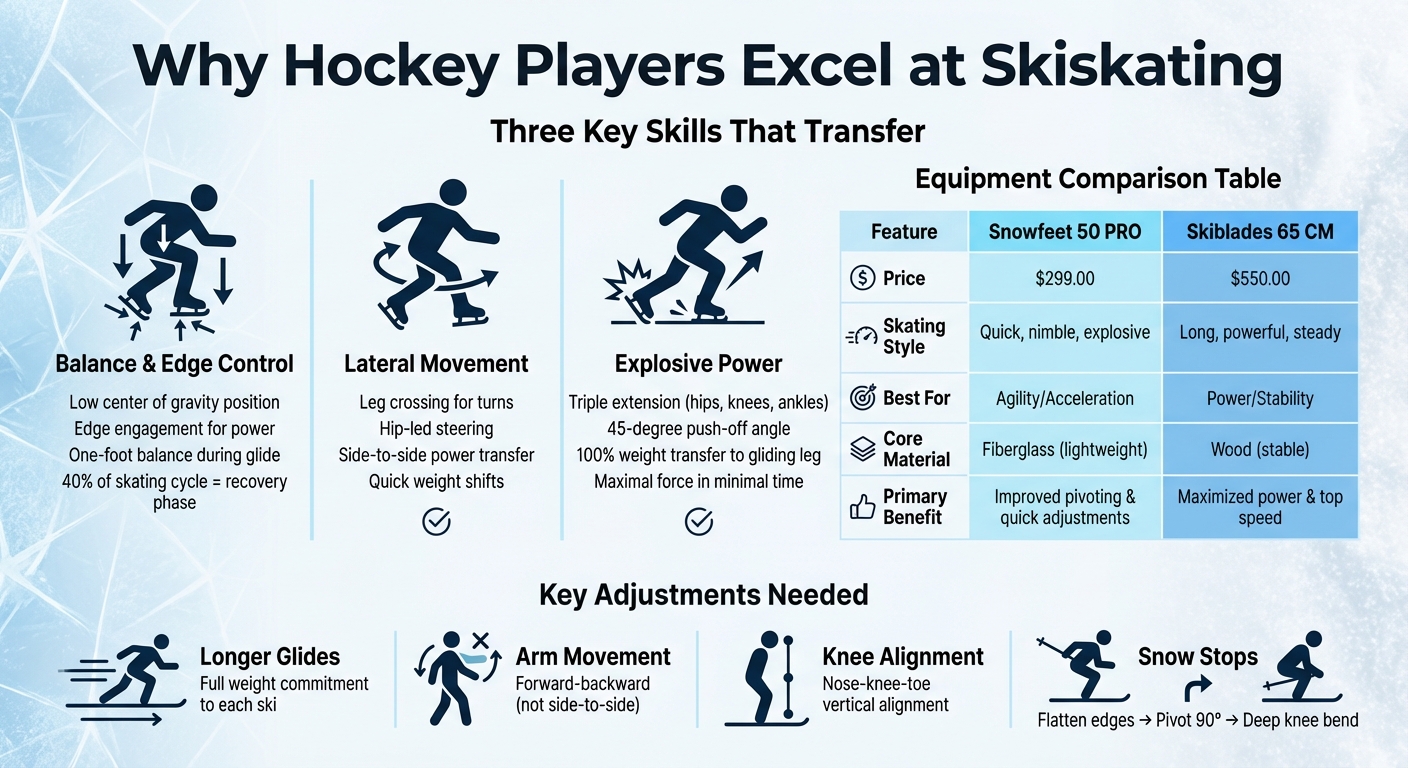
Hockey Skills Transfer to Skiskating: Key Abilities and Equipment Comparison
Snowfeet* & Skiskates Tutorial - How to Become a PRO Skiskater
sbb-itb-32287b2
Hockey Skills That Transfer to Skiskating
Hockey players bring three key abilities to skiskating: balance and edge control, lateral movement, and explosive power transfer. These aren’t new skills you have to master - they’re already ingrained in your muscle memory from years on the ice.
Balance and Edge Control
Hockey players instinctively maintain a low center of gravity - knees bent, hips dropped, and weight forward. This "ready position" is just as effective on skiskates as it is on the ice. If you’re standing too upright (like when you can see your toes while skating), you’re setting yourself up for instability. A proper knee bend not only keeps you steady but also helps you control your movements on snow.
Edge control is another skill that hockey players seamlessly bring to skiskating. You already know how to engage your inside edges to generate power and keep your legs from slipping apart. On skiskates, this is similar, as the flatter alpine camber of skate skis mimics the way hockey blades interact with ice.
Your ability to balance on one foot while the other recovers is also a game-changer. On the ice, this balance is second nature as you shift weight from one blade to the other, relying on core strength and coordination to stay steady during the glide phase. On skiskates, this translates directly to gliding on one ski while the other leg recovers. During these glides, isometric muscle contractions help you maintain position and steer, which is especially useful on uneven snow terrain.
This strong foundation in balance naturally makes lateral movements feel intuitive on skiskates.
Lateral Movement and Quick Turns
Crossing your outside leg over your inside leg to maintain balance is a move every hockey player knows by heart. That same coordination comes in handy when navigating turns on skiskates. Quick weight shifts and leg crossings keep you moving smoothly through curves.
Hockey players also excel at steering with their hips. In tight turns on the ice, your inside hip leads the movement as your weight shifts into the inside leg. This principle carries over to skiskating, where hip rotation and weight distribution guide your direction changes. Your poles act as additional steering aids, helping you maintain control through twists and turns.
The lateral push mechanics you’ve honed on the ice are just as important on skiskates. Techniques like the "waddle skate" and "speed skate" rely on the same side-to-side power transfer you’re used to. Your ability to glide on one foot while driving forward with the other - what’s called an "advanced lateral push" in hockey - propels you forward on snow. Plus, the recovery phase, where your leg returns beneath your body after each stride, makes up about 40% of the skating cycle for both sports.
This agility primes you for explosive power transfer with every stride.
Power Transfer and Explosive Strides
The mechanics of a powerful hockey stride translate seamlessly to skiskating. Both sports demand a low athletic stance - knees and ankles bent, hips dropped - ready to generate force. You’re already trained to push off at a 45-degree angle, ensuring your edges dig in and maximize power.
The triple extension - where your hips, knees, and ankles extend simultaneously - powers both your hockey stride and your skiskating push-off. Gary Roberts, performance lead at Gary Roberts Performance, puts it this way:
Power is the ability to produce maximal force in as short a time as possible... The higher your maximal strength, the higher your submaximal force production.
This ability to fire muscles quickly from a standstill gives you the explosive speed needed for those first few strides on snow, just like on ice.
Weight transfer is another area where hockey players excel. You’ve mastered shifting 100% of your body weight onto your gliding leg, stacking your hip over your knee and foot to avoid wasting energy. This "Step–Shift–Stack" sequence is just as critical in skiskating, where efficient gliding depends on fully committing your weight to one ski while the other leg recovers. Additionally, your strong adductors and core stability help you avoid the short, inefficient movements that often trip up beginners in both sports.
Modifying Hockey Techniques for Skiskating
If you already have a solid foundation in hockey mechanics, you're off to a great start. With a few adjustments, you can fine-tune your stride and movements to glide smoothly on snow.
Using the Hockey Stride on Snow
Snow introduces a whole new dynamic compared to the slick surface of ice. Instead of relying on the near-frictionless glide you're used to, you'll need to focus on deliberate, controlled movements. The key difference? Fully committing to each glide. On ice, quick, short strides with minimal gliding can work well for speed. But on snow, that technique breaks your momentum. Instead, shift your full weight onto one ski for a longer glide while the other leg recovers.
To maximize power, keep your gliding leg bent. This helps load your muscles for the next push and keeps your balance steady. Standing upright wastes energy and makes you less stable. For better control, align your nose, hip, knee, and toe vertically over the gliding ski - this positioning is especially helpful on uneven terrain.
Your arm movement also needs a tweak. Unlike the side-to-side swing common in hockey, move your arms forward and backward like a sprinter. This adjustment helps maintain balance and adds forward momentum.
Once you've nailed the stride, it's time to work on stopping and changing directions.
Executing Stops and Direction Changes
Stopping on snow is trickier than on ice. A hockey stop on snow involves a few extra steps. First, flatten your skis by releasing the edges. Then, pivot your skis 90 degrees under your body. Finally, bend your knees deeply to engage the steel edges and come to a full stop. To get it right, widen your stance slightly, flatten your skis, and rotate your feet and ankles to pivot. As soon as your skis are in position, bend your knees to engage the edges and stop. Throughout the maneuver, keep your head, chest, and hips facing downhill to stay balanced.
When it comes to direction changes, avoid leaning with your upper body - it can lead to skidding and instability. Instead, focus on rolling your ankles and knees to engage the edges. A great exercise to practice this is the Garland Drill. Traverse a slope, roll your ankles and knees outward to flatten the skis, and then roll them back in to re-engage the edges. This drill helps you master smooth transitions.
Carrie Keil, a skating coach with USA Hockey's National Team Development Program, emphasizes the importance of posture:
Players who skate too upright with straight legs are going to fall hard.
Deep knee and hip flexion is essential, especially for quick pivots and stops on uneven snow. It gives you the control and stability you need to handle unpredictable terrain.
Tips for Moving from Hockey to Skiskating
Training Drills for Skiskating
Before heading to the slopes, focus on building muscle memory. Start with the "Soft Landing" Drill: jump up and land gently on the balls of your feet, keeping your knees bent. Once you're comfortable, practice shifting your weight from one foot to the other using your hips, all while maintaining a neutral spine and keeping your gaze forward.
When you're on the snow, try no-pole V-gliding. This drill helps you refine balance and weight transfer by removing the reliance on poles, encouraging you to avoid centering your weight between both skis. For better edge control, practice leaning your skiskates on their inside and outside edges before picking up speed. Incorporate lateral push drills, focusing on pushing off at a 45-degree angle to dig your edges into the snow and generate more power.
Coach Jeremy from How To Hockey explains it well:
In hockey we want speed, power and agility.
To adapt to skiskating, exaggerate your knee bend - position your knees over your toes - to absorb terrain changes and enhance stride power. Aim for "nose-knee-toe" alignment, keeping your nose, knee, and the tip of your skiskate in a straight vertical line for smoother gliding. Unlike traditional skiing, where leaning into your toes is common, skiskating requires you to keep your weight centered or slightly toward your heels to prevent the short tips from catching in the snow.
Once you're confident in your technique, the next step is choosing gear that suits your skating style.
Selecting the Right Skiskates Model
Your ice skating habits should guide your choice of skiskates. If you thrive on quick, explosive toe-based acceleration and sharp pivots, the Snowfeet 50 PRO at $299.00 is a great pick. This model enhances acceleration and transition zones, making it perfect for tight turns and rapid adjustments. On the other hand, if you favor long, powerful strides and prioritize stability at higher speeds, the Skiblades 65 CM at $550.00 is ideal, offering better top speed and steady control.
| Feature | Snowfeet 50 PRO | Skiblades 65 CM |
|---|---|---|
| Skating Style | Quick, nimble, and explosive | Long, powerful, and steady |
| Hockey Profile Equivalent | Zuperior Profile (Agility/Acceleration) | Quad Profile (Power/Stability) |
| Primary Benefit | Improved pivoting and quick adjustments | Maximized power and enhanced top speed |
| Price | $299.00 | $550.00 |
| Binding Compatibility | Ski/Snowboard boots | Ski/Snowboard boots |
Both models feature adjustable bindings and durable steel edges. The Snowfeet 50 PRO boasts a fiberglass core for lightweight maneuverability, while the Skiblades 65 CM uses a wood core for added stability. Whether you prioritize sharp transitions or sustained power, there's a model tailored to your preferences.
Conclusion
All those years spent perfecting your hockey stride have already laid the groundwork for excelling at skiskating. The edge control you’ve mastered for quick stops and sharp turns on the ice translates seamlessly to carving through powder or gliding along groomed trails.
This connection between ice and snow isn’t just a coincidence - it’s rooted in shared physics. Your muscle memory, balance, and power generation techniques give you a natural advantage. Whether you opt for the Snowfeet 50 PRO at $299.00 or the Snowfeet Skiblades 65 CM priced at $550.00, you’ll be using gear that complements your skating style perfectly.
FAQs
How can hockey players adjust their stopping techniques for skiskating?
Hockey players can bring their ice-stopping expertise to skiskating by leveraging the skills they’ve already mastered. The hockey stop - a sharp, sideways slide to a halt - translates seamlessly to skiskating because it draws on balance, edge control, and lateral agility, all of which are second nature to hockey players.
To make this shift, players work on keeping a stable stance, mastering edge control on skis, and smoothly transferring their weight. Starting with basic sideslipping drills and gradually advancing to sharper stops helps build confidence and fine-tune the technique. By making these small adjustments, hockey players can adapt their stopping skills to the slopes, achieving quick and controlled stops on short skis.
How do arm movements differ between hockey and skiskating?
The way arms move in hockey and ski skating reflects the unique demands and mechanics of each sport. In hockey, the arms stay bent and close to the body, with controlled side-to-side swings. This movement helps players stay balanced, agile, and powerful during quick actions like skating, shooting, and handling the stick.
In contrast, ski skating involves arms moving in a straight, forward-and-backward motion. This linear swing boosts rhythm and transfers power more effectively, complementing the skis' gliding motion. While hockey emphasizes quickness and stability through arm movements, ski skating prioritizes smooth coordination with the legs for efficient, powerful strides.
What’s the best skiskate for speed and stability?
If you want a skiskate that delivers speed and stability, go for one built to provide smooth power transfer and precise control. These skiskates are a natural fit for hockey players, as they align well with skills like balance and lateral agility, allowing for an easier transition and confident performance on the slopes.
To get the most out of your skiskating experience, focus on models with durable materials, well-designed edges, and a snug, comfortable fit. These features work together to enhance both your speed and control, ensuring every movement feels sharp and steady.

Leave a comment
This site is protected by hCaptcha and the hCaptcha Privacy Policy and Terms of Service apply.